29.3 Moment of Inertia of a Disc
TL;DR
The video explains the process of calculating the moment of inertia for a thin disk by using integral calculus and limits.
Transcript
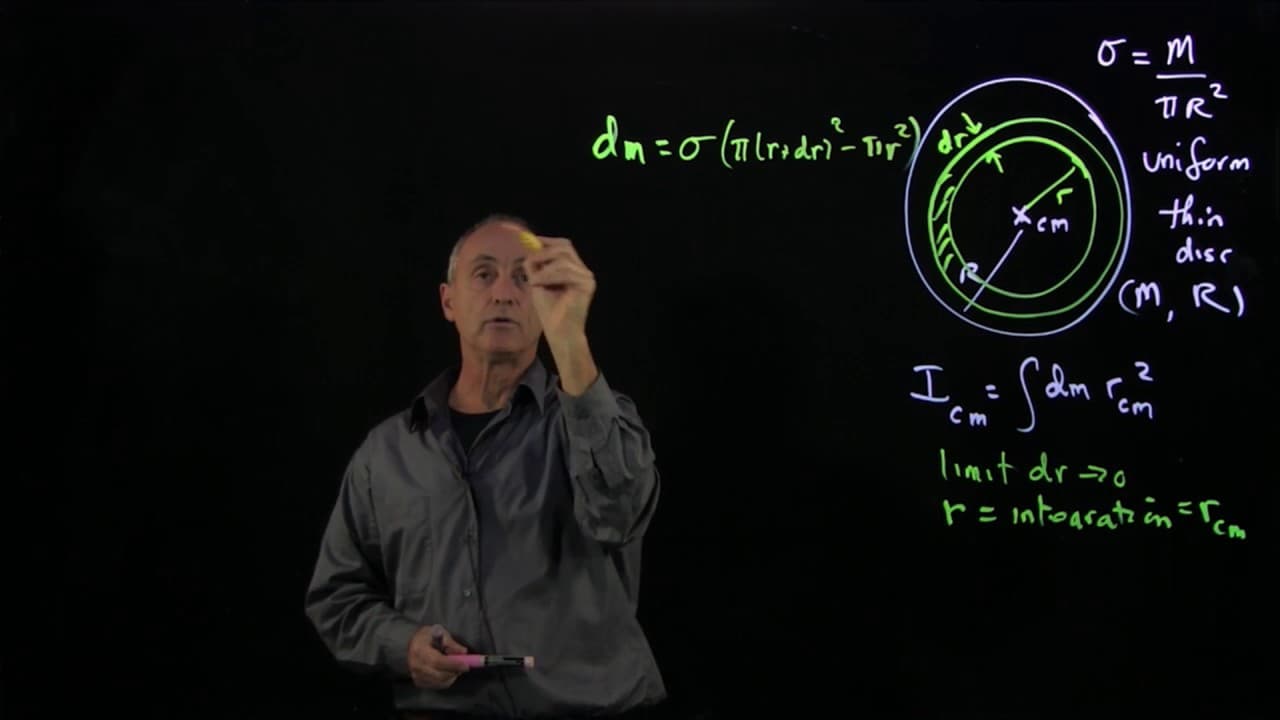
I would now like to calculate the moment of inertia for a very thin disk. So we have a thin disk. And the radius of that disk is r. And it has a mass m. And I would like to calculate the moment of inertia for this disk. Now, let's just remind what point we're calculating it about, about the center of mass. So our definition of moment of inertia was... Read More
Key Insights
- ◾ The moment of inertia for a thin disk is calculated by integrating the product of small mass elements and perpendicular distances squared over the entire body.
- 💆 The mass of the small element is determined by multiplying the disk's mass per unit area by the difference in areas between the outer and inner rings.
- 😋 Taking limits as the thickness of the ring approaches zero allows for simplification of the moment of inertia expression.
Install to Summarize YouTube Videos and Get Transcripts
Explore YouTube Video Summarizer or Get YouTube Transcript Extractor
Questions & Answers
Q: How is the moment of inertia calculated for a thin disk?
The moment of inertia is calculated by taking a small mass element and multiplying it by the perpendicular distance squared from the center of mass. This is done for all mass elements in the disk and integrated over the entire body.
Q: What is the mass of the small element in the calculation?
The mass of the small element is determined by multiplying the disk's mass per unit area by the difference between the area of the outer ring and the area of the inner ring.
Q: What happens when the thickness of the ring approaches zero in the calculation?
As the thickness of the ring approaches zero, the moment of inertia expression is simplified by canceling out certain terms. This allows for the calculation to be done by taking limits and results in a more straightforward expression.
Q: What is the final equation for the moment of inertia of a thin disk?
The moment of inertia of a thin disk is found to be equal to half the mass of the disk times the radius squared.
Summary & Key Takeaways
-
The moment of inertia for a thin disk is calculated by taking a small mass element, multiplying it by the perpendicular distance squared from the center of mass, and integrating it over the entire body.
-
To calculate the mass of the small element, the disk's mass per unit area is multiplied by the area of the outer ring minus the area of the inner ring.
-
The resulting integral expression is simplified by taking limits as the thickness of the ring approaches zero, and the moment of inertia is found to be equal to half the mass times the radius squared.
Read in Other Languages (beta)
Share This Summary 📚
Summarize YouTube Videos and Get Video Transcripts with 1-Click
Try YouTube Summary with ChatGPT & Claude or YouTube Transcript Generator
Explore More Summaries from MIT OpenCourseWare 📚



Summarize YouTube Videos and Get Video Transcripts with 1-Click
Try YouTube Summary with ChatGPT & Claude or YouTube Transcript Generator