What the sugar coating on your cells is trying to tell you | Carolyn Bertozzi
TL;DR
This talk explores the relationship between sugar and cancer, discussing how sugar coating on our cells can affect our immune system's ability to recognize and target cancer cells.
Transcript
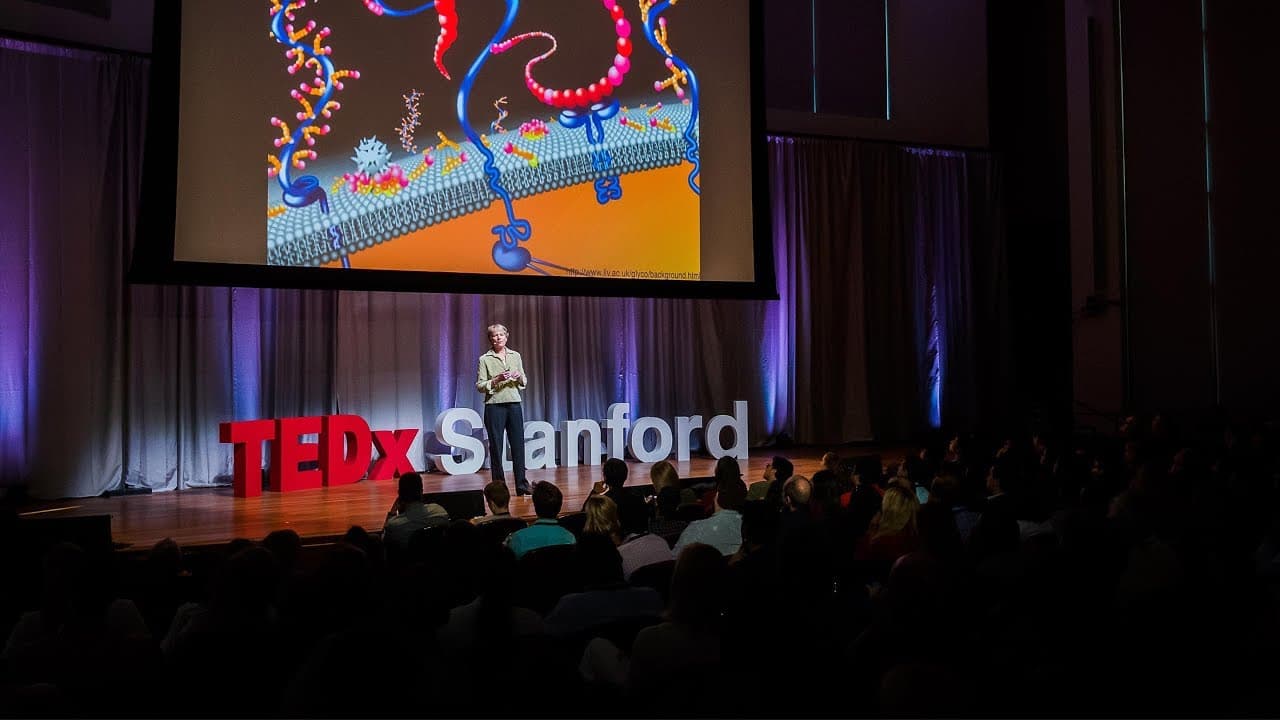
This is a talk about sugar and cancer. I became interested in sugar when I was in college. Not this kind of sugar. It was the sugar that our biology professors taught us about in the context of the coating of your cells. Maybe you didn't know that your cells are coated with sugar. And I didn't know that, either, until I took these courses in colleg... Read More
Key Insights
- 🌳 The sugar coating on our cells is complex and resembles trees and bushes, and it is considered a language with stored information.
- 🩸 Blood type is determined by the sugars on the surface of red blood cells, and this discovery enabled blood transfusions.
- 🔬 Changes in the sugars on tumor cells can indicate the presence of cancer, and studying these changes could lead to better understanding and treatment options.
- 💊 Sialic acid, a specific type of sugar, is found in higher levels on cancer cells and can affect the immune system's response to them.
- 🩺 Cancer immunotherapy, which stimulates the immune system to fight cancer cells, has shown promising results and potential for curing cancer.
- 🌍 Stripping off the sialic acid coat from cancer cells can enhance the immune system's ability to recognize and eliminate them.
- 🧬 Understanding the language of sugars on cells plays a crucial role in distinguishing healthy cells from cancerous ones to avoid autoimmune diseases.
- 🌟 Developing medicines that remove sialic acids from cancer cells could lead to more effective treatments and improved outcomes in cancer patients.
Install to Summarize YouTube Videos and Get Transcripts
Explore YouTube Video Summarizer or Get YouTube Transcript Extractor
Questions & Answers
Q: What is the significance of the sugar coating on our cells?
The sugar coating on our cells, known as glycans, is much more complex than originally believed. The sugars on our cells act as a language and store important information. They can determine our blood type and play a role in various biological processes.
Q: How is blood type determined by sugar coating?
Blood type is determined by the chemical structures of the sugars coating our red blood cells. Blood type O, for example, has three simple sugars linked together, while blood type A and B have additional building blocks incorporated. Blood type AB combines both structures in roughly equal proportions. This understanding of blood types has facilitated blood transfusions by matching compatible blood types.
Q: What correlation has been found between sugars and cancer?
Changes in sugars on the surface of cells have been observed when cells transform from healthy to cancerous. One specific change studied is an increase in the density of a sugar called sialic acid. Cancer cells tend to have higher levels of sialic acid than normal cells. Understanding the importance of sugars in cancer is crucial for developing new treatments and therapeutic approaches.
Q: How does sialic acid affect the immune system in relation to cancer?
Sialic acid has an impact on the immune system's ability to detect and fight cancer cells. When immune cells come into contact with cancer cells, they usually "taste" and destroy them. However, cancer cells with a dense sialic acid coating can deceive the immune system and prevent an immune response. By developing medicines that remove sialic acids from cancer cells, the immune system's ability to recognize and eliminate cancer cells can be enhanced.
Q: What potential impact does targeting sugars on cancer cells have?
By targeting and removing the sugars, such as sialic acid, from cancer cells, new medicines can potentially enable the immune system to recognize and destroy cancer cells more effectively. This approach aims to strip off the sugar coat on cancer cells, allowing the immune system to see them for what they truly are and initiate a response to eliminate them. This research carries the potential for significant advancements in cancer treatment.
Summary & Key Takeaways
-
The speaker became interested in sugar in college, specifically the sugar coating on cells, which was previously thought to be a protective coating.
-
The sugars on the surface of cells contain complex structures that hold important information, such as blood type.
-
Changes in sugars on cancer cells can affect the immune system's ability to recognize and destroy them, but new medicines are being developed to strip off these sugars and activate the immune response against cancer.
Read in Other Languages (beta)
Share This Summary 📚
Summarize YouTube Videos and Get Video Transcripts with 1-Click
Try YouTube Summary with ChatGPT & Claude or YouTube Transcript Generator
Explore More Summaries from TED 📚



Summarize YouTube Videos and Get Video Transcripts with 1-Click
Try YouTube Summary with ChatGPT & Claude or YouTube Transcript Generator