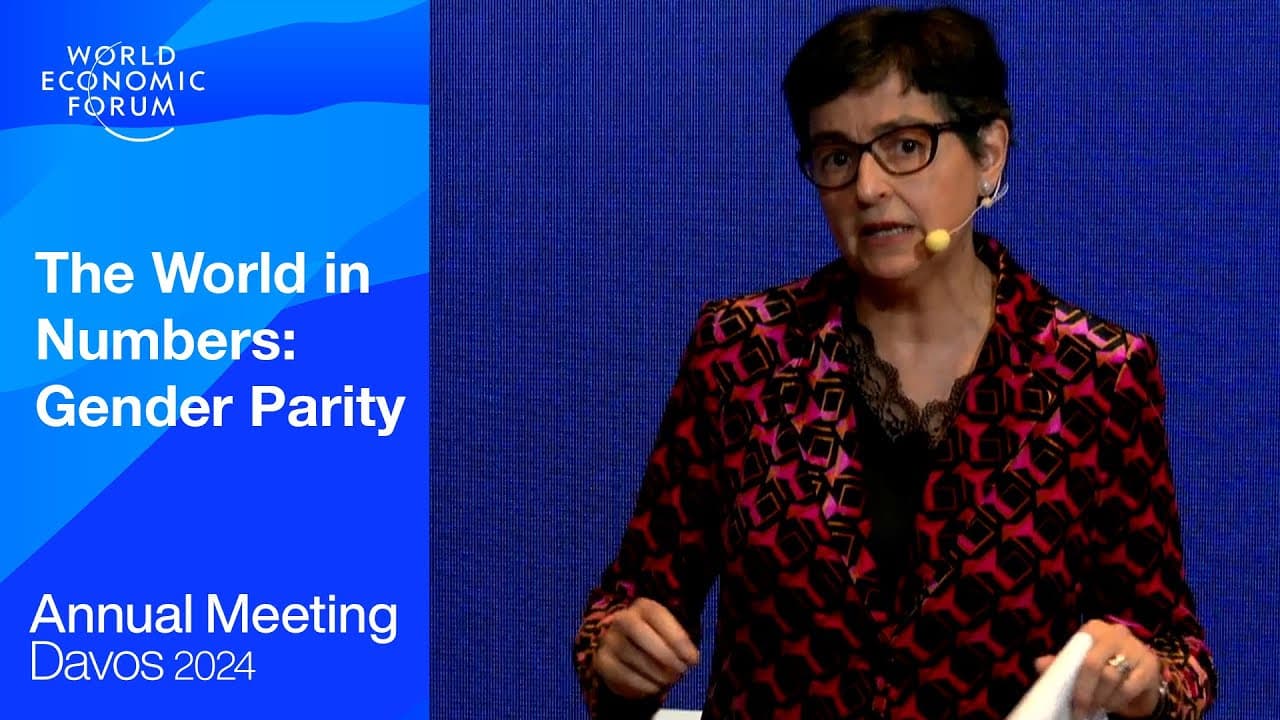
The World in Numbers: Gender Parity | Davos 2024 | World Economic Forum
TL;DR
The session emphasizes the importance of gender parity as a catalyst for global growth and discusses the gaps in economic and political representation. The goal is to achieve 50/50 parity by 2030.
Transcript
welcome everyone um this is a session about the world in numbers focusing on gender parity uh achieving parity gender parity is not just the fair thing to do it's just not the moral thing to do it's also the right thing to do as a catalyst for Global growth as a catalyst for resolving our major challenges to the global political and economic order ... Read More
Key Insights
- 📣 Gender gaps are most significant in economic opportunity and political representation.
- 🧔♀️ The COVID-19 pandemic has further widened these gaps by affecting women's labor force participation.
- 🖐️ Measurement, targets, and reporting play a crucial role in promoting gender parity.
- 🏑 Encouraging diversity and representation across sectors, including STEM fields, is essential for achieving full gender equality.
- 👾 Gender parity is not a zero-sum game, but rather a collective effort to create a fair and inclusive society.
- 👨💼 Businesses, governments, and individuals should collaborate and commit to actively working towards gender parity targets.
- 👨🔬 Affirmative search and finding diverse talent through specific criteria can help address representation gaps.
Install to Summarize YouTube Videos and Get Transcripts
Explore YouTube Video Summarizer or Get YouTube Transcript Extractor
Questions & Answers
Q: What areas does the gender parity report measure regarding gender gaps?
The gender parity report measures gender gaps in education, health, economic opportunity, advancement, and political representation using objective cross-national data.
Q: Are economic development and gender parity directly correlated?
No, economic development does not necessarily guarantee gender parity. Some developing countries have achieved parity, while others face significant gaps.
Q: How is the COVID-19 pandemic affecting women's participation in the workforce?
The pandemic has led to a higher burden of care responsibilities for women, resulting in many leaving the workforce. This absence from work can have long-term negative impacts on their careers.
Q: How can the representation of women in top leadership positions be increased?
It is suggested to set targets, promote gender representation as an issue, provide financial support for women's campaigns in politics, improve work-life balance policies, and encourage mentoring and support within organizations.
Summary & Key Takeaways
-
The session focuses on the outlook for global gender parity and the need to imagine recommendations to achieve 50/50 parity by 2030 in political and economic representation.
-
Gender gaps are smallest in education and health sectors, with progress being made in these areas. However, the biggest gaps are seen in economic opportunity and political representation.
-
The COVID-19 pandemic has led to a significant impact on women leaving the workforce due to care responsibilities, resulting in a penalty for their future career growth.
Read in Other Languages (beta)
Share This Summary 📚
Summarize YouTube Videos and Get Video Transcripts with 1-Click
Try YouTube Summary with ChatGPT & Claude or YouTube Transcript Generator
Explore More Summaries from World Economic Forum 📚
Summarize YouTube Videos and Get Video Transcripts with 1-Click
Try YouTube Summary with ChatGPT & Claude or YouTube Transcript Generator