Lecture 23: Cross Section and Decay Rate
TL;DR
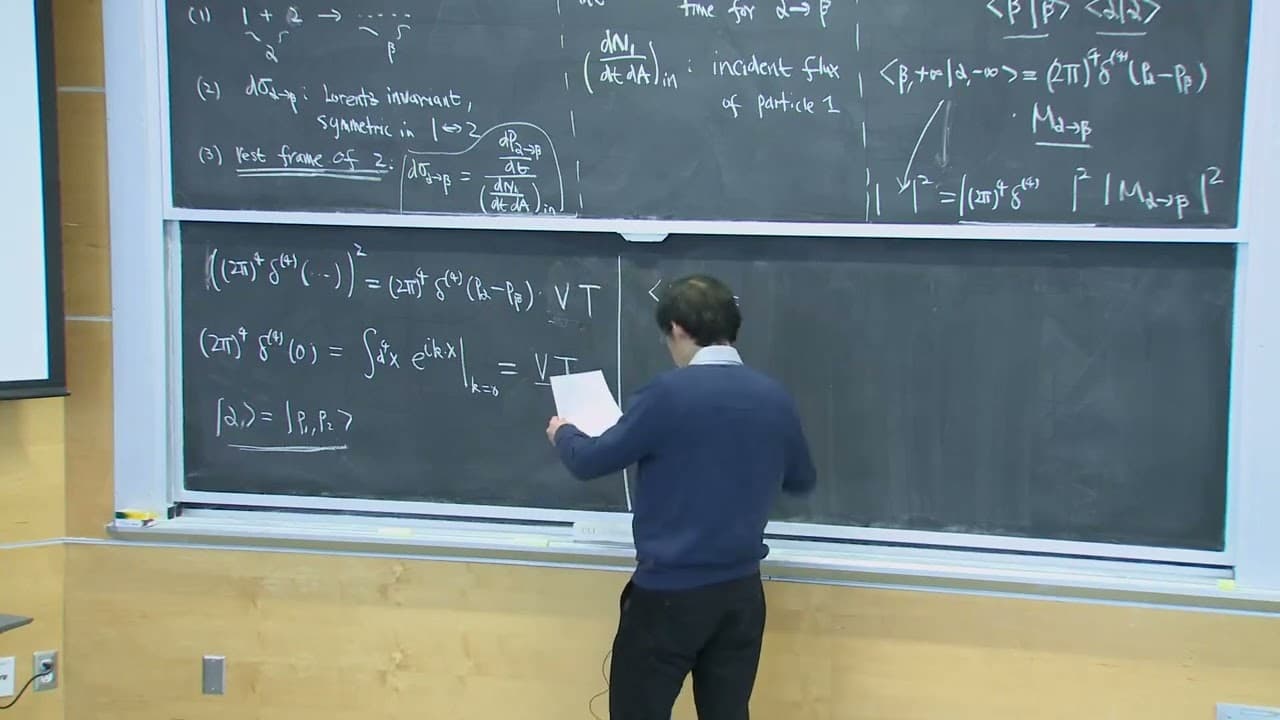
An analysis is conducted on cross sections and decay rates, considering various factors such as Lorentz invariance, spin polarization, and particle scattering processes.
Transcript
[SQUEAKING] [RUSTLING] [CLICKING] HONG LIU: OK, so let us start. So last time, at the end of the lecture, we discussed relativistic generalization of the cross section. So we want to derive a relativistic generalization of the cross section from some initial state to some final state. So initial state is denoted by alpha, the final state denoted by... Read More
Key Insights
- ☠️ The analysis of cross sections and decay rates involves considering Lorentz invariance, spin polarization, and various scattering processes.
- ⌛ The probability per unit time represents the likelihood of a scattering event occurring within a given time period.
- 🖼️ The Lorentz invariance of the scattering process requires careful consideration in the analysis, ensuring that the calculations are valid in any reference frame.
- ☠️ Spin polarization affects the polarization states of particles and their contributions to the cross section or decay rate.
Install to Summarize YouTube Videos and Get Transcripts
Explore YouTube Video Summarizer or Get YouTube Transcript Extractor
Questions & Answers
Q: What is the significance of the probability per unit time in the scattering process?
The probability per unit time represents the likelihood of a scattering event occurring within a given time period. It is an important quantity to calculate in order to understand the dynamics of the scattering process.
Q: How is the Lorentz invariance of the scattering process taken into account in the analysis?
The Lorentz invariance requires that the probability per unit time and the cross section for a scattering process do not depend on the specific reference frame. This is achieved by defining the scattering amplitude and the variables in a way that maintains Lorentz invariance.
Q: How does spin polarization affect the analysis of cross sections and decay rates?
Spin polarization plays a role in determining the polarization states of the initial and final particles in a scattering or decay process. Depending on the experiment and the particles involved, it may be necessary to sum over or average out the spin polarizations to obtain the correct cross section or decay rate.
Q: Can the scattering amplitude and cross section be used to calculate the total decay rate and lifetime of a particle?
Yes, the total decay rate can be obtained by integrating the decay rate over all possible final states. The lifetime of a particle is then given by the inverse of the total decay rate.
Summary & Key Takeaways
-
The analysis begins by deriving relativistic generalizations of the cross section, considering two-particle scattering processes.
-
The probability per unit time for the scattering process is defined in terms of the scattering amplitude and the incident flux of the initial particle.
-
The analysis explores the Lorentz invariance and symmetry in the scattering process, allowing for the calculation of the probability from the initial state to the final state.
-
The final formula for the cross section is obtained, taking into account the center of mass frame and the Lorentz invariance of the scattering process.
-
The analysis is extended to include decay processes, where the decay rate and lifetime of a particle are calculated.
Read in Other Languages (beta)
Share This Summary 📚
Summarize YouTube Videos and Get Video Transcripts with 1-Click
Try YouTube Summary with ChatGPT & Claude or YouTube Transcript Generator
Explore More Summaries from MIT OpenCourseWare 📚



Summarize YouTube Videos and Get Video Transcripts with 1-Click
Try YouTube Summary with ChatGPT & Claude or YouTube Transcript Generator