Root locus in Control system | Poles & Zeros relation O.L.T.F & C.L.T.F | CS | Lec-57
TL;DR
Root locus helps analyze closed-loop pole behavior as gain varies from zero to infinity.
Transcript
hello everyone last class we discussed about the root locus in this also we will discuss about extension of the root locus here so what is the root locus root locus is simply gives whenever gain varies from 0 to infinite how the closed loop poles will be varies close loop poles will be variation of poles is discussed generally so in the previous cl... Read More
Key Insights
- 😚 Root locus analysis is a visual tool for understanding how closed-loop pole positions change with gain alterations.
- 🔁 Open-loop transfer functions are critical in determining closed-loop behavior, emphasizing their relevance in control system design.
- 😚 Characteristic equations serve as a foundation for deriving stability conditions and pole-zero placement in closed-loop systems.
- 🎮 The gain's effect on system dynamics illustrates the delicate balance needed for optimal control and stability.
- ✋ Higher-order systems complicate pole and zero identification, necessitating more sophisticated analysis techniques.
- 🧡 System designers rely on root locus to ascertain system response across a range of gain values, ensuring reliable operations.
- 🧘 Feedback mechanisms in control systems are heavily influenced by the relative positions of poles and zeros, affecting overall stability.
Install to Summarize YouTube Videos and Get Transcripts
Explore YouTube Video Summarizer or Get YouTube Transcript Extractor
Questions & Answers
Q: What is the main purpose of root locus analysis in control systems?
The main purpose of root locus analysis is to visualize how the closed-loop poles of a control system change with varying gain. This method allows engineers to understand the stability and performance of the system as the feedback gain is adjusted, providing essential insights into system behavior that influence design decisions.
Q: How do open-loop transfer functions relate to closed-loop stability?
Open-loop transfer functions are foundational for analyzing closed-loop stability. By examining the poles and zeros of the open-loop transfer function, engineers can infer the behavior of the closed-loop system. The stability is determined by the location of the closed-loop poles in the complex plane, which can be derived from the open-loop system characteristics.
Q: What happens to closed-loop poles when the gain k is set to zero?
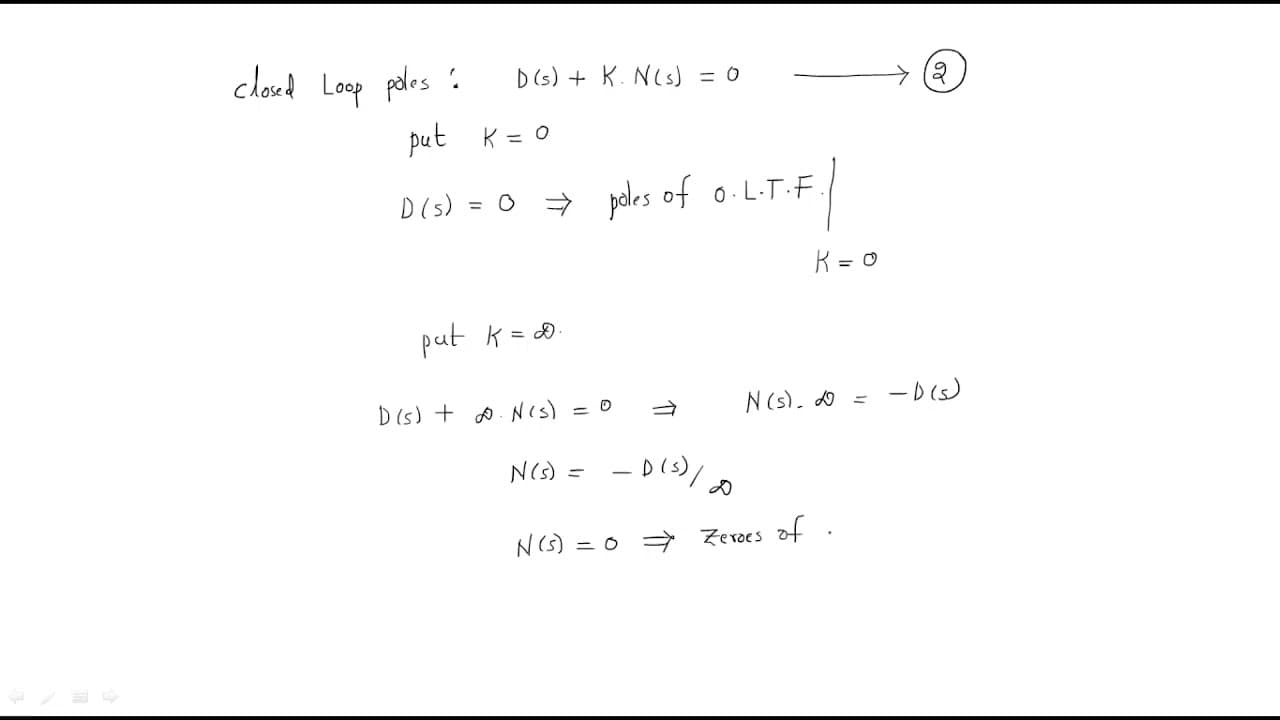
When the gain k is set to zero, the closed-loop poles coincide with the poles of the open-loop transfer function. In this scenario, the system essentially operates without feedback, and its stability is determined solely by the open-loop dynamics. Engineers can use this information to analyze system behavior under specific conditions of feedback.
Q: Why is it challenging to determine closed-loop pole locations if the order of the characteristic equation increases?
As the order of the characteristic equation increases, it introduces additional complexity in calculating the closed-loop pole locations. Higher-order systems have more poles and zeros, making it mathematically intensive and often difficult to solve for k values directly. This complexity necessitates methods like root locus to facilitate analysis and interpretation.
Q: What significance does the characteristic equation hold in root locus analysis?
The characteristic equation plays a crucial role in root locus analysis as it defines the relationship between the open-loop and closed-loop dynamics. By setting the characteristic equation to zero, engineers can derive the closed-loop poles' locations, which are essential for determining the stability and performance of control systems.
Q: How does varying the gain k affect the understanding of closed-loop systems?
Varying the gain k provides a dynamic view of how closed-loop poles shift in response to changes in system feedback. This process allows for the identification of stability margins and system performance limits. It highlights potential issues such as oscillations or instability at certain gain levels, which are crucial for optimal control design.
Q: Can root locus analysis be used for higher-order systems easily?
Root locus analysis can be applied to higher-order systems, but it becomes considerably more complex than for simpler systems. Engineers must often rely on graphical or numerical methods and simulations to analyze and visualize the behavior of closed-loop poles effectively, especially when interactions between poles and zeros increase.
Q: What is the significance of open-loop zeros in the context of root locus?
Open-loop zeros represent frequencies at which the system output can be maximized or minimized, depending on the input. In the context of root locus, understanding where these zeros occur helps in predicting how the closed-loop system will respond with varying gain, bridging gaps in stability and performance analysis.
Summary & Key Takeaways
-
The root locus technique is essential in control systems, illustrating how closed-loop poles change as system gain varies, aiding stability analysis.
-
A comprehensive understanding of open-loop and closed-loop transfer functions is crucial, as the former provides valuable insights into the behavior of the latter through characteristic equations.
-
By varying gain, the relation between open-loop poles and zeros can be assessed, revealing critical information about system stability and response, which is essential for effective control design.
Read in Other Languages (beta)
Share This Summary 📚
Summarize YouTube Videos and Get Video Transcripts with 1-Click
Try YouTube Summary with ChatGPT & Claude or YouTube Transcript Generator