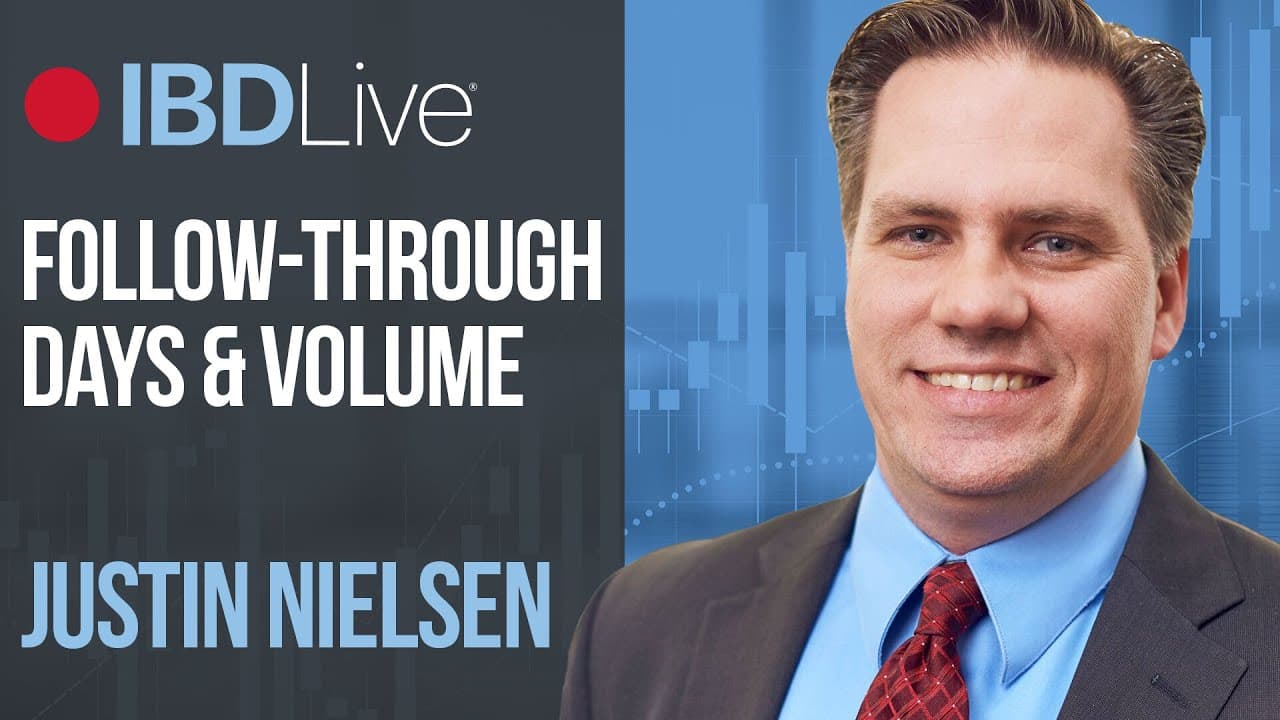
Justin Nielsen: Analyzing Follow-Through Days & Trading Volume | IBD Live
TL;DR
Follow-through days play a crucial role in identifying potential market opportunities and should be considered even if the volume is not above average.
Transcript
[Applause] bill o'neil was always about he he he was more worried about the sin of omission so people are still wondering about that that's why you could we could try to tighten up the criteria on follow-through dates but there would be times when you'd miss out on big runs uh in in doing so so uh you know that's that's what you have to that's what... Read More
Key Insights
- 🎟️ Bill O'Neil believed in capturing all real rallies and prioritizing not missing out on potential market opportunities.
- 🥳 Follow-through days should ideally have above-average volume and demonstrate power by being heavier than the previous day.
- 🔇 However, below-average volume could be forgiven in unique situations, such as heavy downside volume indicating a potential market turnaround.
- 🥳 Examples from history, like the 2012 and 2000 rallies, showed that below-average volume on follow-through days did not necessarily undermine their effectiveness.
- 🦮 Bill O'Neil's approach was based on interpretation rather than prediction, using the market's actions as a guide for decision-making.
- 🤩 The key objective was capturing profitable market moves rather than rigidly adhering to predefined rules.
- 🥳 It is essential to consider multiple factors beyond volume alone when evaluating follow-through days.
Install to Summarize YouTube Videos and Get Transcripts
Explore YouTube Video Summarizer or Get YouTube Transcript Extractor
Questions & Answers
Q: What was Bill O'Neil's approach to follow-through days?
Bill O'Neil prioritized capturing all real rallies instead of excluding potential opportunities. While above-average volume was preferred, below-average volume was forgiven in certain cases to avoid missing significant market moves.
Q: Did Bill O'Neil change his stance on follow-through days?
In the fourth edition of his book, Bill O'Neil modified the criteria to state that volume should be above average in most cases. However, internally, he still emphasized that volume needed to be heavier than the previous day, regardless of whether it met the average threshold.
Q: Can you provide an example of a powerful rally that didn't meet the average volume requirement?
One example is the December 20th, 2012 follow-through day, which had below-average volume. Despite this, it marked the start of a strong rally, with stocks like Buffalo Wild Wings, Michael Kors, and Invensense performing exceptionally well. This demonstrates the need to consider other factors beyond volume alone.
Q: Was there ever a follow-through day with below-average volume that still led to significant market gains?
Yes, May 30th, 2000, is an example where the volume was low, primarily due to the upcoming Memorial Day holiday. However, this rally resulted in notable moves in stocks like Keithley Instruments, SDLI, and Corning, which lasted until September. Bill O'Neil bought stocks on that day, disregarding the below-average volume.
Summary & Key Takeaways
-
Bill O'Neil emphasized the importance of follow-through days to avoid missing out on significant market runs, even at the risk of including false rallies.
-
Follow-through days should ideally have above-average volume and demonstrate power by being heavier than the previous day.
-
However, there were instances where Bill O'Neil forgave below-average volume if there were extenuating circumstances like heavy downside volume indicating a potential market turnaround.
Read in Other Languages (beta)
Share This Summary 📚
Summarize YouTube Videos and Get Video Transcripts with 1-Click
Try YouTube Summary with ChatGPT & Claude or YouTube Transcript Generator
Explore More Summaries from Investor's Business Daily 📚

Summarize YouTube Videos and Get Video Transcripts with 1-Click
Try YouTube Summary with ChatGPT & Claude or YouTube Transcript Generator