Water of Crystallization and Plaster of Paris | Acid Bases and Salts | Don't Memorise
TL;DR
When hydrated salts, such as copper sulfate and gypsum, are heated, they lose their water molecules, causing a change in color. These salts are used in various applications, including medicine, construction, and art.
Transcript
to know if the crystals of salts are really dry let's perform a quick experiment all we would need for this experiment is a burner a test tube and a test tube holder we would also need a few crystals of copper sulfate before we begin our experiment could you tell me the color of the crystals yes it's blue the crystals look dried don't they but are ... Read More
Key Insights
- 💦 Crystal salts like copper sulfate and gypsum contain water of crystallization, which gives them their characteristic properties.
- 🚾 Heating hydrated salts causes them to lose water molecules and undergo color changes.
- 👷 Plaster of Paris, derived from gypsum, has a historical association with the city of Paris and is widely used in medicine and construction.
Install to Summarize YouTube Videos and Get Transcripts
Explore YouTube Video Summarizer or Get YouTube Transcript Extractor
Questions & Answers
Q: What happens to the color of copper sulfate crystals when they are heated?
When copper sulfate crystals are heated, their color changes from blue to greyish white because the heat causes them to lose their water molecules, making them anhydrous copper sulfate.
Q: What is the significance of the water droplets observed on the test tube during the experiment?
The water droplets form on the test tube because the copper sulfate crystals, when heated, release water molecules. These water molecules condense on the cool surface of the test tube.
Q: What is the chemical formula of hydrated copper sulfate, and how many water molecules are present in it?
The chemical formula of hydrated copper sulfate is CuSO4·5H2O. It contains five water molecules per formula unit.
Q: How is gypsum used in various fields?
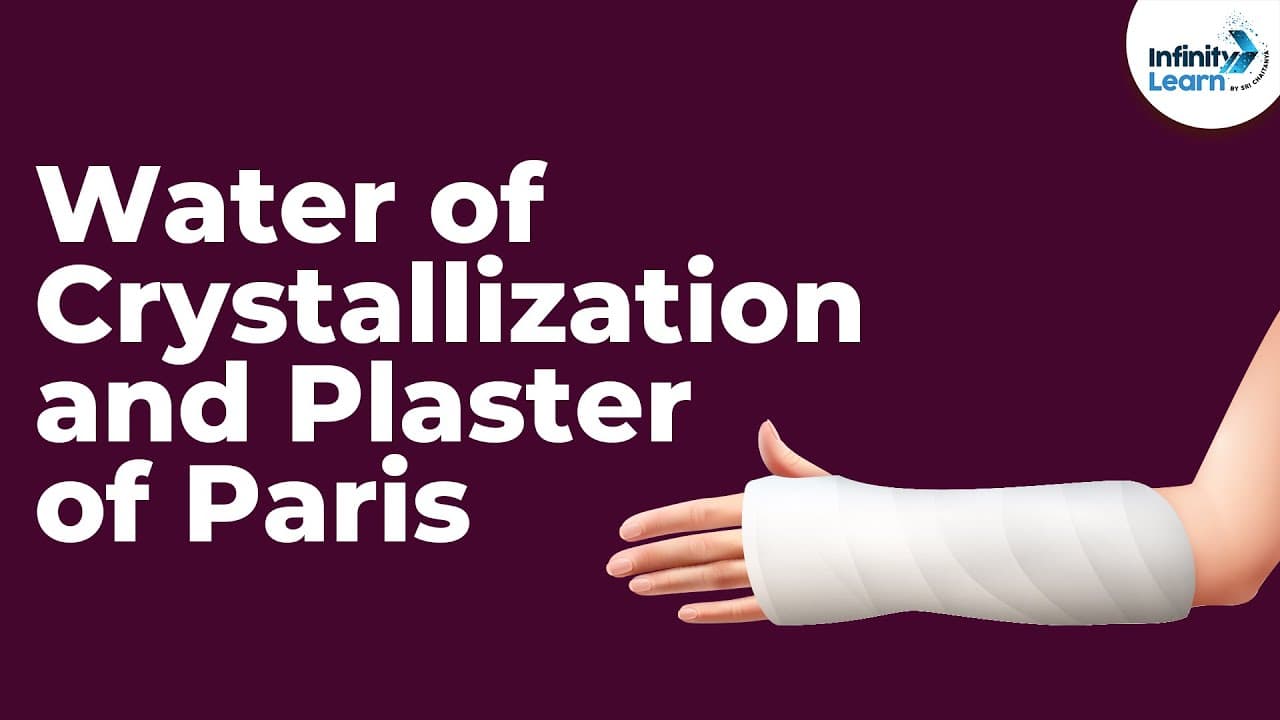
Gypsum, when heated, loses its water molecules and becomes plaster of Paris. Plaster of Paris is used in medicine as a support for fractured bones, in the construction industry, and in art for making casts and designer ceilings.
Summary & Key Takeaways
-
Heating hydrated salts, like copper sulfate and gypsum, causes them to lose water molecules, leading to changes in color.
-
Water of crystallization refers to the fixed number of water molecules present in one formula unit of a salt.
-
Gypsum, when heated, becomes plaster of Paris, which is commonly used in medicine, construction, and art.
Read in Other Languages (beta)
Share This Summary 📚
Summarize YouTube Videos and Get Video Transcripts with 1-Click
Try YouTube Summary with ChatGPT & Claude or YouTube Transcript Generator
Explore More Summaries from Infinity Learn NEET 📚


Summarize YouTube Videos and Get Video Transcripts with 1-Click
Try YouTube Summary with ChatGPT & Claude or YouTube Transcript Generator