22. Government Redistribution and Taxation
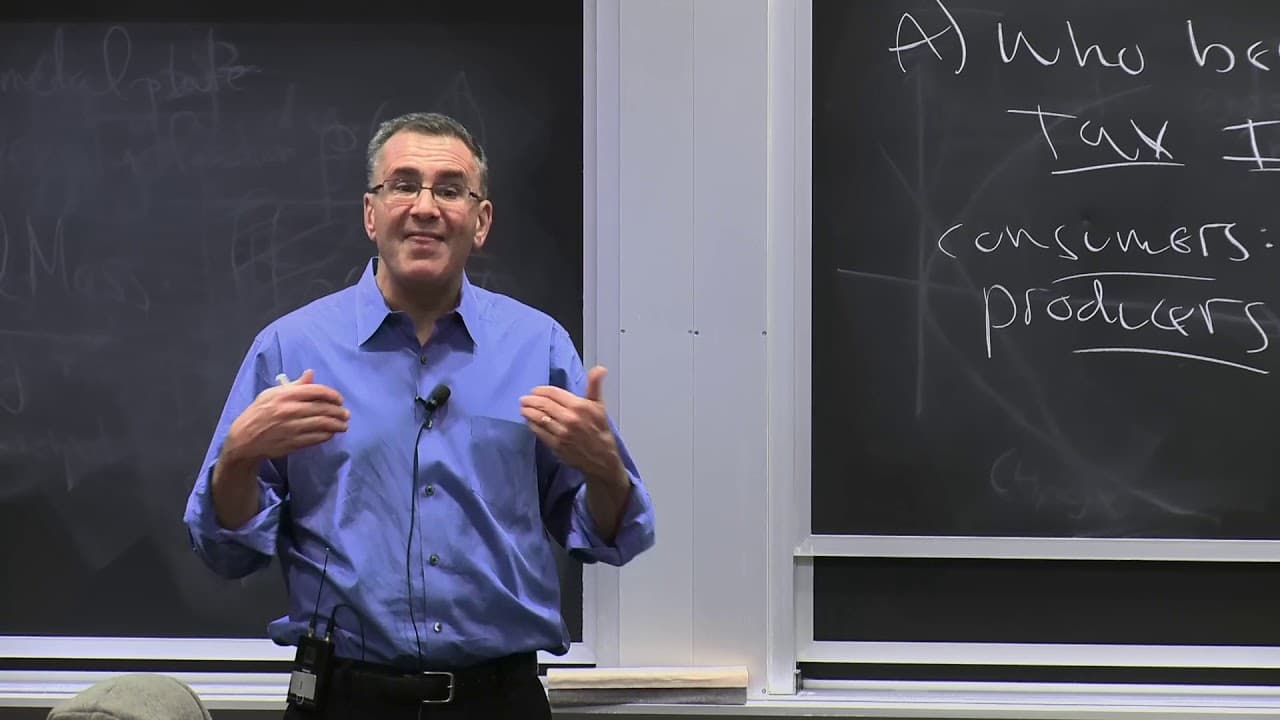
TL;DR
Tax incidence is complex and can be affected by market dynamics, societal factors, and elasticities. Transfers, such as the earned income tax credit (EITC), can effectively redistribute wealth, incentivize work, and reduce poverty.
Transcript
[SQUEAKING] JONATHAN GRUBER: So today, we're going to continue our discussion of equity and efficiency. We started last time talking about the equity-efficiency trade-off. Well, first we talked about why we think redistribution might be necessary, and the striking facts on inequality and poverty in the US. Then we talked about the trade-off, the eq... Read More
Key Insights
- 🚕 Tax incidence is influenced by market dynamics and elasticities, and it is not solely determined by who pays the tax.
- 💦 Conditional transfers, like the EITC, effectively redistribute wealth, incentivize work, and reduce poverty.
- 🎯 Categorical transfers and in-kind transfers offer alternative methods to target assistance and address the leaky bucket problem.
Install to Summarize YouTube Videos and Get Transcripts
Explore YouTube Video Summarizer or Get YouTube Transcript Extractor
Questions & Answers
Q: How are taxes and transfers related to equity and efficiency?
Taxes and transfers serve as mechanisms for redistribution, addressing societal inequalities and promoting economic efficiency by incentivizing work and reducing poverty.
Q: What is the key insight from tax incidence analysis?
Tax incidence is not solely determined by who pays the tax, but rather by the interaction of market forces and elasticities. In some cases, consumers bear the burden, while in others, producers shoulder the tax.
Q: How does the EITC work and what impact does it have on labor supply?
The EITC provides a wage subsidy to low-income individuals, increasing their take-home pay. Studies show that the EITC significantly increases labor supply for those not working, while having little impact on those already working.
Q: What are some limitations of categorical transfers and in-kind transfers?
Categorical transfers, such as SSI and TANF, can be difficult to measure and subject to abuse. In-kind transfers, like housing or medical care, can be effective in targeting those in need but may limit individual autonomy and choice.
Summary & Key Takeaways
-
Taxes and transfers play a critical role in addressing inequality and poverty.
-
Tax incidence is determined by the interaction of market forces and societal factors, resulting in a distribution of the tax burden.
-
The EITC is a successful conditional transfer program that incentivizes work, reduces poverty, and expands the economic pie.
Read in Other Languages (beta)
Share This Summary 📚
Summarize YouTube Videos and Get Video Transcripts with 1-Click
Try YouTube Summary with ChatGPT & Claude or YouTube Transcript Generator
Explore More Summaries from MIT OpenCourseWare 📚



Summarize YouTube Videos and Get Video Transcripts with 1-Click
Try YouTube Summary with ChatGPT & Claude or YouTube Transcript Generator