Clipping in Computer Graphics | CG | Lec-31 | Bhanu Priya
TL;DR
Clipping in computer graphics involves removing unnecessary parts of images outside a defined window.
Transcript
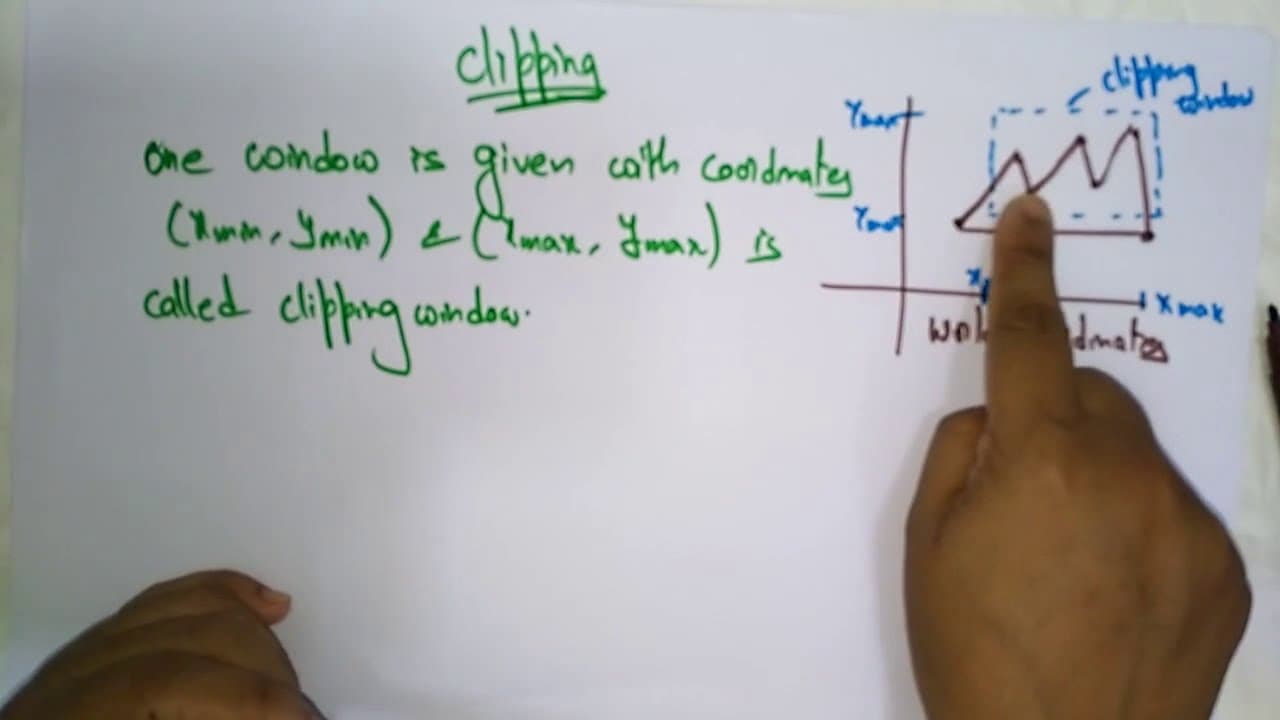
hi students welcome back let's coming to the next topic in the subject computer graphics is a clipping by saying this word what you understand clipping we are clipping the part means we are cutting the part so whatever the unnecessary part is it that we you have to be removed that you call it as a clipping okay so one window is given with the coord... Read More
Key Insights
- 💻 Clipping is crucial for performance optimization in computer graphics, as it reduces unnecessary rendering.
- 🫥 The concept of a clipping window is foundational, defining which part of an image is visible to the user.
- 📋 Clipping helps in managing resources by ensuring that only relevant visual data is processed during rendering.
- 👻 Different types of clipping techniques cater to various graphic elements, allowing for flexibility in design.
- 💦 Understanding clipping is essential for programmers and designers working with both 2D and 3D graphics.
- 📋 Clipping can significantly affect the clarity and quality of rendered graphics through selective visibility.
- 👾 The applications of clipping extend into various fields, including game design, simulation, and interactive media.
Install to Summarize YouTube Videos and Get Transcripts
Explore YouTube Video Summarizer or Get YouTube Transcript Extractor
Questions & Answers
Q: What is the primary purpose of clipping in computer graphics?
The primary purpose of clipping in computer graphics is to enhance performance and rendering efficiency by removing parts of the image that are not visible within the defined clipping window. This means that the graphics processor can focus on rendering only those elements that are within the viewers' view, reducing the computational load and improving frame rates.
Q: Can you explain how clipping windows are defined?
Clipping windows are defined using coordinate parameters known as X minimum, X maximum, Y minimum, and Y maximum. These coordinates outline the area of the image that should be retained for display. Everything outside this defined window is clipped or removed, allowing only the necessary portions of the image to be presented effectively on the screen.
Q: What are some applications of clipping beyond image rendering?
Clipping has several applications beyond simple image rendering. It is utilized in identifying visible and invisible areas in 3D objects, creating solid models, supporting various drawing operations, and facilitating tasks such as moving, copying, or deleting parts of an object. This versatility makes clipping essential in various digital content creation fields.
Q: What types of clipping exist in computer graphics?
There are several types of clipping, including point clipping, line clipping, area clipping, polygon clipping, text clipping, and exterior clipping. Each type serves different functions depending on the elements being processed, whether they are points, lines, shapes, or text. This variety allows for precise control over what parts of an image or object are displayed or deleted.
Summary & Key Takeaways
-
Clipping refers to the process of selectively removing portions of an image that fall outside a specified window, defined by coordinates.
-
The concept of clipping is fundamental in computer graphics as it helps optimize rendering by focusing only on visible image parts and ignoring those outside the clipping window.
-
Various types of clipping exist, including point, line, area, polygon, and text clipping, each serving different purposes in visual representation.
Read in Other Languages (beta)
Share This Summary 📚
Summarize YouTube Videos and Get Video Transcripts with 1-Click
Try YouTube Summary with ChatGPT & Claude or YouTube Transcript Generator