27.2 Relative Velocity in 1D
TL;DR
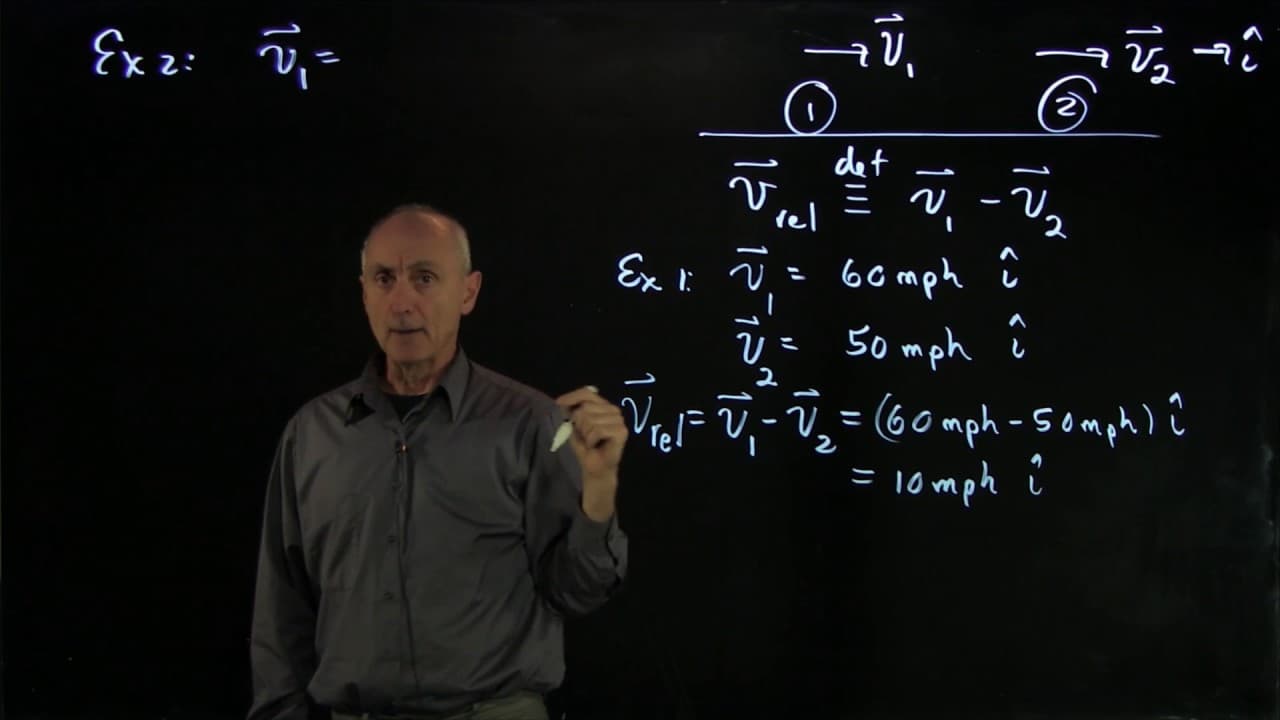
Relative velocity is the difference in velocity between two objects and is experienced in everyday situations, such as cars overtaking on highways.
Transcript
For one-dimensional collisions, let's talk about two objects, 1 and object 2, moving with velocity V1 and another object V2 moving with velocity V2. Let's say they're moving on the ground. Now I'd like to introduce the concept of relative velocity, a concept that we experience all the time in our lives. But let's see what it actually means. So V re... Read More
Key Insights
- ❓ Relative velocity is the difference in velocity between two objects.
- 😨 It is experienced in everyday situations, such as cars overtaking on highways.
- 🐎 When two objects are moving in opposite directions, the component of relative velocity in the opposite direction is twice the speed of one of the objects.
- 💥 Relative velocity plays a crucial role in analyzing elastic collisions in one dimension.
- 🤔 Understanding relative velocity allows for a new way of thinking about the impact and movement of objects.
- 💥 It provides insights into the relationship between different velocities in collisions.
- ❓ Relative velocity can be calculated by subtracting the velocity of one object from the velocity of the other.
Install to Summarize YouTube Videos and Get Transcripts
Explore YouTube Video Summarizer or Get YouTube Transcript Extractor
Questions & Answers
Q: What is relative velocity?
Relative velocity is the difference in velocity between two objects. It is calculated by subtracting the velocity of one object from the velocity of the other.
Q: How is relative velocity experienced in everyday life?
A common example is when one car overtakes another on a highway. If you are in the slower car, the faster car seems to be moving relatively slower.
Q: How is relative velocity different when two objects are moving in opposite directions?
In this case, the component of relative velocity in the opposite direction is twice the speed of one of the objects.
Q: Why is relative velocity important in collisions?
Relative velocity helps in understanding elastic collisions with no external forces in one dimension. It provides a new perspective on the movement and impact between objects.
Summary & Key Takeaways
-
Relative velocity is the velocity of one object minus the velocity of another object.
-
When one car overtakes another on a highway, the relative velocity is the difference in their speeds.
-
In the case of two objects moving in opposite directions, the relative velocity has a component that is twice the speed of one of the objects.
Read in Other Languages (beta)
Share This Summary 📚
Summarize YouTube Videos and Get Video Transcripts with 1-Click
Try YouTube Summary with ChatGPT & Claude or YouTube Transcript Generator
Explore More Summaries from MIT OpenCourseWare 📚



Summarize YouTube Videos and Get Video Transcripts with 1-Click
Try YouTube Summary with ChatGPT & Claude or YouTube Transcript Generator