How Does the Most Realistic Fire Simulation Extinguish Flames With Water?
TL;DR
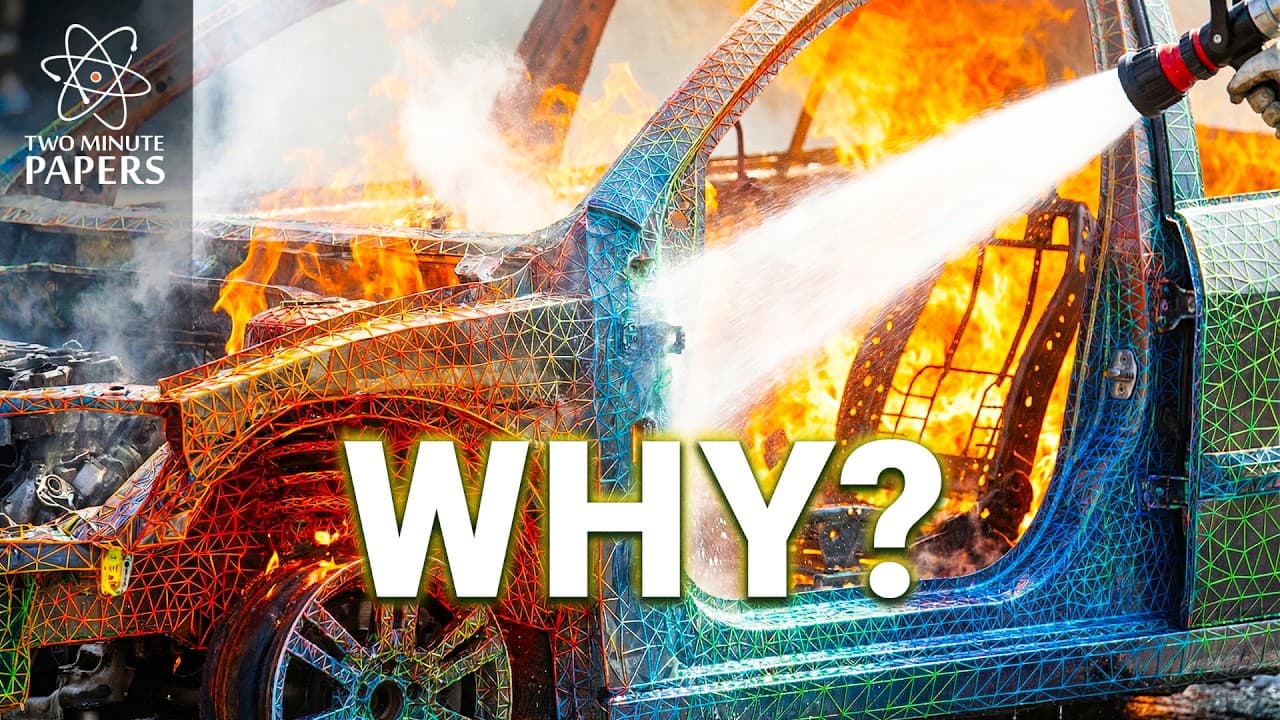
A realistic fire simulation extinguishes flames by modeling how water absorbs heat, becomes steam, and deprives the fire of oxygen. Given scene geometry, a fuel source, and a water source, it can reproduce different flames, soot deposition, the Venturi effect, and sprinkler timing in real time. Its chemically rigorous approach could support VR firefighter training and millions of virtual safety tests, so read on to see how water spray and timing transform the results.
Transcript
Previous works have shown us that fire simulation is possible. You can set a virtual tree on fire and see what happens. Or, on a bigger scale, simulating wildfires! But what about extinguishing the fire? Not like this. With water! Well, I found an amazing research work on that too! Yoohoo! Now, there are different types of flames, dependin... Read More
Key Insights
- Fire simulations previously failed to realistically interact with water due to different computational models for fire and water.
- This new research introduces a translator that allows fire and water to interact, enabling realistic extinguishing scenarios.
- Different fuel types and fuel-oxygen ratios create various flame behaviors, enhancing the simulation's realism.
- A spray of water is more effective than a solid beam in extinguishing flames due to increased surface area for heat absorption.
- The simulation can model complex scenarios like the Venturi effect to vacuum smoke and heat out of rooms.
- The Arrhenius equation is used to control the fire's burn rate, allowing precise manipulation of the fire's behavior.
- The simulation can test millions of 'what if' scenarios, providing a safe environment for fire safety training.
- Despite its advancements, the simulation has limitations, such as static geometry, but it represents a significant step forward in fire modeling.
Install to Summarize YouTube Videos and Get Transcripts
Explore YouTube Video Summarizer or Get YouTube Transcript Extractor
Questions & Answers
Q: How does the realistic fire simulation extinguish flames with water?
The simulation models liquid water hitting hot gas, absorbing heat, and transforming into steam that mixes with smoke. Cooling the reaction and starving it of oxygen can make the fire die instead of allowing water to pass through it.
Q: Why is a water spray more effective than a solid beam in the simulation?
A laminar flow acts like a solid beam with minimal surface area, limiting how much heat it can absorb. Breaking the water into thousands of tiny droplets increases the surface area, cools the area instantly, and creates expanding steam that suffocates the fire.
Q: What inputs does the fire simulation require?
The research asks for the geometry of the scene, a fuel source, and a water source. It then produces a chemically rigorous simulation in which cooling the fire or starving it of oxygen can extinguish it.
Q: Can the simulation model different types of flames?
Yes. It can mix different fuel types and fuel-oxygen ratios, producing completely different kinds of flames.
Q: How does the simulation reproduce the Venturi effect?
Water is sprayed at high speed out of a window rather than into it. This lowers the air pressure near the window and vacuums smoke and heat out of the room.
Q: Does the simulation track lasting effects of combustion?
Yes. It tracks soot formation during incomplete combustion and deposits soot onto surfaces, causing a nearby wall to darken over time. A heated metal rod also remains glowing and slowly cools after the flame is removed.
Q: How could the simulation improve fire safety training?
It could place firefighters in VR scenarios where realistic fires respond to water hoses. As a virtual safety lab, it can test millions of scenarios involving different sprinkler positions, activation delays, and fuels without burning down a house.
Q: Why does sprinkler timing matter in the simulated kitchen fire?
With a tiny delay, the stove fire grows, climbs the walls, reaches the ceiling, and fills the room with thick black smoke. When the sprinkler activates slightly earlier, its spray cools the reaction instantly, turning the fire into white vapor before it dies out.
Summary & Key Takeaways
-
This video discusses a realistic fire simulation that models fire extinguishing with water, using a chemically rigorous approach. It allows for realistic training scenarios by enabling interactions between fire, water, and different fuel types. The simulation showcases its potential for fire safety training and virtual safety labs by providing a safe environment to test various scenarios.
-
The research introduces a translator that allows fire and water to interact, overcoming previous limitations where water particles would pass through fire grids. This enables realistic extinguishing scenarios, where a spray of water is shown to be more effective than a solid beam due to increased surface area for heat absorption.
-
The simulation can model complex scenarios like the Venturi effect to vacuum smoke and heat out of rooms. It uses the Arrhenius equation to control the fire's burn rate, allowing precise manipulation of the fire's behavior. Although it has limitations, such as static geometry, it represents a significant advancement in fire modeling.
Read in Other Languages (beta)
Share This Summary 📚
Summarize YouTube Videos and Get Video Transcripts with 1-Click
Try YouTube Summary with ChatGPT & Claude or YouTube Transcript Generator
Explore More Summaries from Two Minute Papers 📚



Summarize YouTube Videos and Get Video Transcripts with 1-Click
Try YouTube Summary with ChatGPT & Claude or YouTube Transcript Generator