How to Prove a Sequence with Two Components Converges
TL;DR
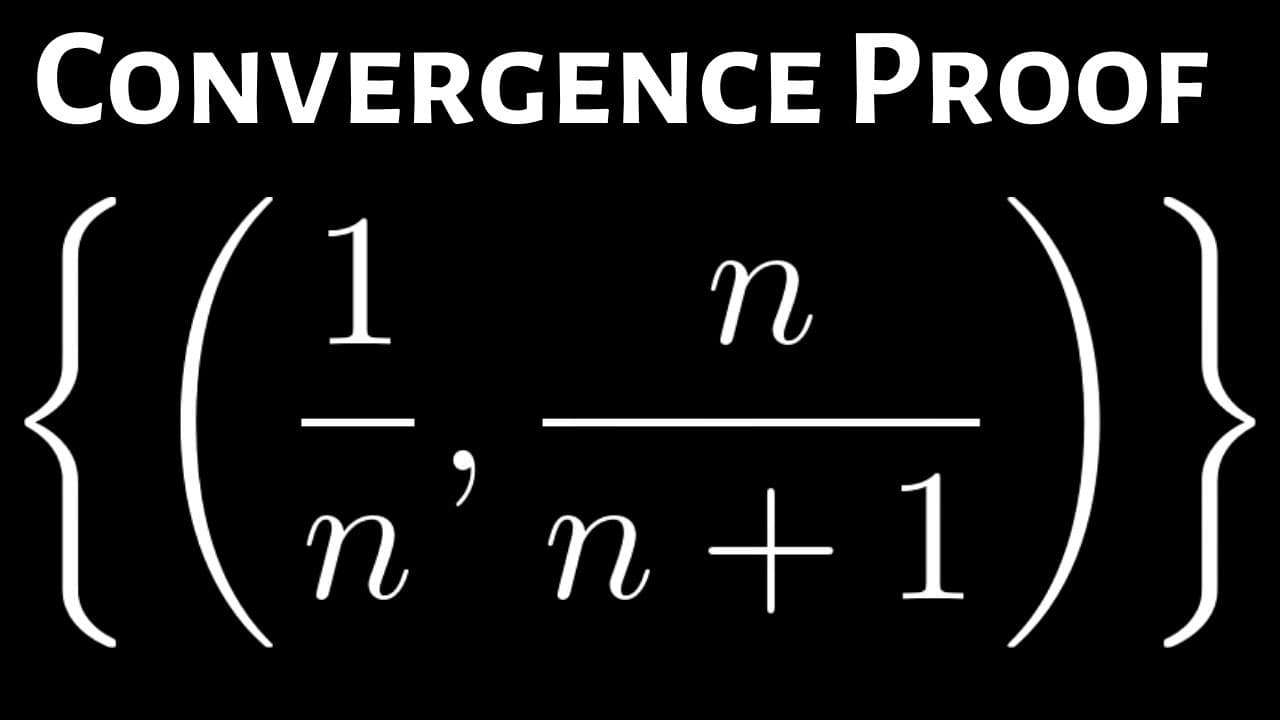
This video provides a proof of the convergence of a sequence to (0,1) as n approaches infinity using the definition of convergence.
Transcript
hi everyone in this video we're going to prove that the sequence converges to 0 1 as n approaches infinity using the definition of convergence let me recall the definition of convergence so we say that say P sub n converges to L if for all epsilon greater than 0 we can find some positive integer so there exist in n in the set of positive integers s... Read More
Key Insights
- 🪈 The definition of convergence applies to sequences in both real numbers and ordered pairs, with minor differences in the proof process.
- 😥 The distance between the elements of a sequence and the limit point is calculated using the Euclidean norm.
- 😑 Simplifying the expression for the distance involves algebraic manipulation and comparing fractions to eliminate terms.
Install to Summarize YouTube Videos and Get Transcripts
Explore YouTube Video Summarizer or Get YouTube Transcript Extractor
Questions & Answers
Q: What is the definition of convergence?
Convergence occurs when, for any given epsilon greater than 0, there exists a positive integer N such that for all n greater than N, the distance between the elements of the sequence and the limit point can be made arbitrarily small.
Q: How is the distance between the elements and the limit point calculated?
The distance is calculated using the Euclidean norm, which involves taking the square root of the sum of the squares of the differences between the components of the elements and the limit point.
Q: How does the presenter simplify the expression for the distance?
By subtracting the components of the elements and the limit point and simplifying the resulting fractions, the presenter reduces the expression to √2/N using algebraic manipulation.
Q: How does the presenter determine the appropriate value of N for convergence?
The presenter utilizes the Archimedean principle, which states that for any real number, there exists a natural number larger than it. By choosing an N larger than √2/ε, where ε is the given epsilon, the distance can be made smaller than ε for all n greater than N.
Summary & Key Takeaways
-
The video explains the definition of convergence and how it applies to the sequence (1/n, n/(n+1)).
-
The presenter shows step-by-step calculations to determine the distance between the elements of the sequence and the limit point (0,1).
-
The goal is to find an N such that the distance between the elements and the limit point is smaller than a given epsilon.
-
The presenter derives the expression for the distance and shows how to choose an appropriate N for convergence.
Read in Other Languages (beta)
Share This Summary 📚
Summarize YouTube Videos and Get Video Transcripts with 1-Click
Try YouTube Summary with ChatGPT & Claude or YouTube Transcript Generator
Explore More Summaries from The Math Sorcerer 📚


Summarize YouTube Videos and Get Video Transcripts with 1-Click
Try YouTube Summary with ChatGPT & Claude or YouTube Transcript Generator