L0.5 Introduction: Early History and People in Nuclear and Particle Physics
TL;DR
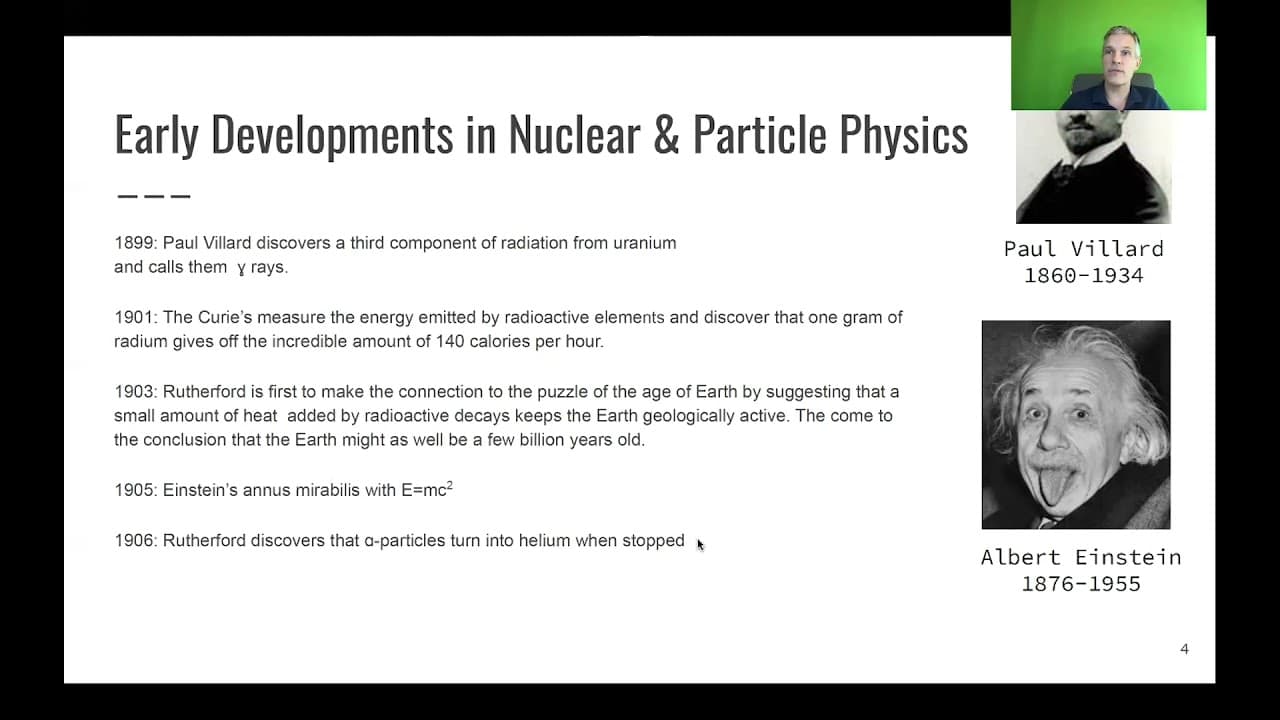
This content discusses the early history of nuclear and particle physics, including key figures, discoveries, and their impact on the understanding of the Earth's age and the development of the standard model.
Transcript
MARKUS KLUTE: Welcome again to 8.701. So this is the fifth section of our introduction. I'd like to talk about the early history and the people involved in nuclear and particle physics. I cover the period from 1820 to the beginning of the Second World War. other elements of the later history of the development of the standard model-- parity violati... Read More
Key Insights
- 🤕 The debate over the age of the Earth highlighted the need for a deeper understanding of physics and geological/biological processes.
- ❓ Discoveries in radioactivity by Becquerel and the Curies contributed to advancements in nuclear physics and the understanding of nuclear decay.
- 💨 Theoretical developments in special relativity, quantum mechanics, and the prediction of antimatter paved the way for further discoveries in particle physics.
- 🥺 Rutherford's experiments with alpha particles and gold foil led to the modern understanding of atomic structure.
- 💣 Concerns over Nazi Germany's nuclear bomb development led to the Manhattan Program and the subsequent use of atomic bombs in Japan.
- 🖐️ The historical context, including the impact of discrimination (e.g., Lise Meitner's forced exile), played a significant role in the progression of scientific discoveries.
Install to Summarize YouTube Videos and Get Transcripts
Explore YouTube Video Summarizer or Get YouTube Transcript Extractor
Questions & Answers
Q: What was the main debate regarding the age of the Earth?
The debate centered around physicists arguing for a younger Earth (~10,000 years) based on classical thermodynamics calculations, while geologists and biologists argued for an older Earth based on observations of geological and biological processes.
Q: What were the key discoveries made by Henri Becquerel and Marie and Pierre Curie?
Henri Becquerel discovered radiation from uranium, while Marie and Pierre Curie discovered additional radioactive materials such as thorium, polonium, and radium. They also measured the energy emitted by these materials, with a gram of radium capable of emitting up to 140 calories per hour.
Q: How did Rutherford contribute to the understanding of atoms and the age of the Earth?
Rutherford's experiments with alpha particles led to the discovery of alpha and beta rays, as well as the identification of a third component of radiation called gamma rays. He proposed that radioactive elements in the Earth's core kept it geologically active and suggested that the Earth could be several billion years old.
Q: What were some of the theoretical developments during this period?
Theoretical developments included Albert Einstein's special relativity and the equivalence between energy and mass, Dirac's combination of relativity and quantum mechanics leading to antimatter prediction, and Yukawa's proposal of a strong force binding neutrons and protons in nuclei.
Summary & Key Takeaways
-
The content explores the debate over the age of the Earth, with physicists arguing it is younger and geologists/biologists arguing it is older based on observations of geological and biological processes.
-
It highlights the discoveries of Henri Becquerel, Marie and Pierre Curie, and Rutherford in the field of radioactivity, which led to the understanding of nuclear decay.
-
The content also mentions the connection between Albert Einstein's theory of special relativity and mass-energy equivalence, as well as the development of quantum mechanics and the prediction of antimatter.
Read in Other Languages (beta)
Share This Summary 📚
Summarize YouTube Videos and Get Video Transcripts with 1-Click
Try YouTube Summary with ChatGPT & Claude or YouTube Transcript Generator
Explore More Summaries from MIT OpenCourseWare 📚
Summarize YouTube Videos and Get Video Transcripts with 1-Click
Try YouTube Summary with ChatGPT & Claude or YouTube Transcript Generator