21. X-ray Diffraction Techniques I (Intro to Solid-State Chemistry)
TL;DR
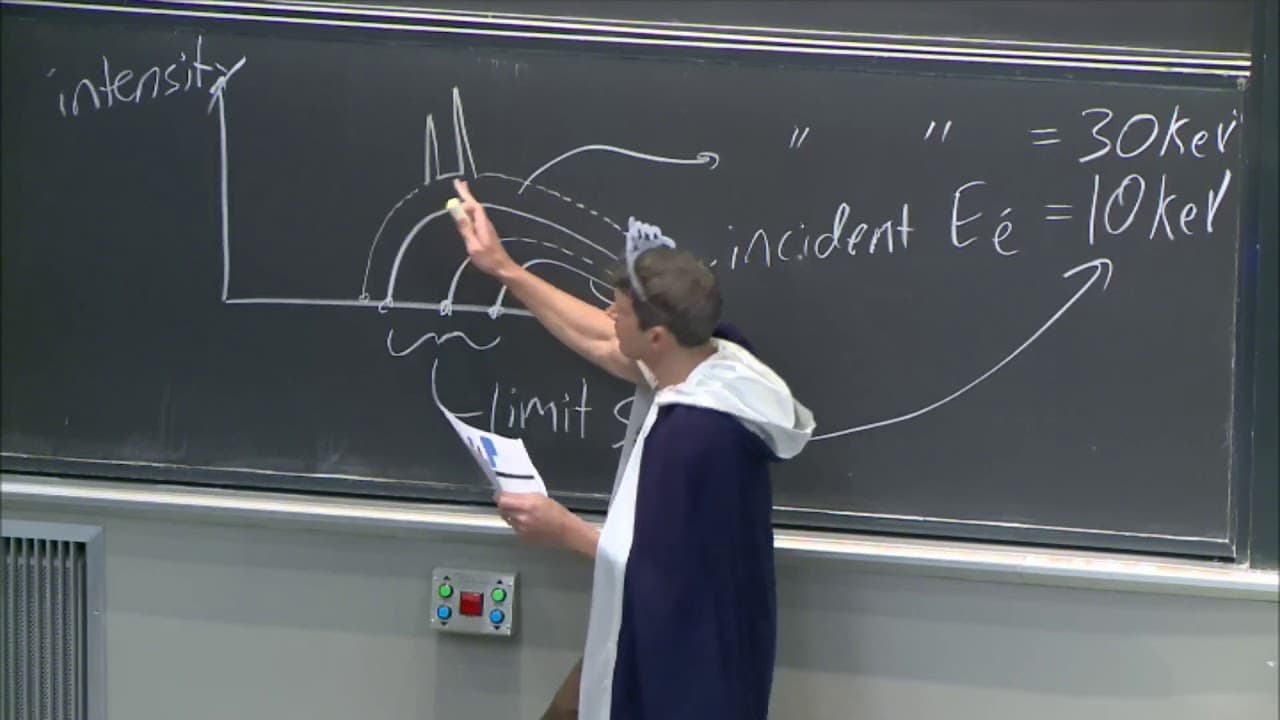
X-ray diffraction is a technique that uses X-rays to determine the crystal structure and lattice constant of a material, based on the interference pattern produced when X-rays are scattered by the crystal planes.
Transcript
Today, clearly, I am a noble gas. Thanks to-- it was actually the TAs' idea. And I was like, of course, that sounds awesome. So I hope you guys have a fantastic Halloween. Obviously, what you want to do is any kind of trick or treating or partying, you know the drill, you bring your periodic table, because you never know. And that's what happened--... Read More
Key Insights
- 🥳 Periodic tables can be a useful study tool even during Halloween celebrations.
- 📙 Exam results indicate a solid B range average with a wide score distribution.
- 🙌 X-rays can be generated through Bremsstrahlung and characteristic processes.
- 🙌 Characteristic X-rays offer well-defined energies for various applications.
- 📤 X-ray diffraction utilizes interference patterns to determine crystal structures.
- 📤 Selection rules restrict the allowed reflections in X-ray diffraction.
- 👨💼 Data analysis involves converting 2θ angles to sine squared values and matching them with hkl values.
Install to Summarize YouTube Videos and Get Transcripts
Explore YouTube Video Summarizer or Get YouTube Transcript Extractor
Questions & Answers
Q: What is the purpose of bringing periodic tables to Halloween celebrations?
Bringing periodic tables to Halloween celebrations allows students to study and celebrate at the same time, as they can revise periodic table elements while engaging in Halloween activities.
Q: What does the average exam score indicate about students' performance?
The average exam score indicates that most students performed well, as the average falls within the solid B range territory. The wide distribution of scores suggests that some topics were more challenging for certain students.
Q: Why does the author recommend revisiting missed topics after exams?
Revisiting missed topics allows students to identify areas of weakness and learn from their mistakes. This process helps improve understanding and retain important concepts.
Q: What is the significance of the continuous spectrum in X-rays?
The continuous spectrum in X-rays is a result of Bremsstrahlung, where electrons slow down and emit radiation in a continuous range of energies. It provides a wide range of X-ray energies and is used in X-ray imaging.
Q: How are characteristic X-rays different from the continuous spectrum?
Characteristic X-rays are specific energies emitted when electrons transition between energy levels in atoms. These energies are discrete and dependent on the elements present. They offer a well-defined source of X-rays for various applications, such as crystallography.
Q: What is the purpose of X-ray diffraction in determining crystal structures?
X-ray diffraction is used to analyze the interference pattern produced by X-rays scattering off crystal planes. By measuring the angles and intensities of the diffracted X-rays, one can determine the crystal structure and lattice constant.
Q: What are the selection rules in X-ray diffraction?
Selection rules determine which reflections are allowed or forbidden in X-ray diffraction. For example, in BCC crystals, reflections with an even sum of Miller indices are allowed, while in FCC crystals, reflections with either all even or all odd Miller indices are allowed.
Q: How is X-ray diffraction data analyzed to obtain crystal structures?
X-ray diffraction data is analyzed by measuring the 2θ angles and converting them to sine squared values. These values are then normalized, cleared of fractions, and matched with corresponding hkl values to determine the crystal structure and lattice constant.
Summary & Key Takeaways
-
The content discusses the use of periodic tables for studying and celebrating Halloween.
-
It provides an overview of the exam results and encourages students to learn from their mistakes.
-
The video explains the generation and types of X-rays, as well as the concept of diffraction and selection rules in crystal structures.
Read in Other Languages (beta)
Share This Summary 📚
Summarize YouTube Videos and Get Video Transcripts with 1-Click
Try YouTube Summary with ChatGPT & Claude or YouTube Transcript Generator
Explore More Summaries from MIT OpenCourseWare 📚


Summarize YouTube Videos and Get Video Transcripts with 1-Click
Try YouTube Summary with ChatGPT & Claude or YouTube Transcript Generator