Neuromuscular Junction
TL;DR
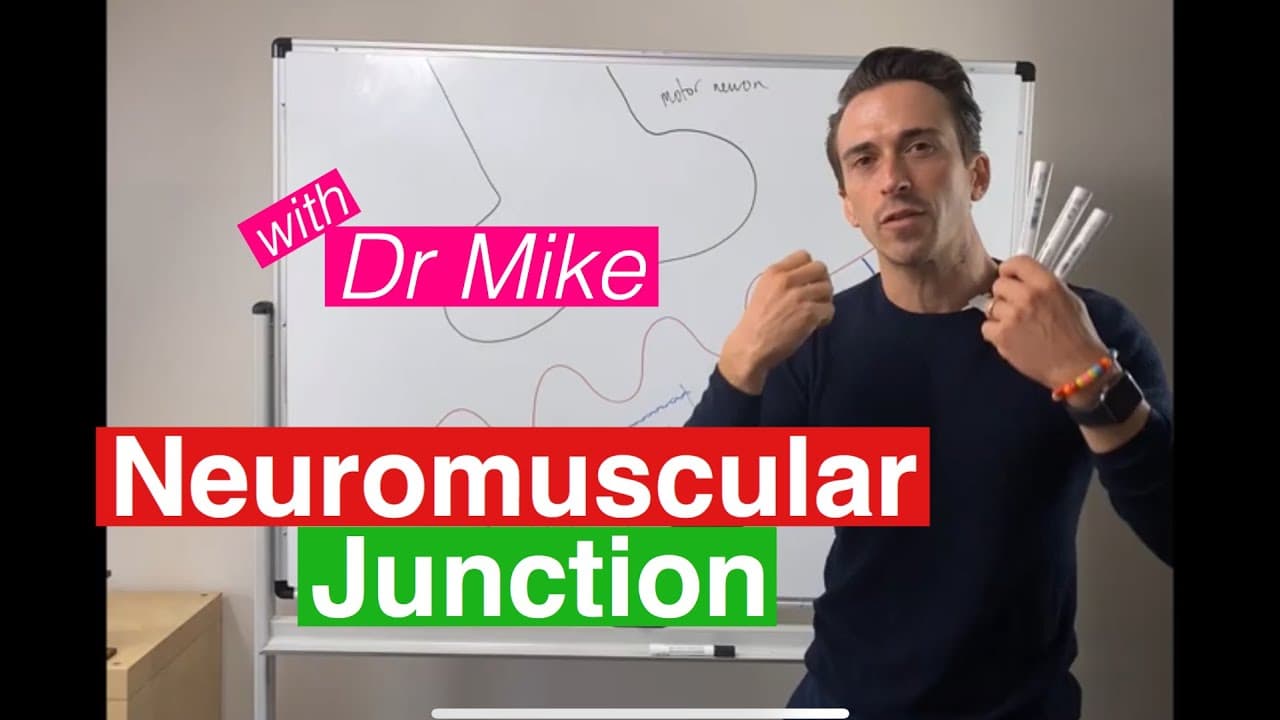
Dr. Mike explains how neurons signal muscles to contract.
Transcript
hi everybody dr. Mikey in this video we're gonna take a quick look at the neuromuscular Junction now the neuromuscular Junction is basically the point in which a neuron speaks to a muscle to tell that muscle to contract if we want to be specific the neuron is going to be a motor neuron and the muscle is going to be skeletal muscle we know t... Read More
Key Insights
- The neuromuscular junction is where a motor neuron communicates with skeletal muscle to initiate contraction.
- Neurons send electrical signals which convert to chemical signals to cross the synapse, using neurotransmitters like acetylcholine.
- Voltage-gated sodium channels propagate action potentials along neurons, leading to calcium channel activation at the synapse.
- Calcium influx triggers the release of acetylcholine from vesicles into the synaptic cleft, initiating muscle contraction.
- Acetylcholine binds to nicotinic receptors on muscle cells, causing sodium influx and membrane depolarization.
- Depolarization triggers calcium release from the sarcoplasmic reticulum, essential for muscle fiber contraction.
- Muscle contraction requires both calcium and ATP, enabling myosin-actin interaction for fiber shortening.
- Muscle relaxants like succinylcholine and non-depolarizing agents affect neuromuscular transmission differently.
Install to Summarize YouTube Videos and Get Transcripts
Explore YouTube Video Summarizer or Get YouTube Transcript Extractor
Questions & Answers
Q: What is the neuromuscular junction?
The neuromuscular junction is the site where a motor neuron communicates with a skeletal muscle fiber to initiate contraction. It involves the conversion of electrical nerve impulses into chemical signals via neurotransmitters, which then trigger muscle contraction through a series of biochemical events.
Q: How do electrical signals in neurons convert to chemical signals?
Electrical signals in neurons, known as action potentials, travel along the axon to the synapse. At the synapse, the electrical signal triggers voltage-gated calcium channels to open, allowing calcium ions to enter the neuron. This influx of calcium causes vesicles containing neurotransmitters like acetylcholine to fuse with the neuron's membrane, releasing the neurotransmitter into the synaptic cleft.
Q: What role does acetylcholine play at the neuromuscular junction?
Acetylcholine acts as a neurotransmitter at the neuromuscular junction. Once released into the synaptic cleft, it binds to nicotinic receptors on the muscle cell membrane. This binding opens ligand-gated sodium channels, allowing sodium ions to enter the muscle cell, leading to depolarization and subsequent muscle contraction.
Q: How does muscle contraction occur at the cellular level?
Muscle contraction occurs when depolarization of the muscle cell membrane triggers the release of calcium from the sarcoplasmic reticulum. Calcium binds to regulatory proteins on actin filaments, allowing myosin heads to attach to actin. ATP provides the energy for myosin to pull actin filaments, shortening the muscle fiber and causing contraction.
Q: What are the two main types of acetylcholine receptors?
The two main types of acetylcholine receptors are nicotinic and muscarinic receptors. At the neuromuscular junction, nicotinic receptors are primarily involved. These receptors are ligand-gated ion channels that open in response to acetylcholine binding, allowing sodium ions to enter the muscle cell and initiate depolarization.
Q: How do muscle relaxants like succinylcholine work?
Succinylcholine is a depolarizing muscle relaxant that mimics acetylcholine. It binds to acetylcholine receptors, causing initial muscle contractions (fasciculations) followed by paralysis. Succinylcholine is not broken down as quickly as acetylcholine, leading to prolonged depolarization and preventing further muscle contractions, resulting in temporary paralysis.
Q: What is the function of the sarcoplasmic reticulum in muscle cells?
The sarcoplasmic reticulum is an organelle in muscle cells that stores calcium ions. During muscle contraction, depolarization of the muscle cell membrane triggers the release of calcium from the sarcoplasmic reticulum. This calcium binds to regulatory proteins on actin filaments, facilitating the interaction between actin and myosin, which is essential for muscle contraction.
Q: How do non-depolarizing muscle relaxants differ from depolarizing ones?
Non-depolarizing muscle relaxants block acetylcholine receptors without causing depolarization. They prevent acetylcholine from binding to its receptors, thereby inhibiting sodium influx and subsequent muscle contraction. Unlike depolarizing agents like succinylcholine, non-depolarizing relaxants do not cause initial muscle contractions and are used to achieve muscle relaxation during surgical procedures.
Summary & Key Takeaways
-
Dr. Mike provides an overview of the neuromuscular junction, explaining how motor neurons communicate with skeletal muscles to trigger contraction. He describes the role of sodium and calcium ions, as well as acetylcholine, in this process.
-
The video details the sequence of events at the neuromuscular junction, including action potential propagation, neurotransmitter release, and receptor binding, leading to muscle fiber contraction through myosin-actin interactions.
-
Dr. Mike also discusses the mechanisms of muscle relaxants, distinguishing between depolarizing and non-depolarizing types, and their effects on neuromuscular transmission and muscle contraction.
Read in Other Languages (beta)
Share This Summary 📚
Summarize YouTube Videos and Get Video Transcripts with 1-Click
Try YouTube Summary with ChatGPT & Claude or YouTube Transcript Generator
Explore More Summaries from Dr Matt & Dr Mike 📚



Summarize YouTube Videos and Get Video Transcripts with 1-Click
Try YouTube Summary with ChatGPT & Claude or YouTube Transcript Generator