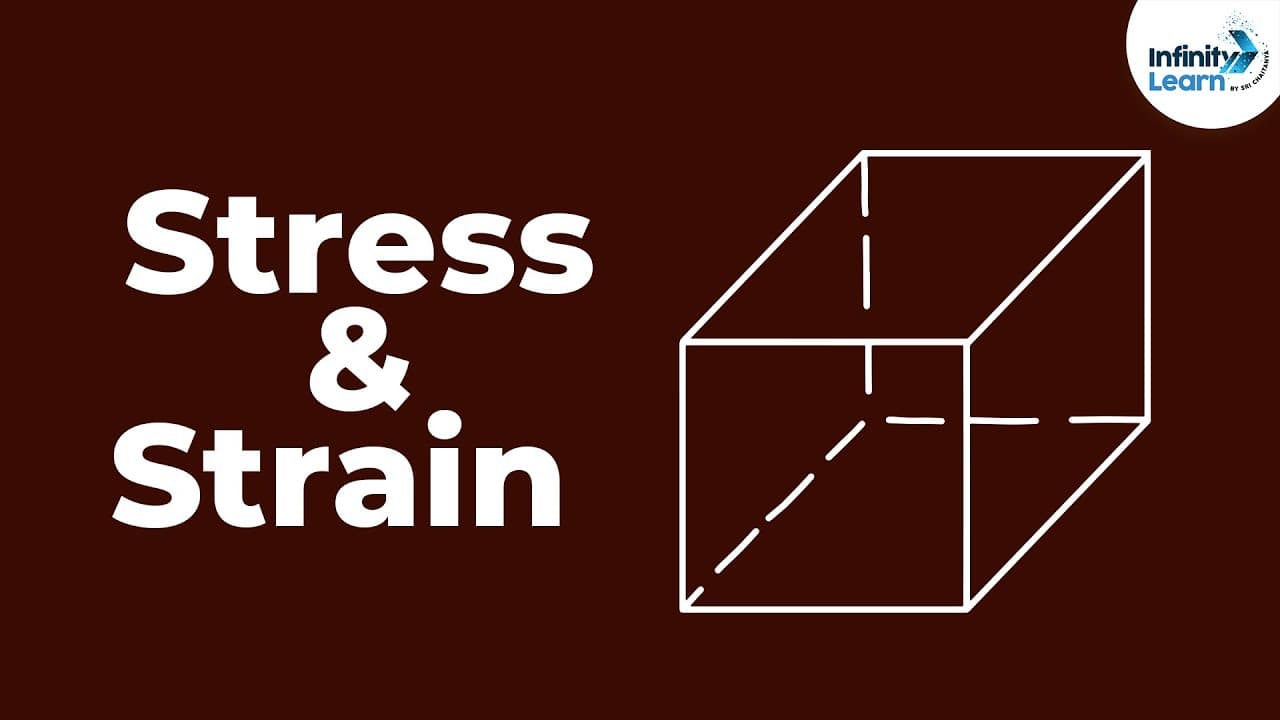
Stress and Strain | Mechanical Properties of Solids | Don't Memorise
TL;DR
This video explains the concept of stress and strain in physics and engineering, with a focus on beams made of different materials.
Transcript
do you know what a beam is there are many different meanings of this word in physics we use this word in two ways in optics we say a beam of light it can be thought of as a sequence of photons traveling in a straight line in mechanical engineering a beam is a long piece made of some material it can be a wooden beam a steel beam or a concrete beam w... Read More
Key Insights
- 😁 A beam can refer to a sequence of photons in optics or a long piece made of various materials in mechanical engineering.
- 😁 Stress in a beam is a result of interatomic and intermolecular forces caused by an applied force, and it is defined as force per unit cross-sectional area.
- 😁 Increasing the applied force on a beam increases its stress, while increasing the surface area decreases the stress.
- 🍉 Strain is the change in dimensions per unit of the original dimensions and can be calculated in terms of length, area, and volume.
Install to Summarize YouTube Videos and Get Transcripts
Explore YouTube Video Summarizer or Get YouTube Transcript Extractor
Questions & Answers
Q: How is stress defined and calculated in the context of beams?
Stress is defined as force per unit cross-sectional area, calculated by dividing the applied force by the area of the beam's cross-section. It determines the extent of the uncomfortable state experienced by the beam.
Q: How does increasing the force applied to a beam affect its stress?
Increasing the force applied to a beam increases the stress it experiences. This is because stress is directly proportional to the force, while the cross-sectional area remains constant.
Q: What happens to the stress when the surface area of a beam is increased?
Increasing the surface area of a beam decreases the stress it experiences. This is because stress is inversely proportional to the area, so a larger area results in a lower stress for the same applied force.
Q: What is the SI unit of stress?
The SI unit of stress is the pascal (Pa), which is equal to 1 Newton per square meter (N/m²). Stress is measured in terms of force per unit area.
Summary & Key Takeaways
-
The video explores the different meanings of the word "beam" in physics and mechanical engineering.
-
It explains how a beam experiences stress when a force is applied to it, and how stress is defined as force per unit cross-sectional area.
-
The concept of strain is introduced as the change in dimensions per unit of original dimensions, and examples of strain in terms of length, area, and volume are provided.
Read in Other Languages (beta)
Share This Summary 📚
Summarize YouTube Videos and Get Video Transcripts with 1-Click
Try YouTube Summary with ChatGPT & Claude or YouTube Transcript Generator
Explore More Summaries from Infinity Learn NEET 📚

Summarize YouTube Videos and Get Video Transcripts with 1-Click
Try YouTube Summary with ChatGPT & Claude or YouTube Transcript Generator