General Balance Equation for Alternating Current Bridges A C Bridges
TL;DR
AC bridges are accurate instruments used for measuring AC resistance, capacitance, impedance, storage factor, and power factor.
Transcript
hello friends in this video we will derive the general balance equation for the alternating current bridge network so let us start with our topic the alternating current bridges or ac bridges are the most popular and accurate instruments which are used for the measurement of ac resistance capacitance and impedance also they can be used for the meas... Read More
Key Insights
- 🔙 AC bridges are accurate instruments used for measuring AC resistance, capacitance, and impedance.
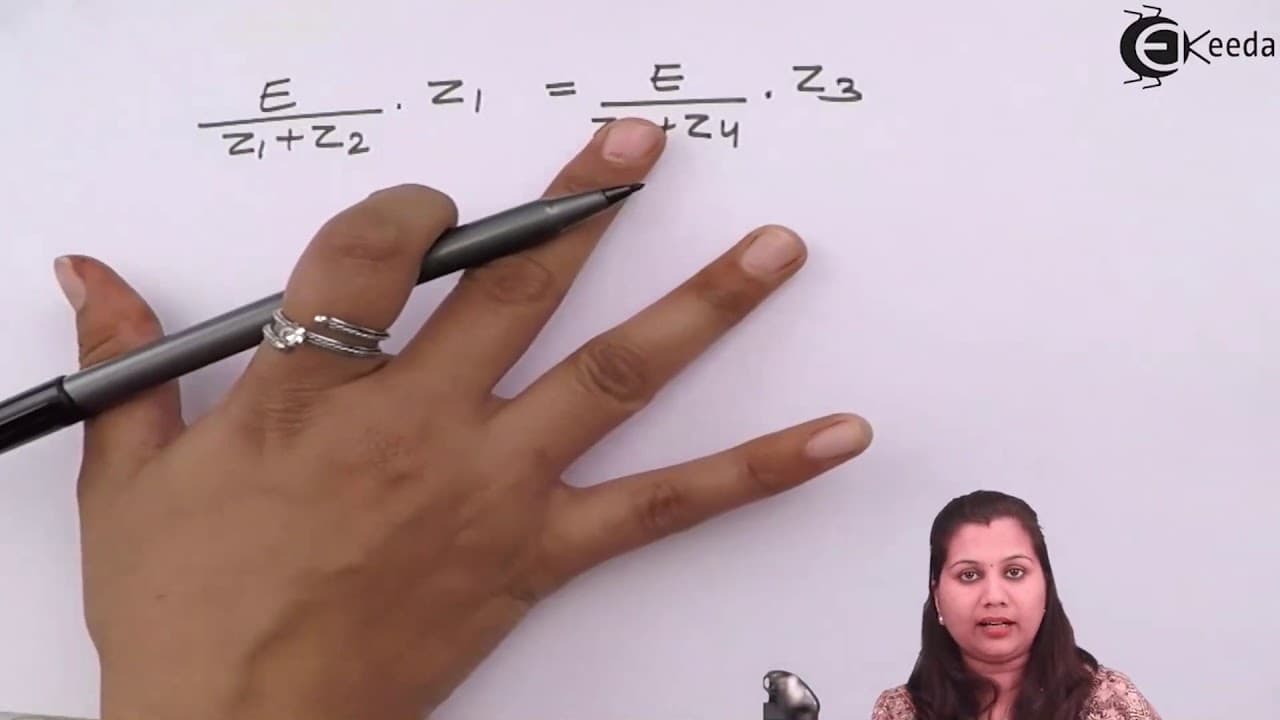
- 🌉 The balance equation for AC bridges states that the product of the impedances in opposite arms of the bridge is equal.
- 💁 Impedances in AC bridges can be represented in polar form or resistive form.
- 😑 The balance equation can also be expressed in terms of admittance.
- 🖐️ Inductive and capacitive reactance play a role in the impedance of AC bridges.
- 💦 When an AC bridge is balanced, the potential and voltage drops across opposite arms are equal.
- 🧑🏭 AC bridges can be used to measure storage factor and power factor.
Install to Summarize YouTube Videos and Get Transcripts
Explore YouTube Video Summarizer or Get YouTube Transcript Extractor
Questions & Answers
Q: How are AC bridges different from Wheatstone bridges?
AC bridges use complex impedances instead of resistances, and they can measure AC resistance, capacitance, and impedance.
Q: What is the purpose of the detector in an AC bridge?
The detector is used to balance the bridge by showing null deflection, indicating that no current is passing through it.
Q: What happens when an AC bridge is balanced?
When the bridge is balanced, the potential of point B is equal to the potential of point D, and the voltage drops across the opposite arms of the bridge are equal.
Q: How can the balance equation for AC bridges be expressed in terms of admittance?
The balance equation can be written as 1/y1 * 1/y4 = 1/y2 * 1/y3, where y is the reciprocal of impedance.
Q: How are the impedances in AC bridges represented in polar form?
Impedances are represented as Z = Z magnitude * e^(j*theta), where Z magnitude is the magnitude of impedance and theta is the phase angle.
Q: What are the relationships between the magnitude and phase angles of the impedances in a balanced AC bridge?
The product of the magnitudes of opposite arm impedances is equal, and the sum of the phase angles of opposite arm impedances is equal.
Q: How are inductive and capacitive impedances represented in AC bridges?
Inductive impedance (ZL) is represented as R + jXL, while capacitive impedance (ZC) is represented as R - jXC.
Q: What are the units of measurement for inductive and capacitive reactance?
Inductive reactance (XL) is measured in ohms, represented as 2pi f L, while capacitive reactance (XC) is measured in ohms, represented as 1/(2pi f C).
Summary & Key Takeaways
-
AC bridges are based on Wheatstone bridges and are used for measuring AC resistance, capacitance, and impedance.
-
AC bridges consist of four arms with four complex impedances.
-
The balance equation for AC bridges states that the product of the impedances in opposite arms of the bridge is equal.
Read in Other Languages (beta)
Share This Summary 📚
Summarize YouTube Videos and Get Video Transcripts with 1-Click
Try YouTube Summary with ChatGPT & Claude or YouTube Transcript Generator
Explore More Summaries from Ekeeda 📚



Summarize YouTube Videos and Get Video Transcripts with 1-Click
Try YouTube Summary with ChatGPT & Claude or YouTube Transcript Generator