How do Exponents and Powers Work in Maths?
TL;DR
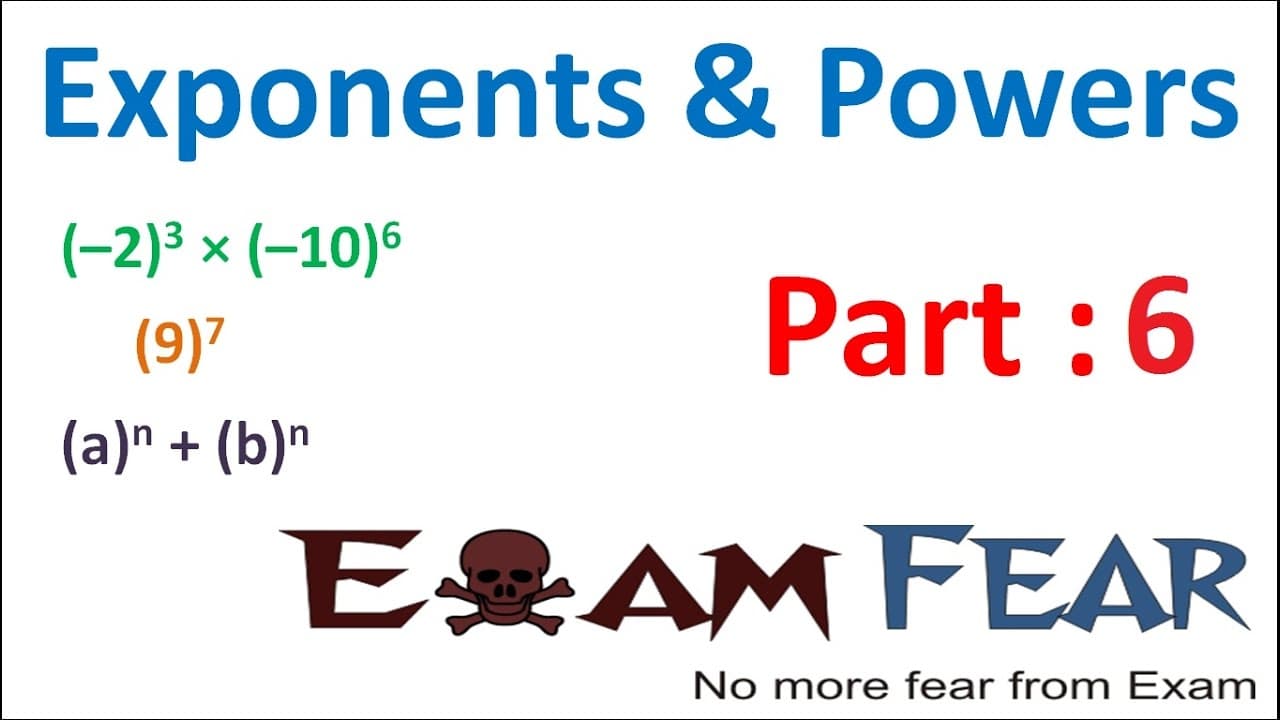
Exponents and powers follow specific laws, such as power to the power which multiplies exponents, and same exponent for different bases where the bases multiply but the exponent remains unchanged. Understanding these rules helps in simplifying calculations and writing numbers in exponential form.
Transcript
hello friends this video on exponents and powers part six is brought to you by exam for calm no hole fear from exam category now let's look at the next category which is power to the power so when you have a number a to the power M which which in itself has a power and you put another power to this number that is a to the power M to the power n so ... Read More
Key Insights
- ✊ Power to the power rule: a^(m^n) = a^(m*n).
- 💁 Writing numbers in exponential form using prime factorization.
- 👮 Law of exponents for multiplication: a^m * b^m = (a*b)^m.
- 👮 Law of exponents for division: a^m / b^m = (a/b)^m.
- 🗂️ Same exponent, different bases: bases are multiplied or divided, exponent remains the same.
- ⚾ Base multiplication is commutative: a^m * b^m = b^m * a^m.
- 🪜 Same bases, different exponents: exponents are added or subtracted.
Install to Summarize YouTube Videos and Get Transcripts
Explore YouTube Video Summarizer or Get YouTube Transcript Extractor
Questions & Answers
Q: What is the meaning of power to the power, and how do you calculate it?
Power to the power refers to a number with an exponent that is itself raised to another power. To calculate it, you multiply the two powers: a^m^n = a^(m*n).
Q: How do you write a number in exponential form using prime factorization?
To write a number in exponential form, find its prime factorization. For example, 64 can be written as 2^6, since 2 is repeated 6 times in the factorization.
Q: What is the law of exponents for multiplication with the same exponent but different bases?
When multiplying numbers with the same exponent but different bases, the product has the same exponent and the bases are multiplied. For example, 2^3 * 4^3 = (2*4)^3 = 8^3.
Q: How does the law of exponents apply to division with the same exponent but different bases?
When dividing numbers with the same exponent but different bases, the result has the same exponent and the bases are divided. For example, 2^3 / 2^3 = (2/2)^3 = 1^3 = 1.
Summary & Key Takeaways
-
The video explains the concept of power to the power and how to apply it using examples.
-
The video demonstrates how to write numbers in exponential form using prime factorization.
-
The video explores the laws of exponents and powers for multiplication and division scenarios.
Read in Other Languages (beta)
Share This Summary 📚
Summarize YouTube Videos and Get Video Transcripts with 1-Click
Try YouTube Summary with ChatGPT & Claude or YouTube Transcript Generator
Explore More Summaries from LearnoHub - Class 11, 12 📚





Summarize YouTube Videos and Get Video Transcripts with 1-Click
Try YouTube Summary with ChatGPT & Claude or YouTube Transcript Generator