Rectangular Wave guide | Propagation of TM waves | Part-1/3 | Microwave Engineering | Lec-09
TL;DR
This video explains TM wave propagation in rectangular waveguides and calculates wave equations.
Transcript
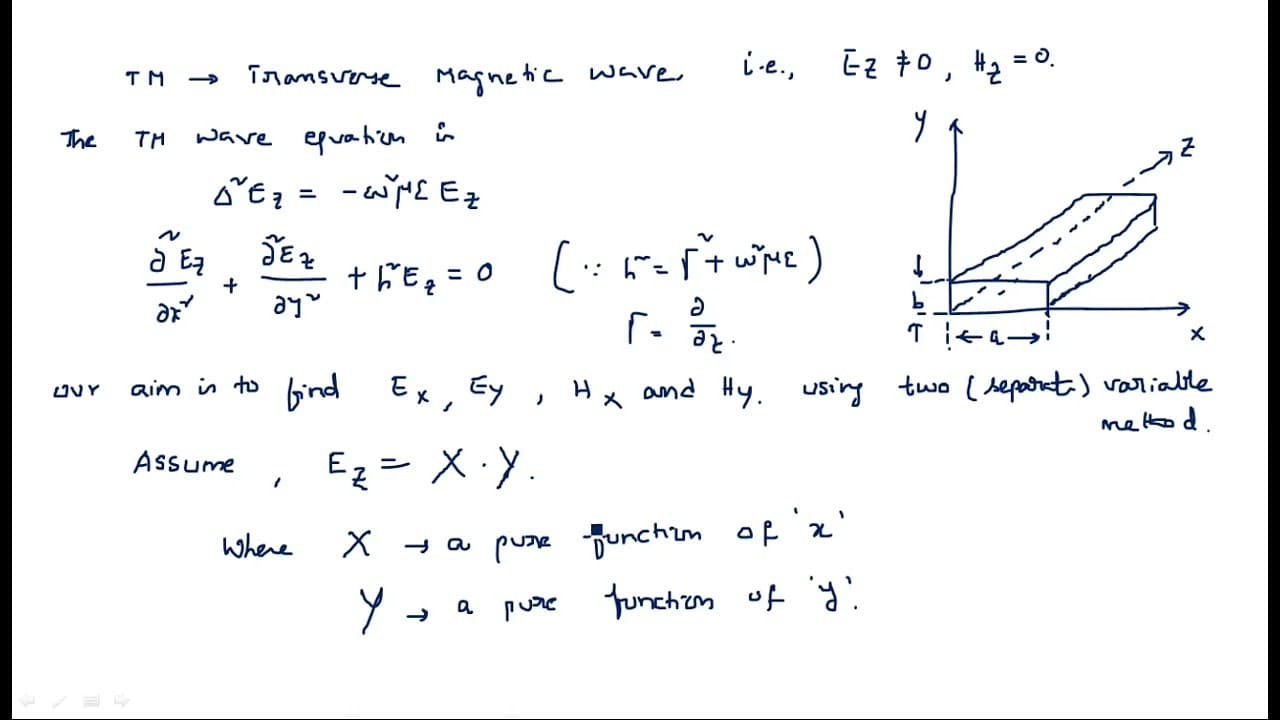
hi everyone in this video I'm going to start the deration of propagation of TM waves in rectangular wave guide in this uh TM waves in rectangular wave guide here also we going to calculate the wave equations for exy HX Hy previously we have discussed the propagation of waves in rectangular wave G that means generally what type any type of wave can ... Read More
Key Insights
- 👋 TM waves possess electric fields perpendicular to the direction of propagation, making them distinct from TE waves.
- 👋 Understanding the relationships among the electric and magnetic field components is essential to analyzing wave propagation in rectangular waveguides.
- 👋 The mathematical treatment of wave propagation involves complex equations that can be simplified by employing separation of variables, drastically aiding in solving the problem.
- 😃 The parameters a and b in the equations relate directly to the differential equations governing the solutions for electric and magnetic fields.
- 🖐️ Boundary conditions play a fundamental role in uniquely determining the constants in the solutions, ensuring they fit the physical setup of the waveguide.
- 👋 The derivation process, while intricate, follows a logical progression from defining wave properties to solving for components essential for understanding wave behavior in guides.
- 👋 The intuition behind assuming electric fields as products of dimensionally separated functions aids in visualizing the behavior of TM waves.
Install to Summarize YouTube Videos and Get Transcripts
Explore YouTube Video Summarizer or Get YouTube Transcript Extractor
Questions & Answers
Q: What are TM waves and how are they defined in the context of rectangular waveguides?
TM waves, or Transverse Magnetic waves, are defined by having their electric field components present while the magnetic field component in the direction of propagation is zero. In rectangular waveguides, these waves propagate such that their electric field is perpendicular to a defined magnetic field, allowing for effective transmission of electromagnetic energy.
Q: What is the significance of the parameters Ex, Ey, Hx, and Hy in TM wave propagation?
The parameters Ex, Ey, Hx, and Hy are critical in determining the characteristics of TM wave propagation. Ex and Ey represent the electric field components in the x and y directions, respectively, while Hx and Hy represent the magnetic field components in those same directions. The existence of these parameters indicates that a TM wave is present and engaged in effective energy transmission.
Q: How does the concept of separation of variables apply to the derivation of TM wave equations?
The separation of variables technique involves treating the electric field E as a product of two independent functions of x and y. This allows for easier manipulation and simplification of the original wave equation. By breaking down the equation into manageable parts, it becomes feasible to solve for individual components, leading to the derivation of equations for Ex and Ey.
Q: What are the boundary conditions mentioned for solving TM wave equations?
Boundary conditions are used to determine the constants C1, C2, C3, and C4 in the solutions derived from the ordinary second-order differential equations for the fields. These conditions are critical as they define how the fields behave at the physical boundaries of the waveguide, ensuring solutions are physically meaningful and applicable.
Summary & Key Takeaways
-
The video introduces the propagation of Transverse Magnetic (TM) waves in rectangular waveguides, focusing on the calculation of wave equations for electric and magnetic fields in different directions.
-
A detailed derivation of the TM wave equation is presented, emphasizing the importance of specific parameters such as electric field components and boundary conditions.
-
The speaker describes the method of separation of variables to simplify the calculations and derive the solutions for the electric field and magnetic field components.
Read in Other Languages (beta)
Share This Summary 📚
Summarize YouTube Videos and Get Video Transcripts with 1-Click
Try YouTube Summary with ChatGPT & Claude or YouTube Transcript Generator