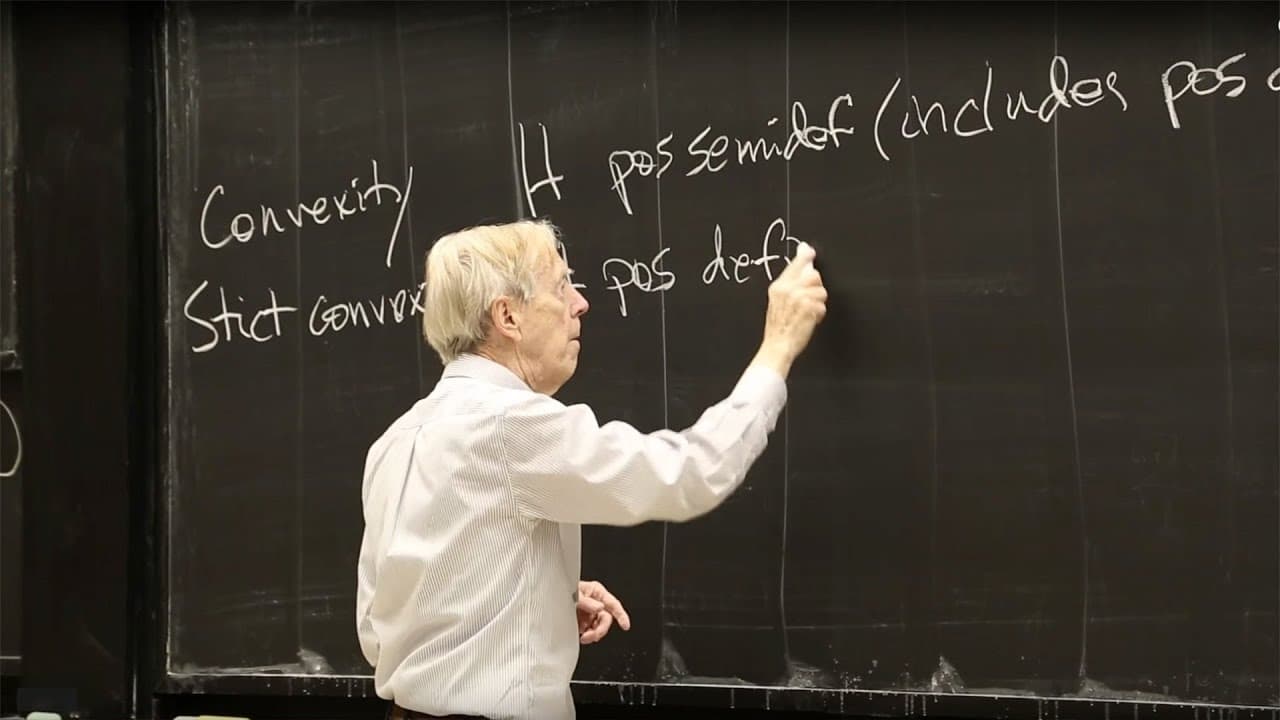
22. Gradient Descent: Downhill to a Minimum
TL;DR
Gradient descent is a fundamental algorithm in machine learning and optimization, with the key factor for convergence being the condition number of the function.
Transcript
The following content is provided under a Creative Commons license. Your support will help MIT Open Courseware continue to offer high quality educational resources for free. To make a donation or to view additional materials from hundreds of MIT courses, visit [email protected]. GILBERT STRANG: So I'm going to talk about the gradient de... Read More
Key Insights
- 🎰 Gradient descent is a central algorithm in deep learning, machine learning, and optimization.
- ☠️ The condition number of the matrix plays a crucial role in the convergence rate of gradient descent.
- 🫥 Exact line search and backtracking line search are two common methods for determining the step size in gradient descent.
Install to Summarize YouTube Videos and Get Transcripts
Explore YouTube Video Summarizer or Get YouTube Transcript Extractor
Questions & Answers
Q: How does gradient descent work to minimize a function?
Gradient descent minimizes a function by iteratively updating the variables based on the negative gradient of the function. The step size determines the rate of descent.
Q: What is the role of the condition number in gradient descent?
The condition number, which is the ratio of the largest to the smallest eigenvalues of the matrix, determines the speed of convergence in gradient descent. A large condition number results in slower convergence.
Q: What is the purpose of an exact line search in optimization?
An exact line search finds the optimal step size for the descent direction to minimize the function. It involves finding the point where the function reaches a minimum in the search direction.
Q: How can backtracking line search be used in gradient descent?
Backtracking line search involves starting with an initial step size and iteratively reducing it until a satisfactory decrease in the function is achieved. This approach allows for more flexibility in choosing the step size.
Summary & Key Takeaways
-
Gradient descent is a method to minimize a function when there are many variables, relying on first derivatives instead of second derivatives.
-
The function being minimized can be represented as a pure quadratic using a symmetric matrix.
-
The condition number of the matrix, which is the ratio of the largest to the smallest eigenvalues, determines the speed of convergence in gradient descent.
-
Exact line search or backtracking line search can be used to determine the step size in gradient descent.
Read in Other Languages (beta)
Share This Summary 📚
Summarize YouTube Videos and Get Video Transcripts with 1-Click
Try YouTube Summary with ChatGPT & Claude or YouTube Transcript Generator
Explore More Summaries from MIT OpenCourseWare 📚


Summarize YouTube Videos and Get Video Transcripts with 1-Click
Try YouTube Summary with ChatGPT & Claude or YouTube Transcript Generator