Sweep circuit using UJT | PDC | Lec-75
TL;DR
This video covers the UJT relaxation oscillator's operation and circuit components.
Transcript
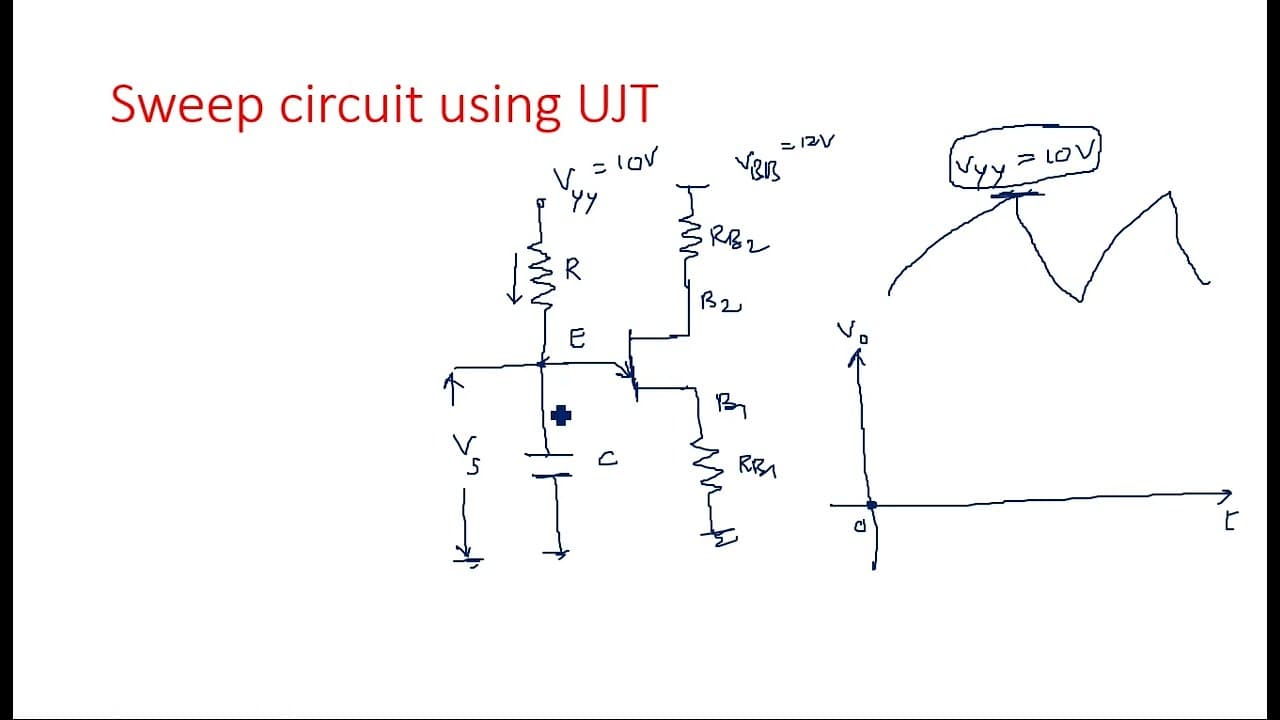
hi everyone in this video I am going to explain about the ujt relaxation oscillator or sweeps are cute or time-based generator okay these are the free running oscillator is also there so different names of they are there for this ujt relaxation oscillator if you see the circuit diagram already I told you how the symbolic representation of fugit is ... Read More
Key Insights
- ⌛ The UJT relaxation oscillator, also known as a time-based generator, utilizes a unique transistor configuration to create oscillations.
- ⚡ It features three terminals: one emitter and two base terminals, each connected through resistors to different voltage supplies.
- 🖐️ The capacitor plays a vital role by charging and discharging, with its output voltage influencing circuit behavior.
- ⚡ The separation of biasing voltages helps stabilize the oscillator's amplitude and frequency without external disturbances.
- 💄 The charging and discharging phases produce an AC output signal from a DC input, making it a versatile oscillator.
- ⌛ Sweep time and retrace time are essential to understanding the operation cycle, where sweep time is significantly longer than retrace time.
- ⚡ The frequency of oscillation is mainly determined by resistance, capacitance, and the specific voltage values applied in the circuit.
Install to Summarize YouTube Videos and Get Transcripts
Explore YouTube Video Summarizer or Get YouTube Transcript Extractor
Questions & Answers
Q: What does UJT stand for, and why is it important in this context?
UJT stands for Unijunction Transistor. It's crucial in the UJT relaxation oscillator as it controls the charging and discharging of the capacitor, enabling the generation of oscillations based on specific voltages within the circuit. Its unique characteristics facilitate the creation of time-based signals essential in applications like timing circuits and waveform generation.
Q: How does the UJT oscillator differentiate between charging and discharging states?
The UJT oscillator alternates between charging and discharging states based on the voltage across the capacitor. When the capacitor voltage reaches a critical level, it turns the UJT on, allowing current to discharge through the circuit. This transition creates a cycle where the capacitor charges up to a peak voltage and subsequently discharges to a minimum level before repeating the process.
Q: What is the significance of the peak voltage (VP) and valley voltage (VV) in the oscillator operation?
The peak voltage (VP) represents the maximum voltage the capacitor reaches before the UJT turns on and discharges the capacitor. Conversely, the valley voltage (VV) is the minimum voltage required for the UJT to turn off. The oscillation occurs between VP and VV, determining the operational limits of the capacitor in the circuit and affecting the oscillation frequency.
Q: Can you explain how the oscillation frequency of the UJT relaxation oscillator is calculated?
The oscillation frequency (f) is calculated using the formula f = 1/(RCln(1/(1-ETA))). ETA is derived from the circuit parameters, where R is resistance and C is capacitance, with the voltage values influencing the oscillation. The formula reflects the relationship between the circuit components and the charge/discharge cycle duration, directly impacting the frequency of oscillations produced.
Summary & Key Takeaways
-
The video demonstrates the working of a UJT relaxation oscillator, detailing its circuit diagram and essential components, including resistors and capacitors.
-
It explains how the UJT transitions from an off to an on state during capacitor charging and discharging cycles, establishing the frequency of oscillation.
-
The content analyzes the relationship between various voltages in the circuit, emphasizing how they affect the oscillation's amplitude and frequency calculations.
Read in Other Languages (beta)
Share This Summary 📚
Summarize YouTube Videos and Get Video Transcripts with 1-Click
Try YouTube Summary with ChatGPT & Claude or YouTube Transcript Generator