Why Vietnam War TUNNEL RAT Job Was so DEADLY
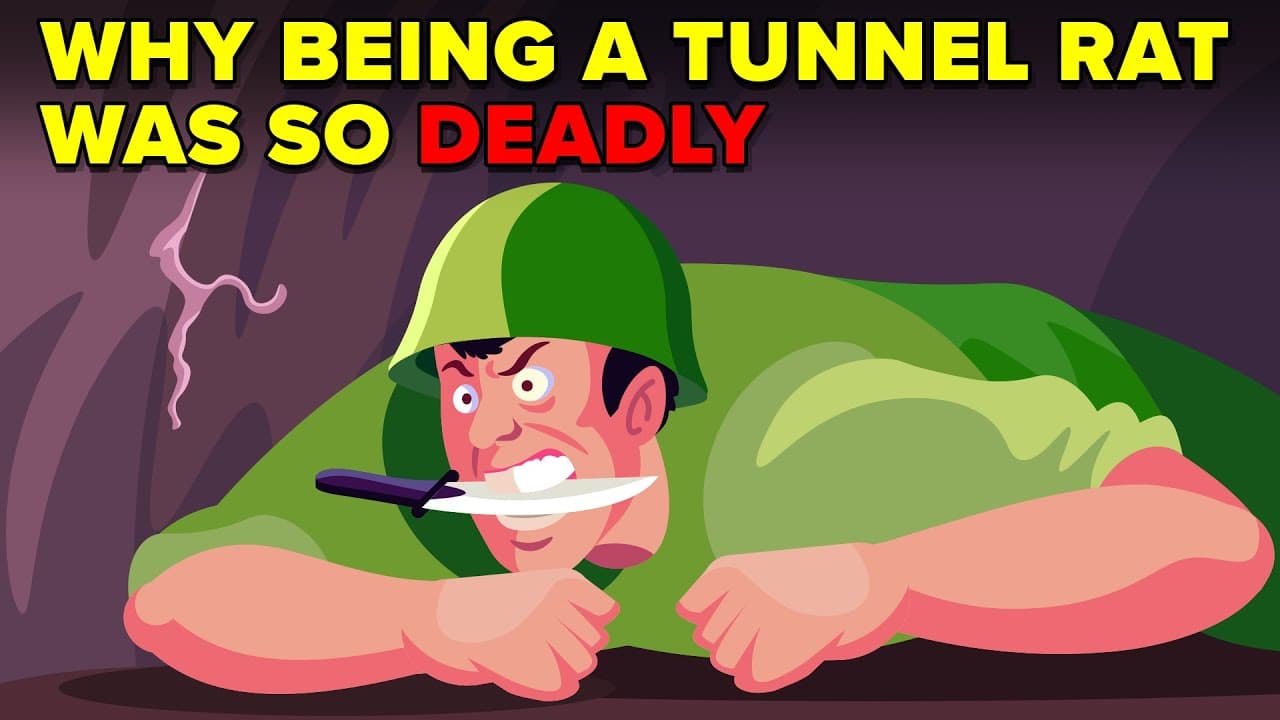
TL;DR
Tunnel rats faced extreme dangers in Vietnam's underground warfare.
Transcript
June 11, 1969, Ba Ria city, Vung Tau province, Vietnam. A newbie tunnel rat arrived at the base to a scene of utter destruction. Just days earlier a platoon was hit by a M16 mine, aka, the “Jumping jack.” It got that name for the way it jumped in the air when stepped on. It killed three men and injured 24 others. Not long after the hidden enemy lai... Read More
Key Insights
- The role of a tunnel rat was one of the most dangerous and challenging positions during the Vietnam War, requiring immense bravery and skill.
- Tunnel rats were tasked with infiltrating Viet Cong tunnels, which were used for hiding, planning attacks, and storing weapons, making them critical to enemy operations.
- The tunnels were filled with various threats, including venomous snakes, giant centipedes, and booby traps designed to kill or incapacitate intruders.
- Tunnel rats had to be small in stature to navigate the narrow tunnels and were typically armed with only a pistol, flashlight, knife, and explosives.
- The psychological stress of the job was immense, with soldiers having to confront the fear of being trapped, suffocated, or ambushed in the dark, confined spaces.
- Despite the dangers, some soldiers volunteered for the role to prove their toughness or because they felt they had something to prove.
- The Viet Cong's tunnel systems were ingeniously designed to withstand bombing, flooding, and gas attacks, demonstrating their resilience and strategic acumen.
- The high casualty rate among tunnel rats underscores the perilous nature of their mission, with only a small number surviving to share their experiences.
Install to Summarize YouTube Videos and Get Transcripts
Explore YouTube Video Summarizer or Get YouTube Transcript Extractor
Questions & Answers
Q: What were the main responsibilities of a tunnel rat during the Vietnam War?
Tunnel rats were responsible for infiltrating Viet Cong tunnel systems to neutralize enemy threats and gather intelligence. They had to navigate through narrow, dark tunnels, disarm booby traps, and engage in combat with enemy soldiers, all while facing the risk of suffocation, collapse, and animal attacks.
Q: What made the Viet Cong's tunnel systems so challenging to combat?
The Viet Cong's tunnel systems were ingeniously constructed to be blast-proof, flood-proof, and resistant to gas attacks. They featured zig-zag patterns to mitigate explosions and had ventilation systems allowing long-term habitation. These tunnels provided strategic advantages, making them difficult to destroy and allowing the Viet Cong to launch surprise attacks.
Q: Why did some soldiers volunteer to become tunnel rats despite the dangers?
Some soldiers volunteered to become tunnel rats to prove their toughness and bravery, often driven by a desire to demonstrate their worth or overcome personal challenges. The role was seen as a test of courage, and for some, it was an opportunity to distinguish themselves in the face of extreme adversity.
Q: What types of threats did tunnel rats face inside the tunnels?
Tunnel rats faced numerous threats inside the tunnels, including deadly booby traps, such as tripwires and Punji stakes, as well as venomous snakes, giant centipedes, and scorpions. The confined spaces also posed risks of suffocation, collapse, and ambush by enemy soldiers, adding to the psychological stress of the job.
Q: How did the Viet Cong use the tunnels to their advantage during the war?
The Viet Cong used the tunnels as operational bases for planning attacks, storing weapons, and providing shelter from aerial bombardments. The tunnels allowed them to move undetected, lay traps for enemy forces, and launch surprise attacks, making them a formidable component of their guerilla warfare strategy.
Q: What equipment did tunnel rats typically carry during their missions?
Tunnel rats typically carried minimal equipment due to the confined spaces. They were usually armed with a pistol, such as the M1911 or M1917 revolver, a flashlight, a knife, and explosives for destroying enemy supplies and tunnel sections. This limited gear was essential for maneuverability and quick responses to threats.
Q: What psychological effects did the role of a tunnel rat have on soldiers?
The role of a tunnel rat was psychologically taxing, as soldiers had to confront intense fear, claustrophobia, and the constant threat of death or injury. The stress of navigating dark, hostile environments and the unpredictability of enemy encounters contributed to mental strain and anxiety, affecting soldiers' long-term well-being.
Q: What was the impact of the tunnel rats' efforts on the overall outcome of the Vietnam War?
While tunnel rats played a crucial role in disrupting Viet Cong operations, their efforts were not sufficient to decisively alter the war's outcome. The resilience of the Viet Cong and their ability to rebuild and adapt their tunnel systems meant that the tunnel rats' successes were often short-lived, highlighting the challenges of countering guerilla warfare.
Summary & Key Takeaways
-
Tunnel rats played a crucial role during the Vietnam War, tasked with infiltrating and neutralizing the extensive tunnel systems used by the Viet Cong. These tunnels were not only strategic hiding spots but also served as operational bases for the enemy, posing significant challenges to American and Australian forces.
-
The perilous job of a tunnel rat involved navigating through dark, narrow tunnels filled with deadly traps and creatures. Armed with minimal equipment, these soldiers faced constant threats from booby traps, venomous snakes, and enemy combatants, all while operating in confined, suffocating conditions.
-
Despite the extreme dangers, many soldiers volunteered for the role of tunnel rat, driven by a desire to prove their courage and usefulness. The resilience of the Viet Cong's tunnel systems, however, made it difficult for American forces to gain a decisive advantage, highlighting the challenges of guerilla warfare.
Read in Other Languages (beta)
Share This Summary 📚
Summarize YouTube Videos and Get Video Transcripts with 1-Click
Try YouTube Summary with ChatGPT & Claude or YouTube Transcript Generator
Explore More Summaries from The Infographics Show 📚






Summarize YouTube Videos and Get Video Transcripts with 1-Click
Try YouTube Summary with ChatGPT & Claude or YouTube Transcript Generator