Lorentzian Classification: Machine Learning Driven TradingView Indicator
TL;DR
This video discusses a machine learning indicator called machine learning lorenzian distance classification and provides an overview of its theory, optimization, and backtesting using the trading view framework.
Transcript
hey everyone this is Justin and this is another video on a completely free and open source script that I published recently on trading view titled machine learning lorenzian distance classification this script was featured recently as one of the editors pick Publications in the platform and in the past few days it's actually been trending as the nu... Read More
Key Insights
- 🤓 This script has gained popularity on the trading view platform and has received a lot of questions and requests for a video explanation.
- 🤖 The script is based on a machine learning algorithm known as nearest neighbors, which is a simple and intuitive classification algorithm.
- 🌐 Nearest neighbors algorithm relies on measuring the distance between two points to determine similarity, with Euclidean distance being the default choice.
- ⚖️ The Euclidean distance algorithm works well in most cases, but it becomes inadequate when there are major events or anomalies in the financial time series, causing the distance to be warped.
- 📏 The Lorenzian distance algorithm, on the other hand, is more robust and performs well across a wide range of time series data sets, including financial time series.
- 🌟 By switching to the Lorenzian distance algorithm, the indicator can better handle the warping effect in price time continuum caused by major events.
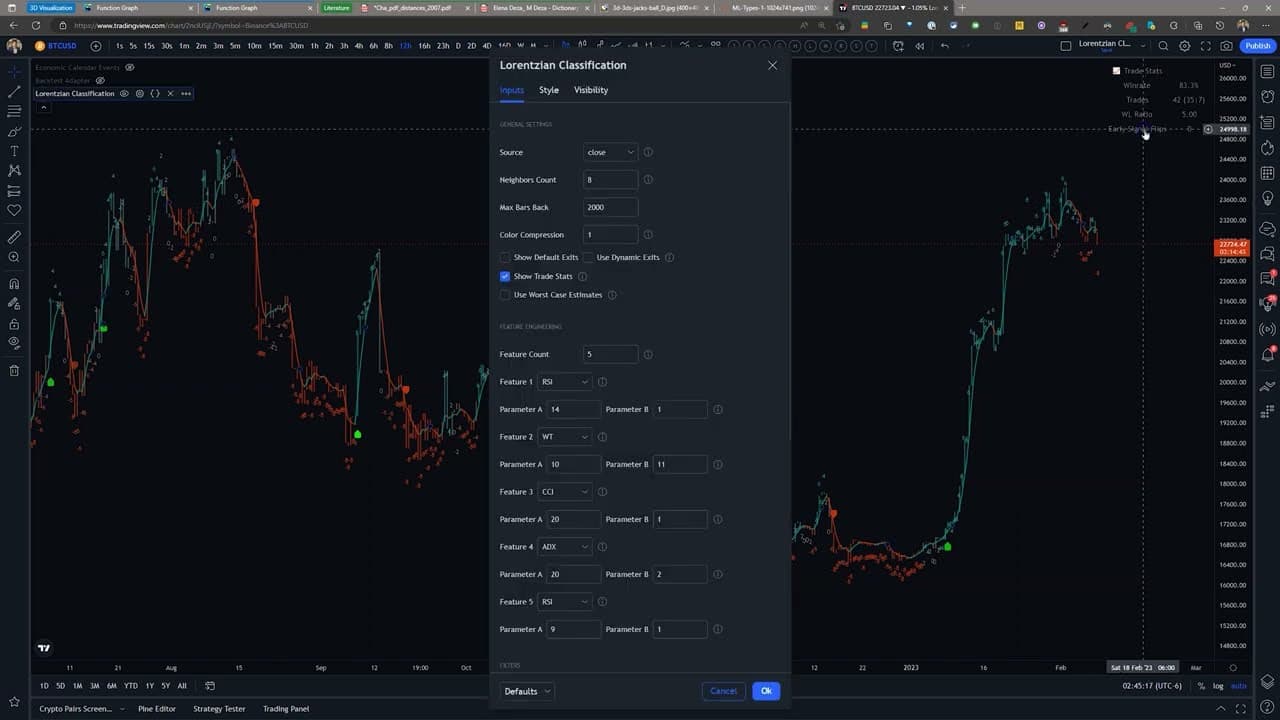
- 🔧 The indicator allows for customization and optimization, including adjusting feature engineering, applying filters, and changing kernel settings.
- 📊 The indicator can be backtested using TradingView's backtesting framework, providing valuable insights into performance and allowing for fine-tuning of settings.
Install to Summarize YouTube Videos and Get Transcripts
Explore YouTube Video Summarizer or Get YouTube Transcript Extractor
Questions & Answers
Q: What is the difference between supervised learning and regression in machine learning?
Supervised learning and regression are both types of machine learning algorithms, but they have different goals. Supervised learning aims to classify data into predefined categories, while regression aims to predict continuous values based on input variables. In the case of the machine learning lorenzian distance classification indicator, it uses supervised learning to classify price movements as either bullish or bearish based on historical data.
Q: Why is the euclidean distance algorithm inadequate for measuring similarity in financial time series?
The euclidean distance algorithm assumes a linear relationship between points, which may not hold true in financial time series due to significant events causing the data to deviate from normal patterns. The algorithm fails to account for the warping and buckling effect that occurs during these events, leading to inaccurate similarity measurements. The lorenzian distance algorithm addresses this issue by considering the warped nature of the price-time continuum and providing more accurate similarity measurements.
Q: How can the machine learning lorenzian distance classification indicator be optimized for different time frames?
The indicator can be optimized by adjusting various settings, such as the feature engineering section, which allows fine-tuning of different features used in the machine learning model. Starting with a smaller number of features and gradually expanding to include additional ones can help find the optimal combination. Additionally, the use of filters and kernel settings can further refine the indicator's performance based on specific requirements.
Q: How can the machine learning lorenzian distance classification indicator be backtested using the trading view framework?
To backtest the indicator, a back test adapter needs to be set up, which translates the indicator's settings to match the trading view's native backtesting framework. By selecting the back test stream as the source, users can leverage trading view's backtesting capabilities to evaluate the indicator's performance. It is recommended to use filters and analyze historical data to improve the accuracy of the backtest results.
Summary & Key Takeaways
-
The indicator is based on a nearest neighbors-based machine learning algorithm known as supervised learning, specifically a form of classification.
-
The video explains the limitations of the euclidean distance algorithm for measuring the similarity between points in financial time series and introduces the lorenzian distance algorithm as a more robust alternative.
-
The presenter demonstrates how to optimize the indicator's settings for different time frames and how to perform a proper backtest using the trading view framework.
Read in Other Languages (beta)
Share This Summary 📚
Summarize YouTube Videos and Get Video Transcripts with 1-Click
Try YouTube Summary with ChatGPT & Claude or YouTube Transcript Generator