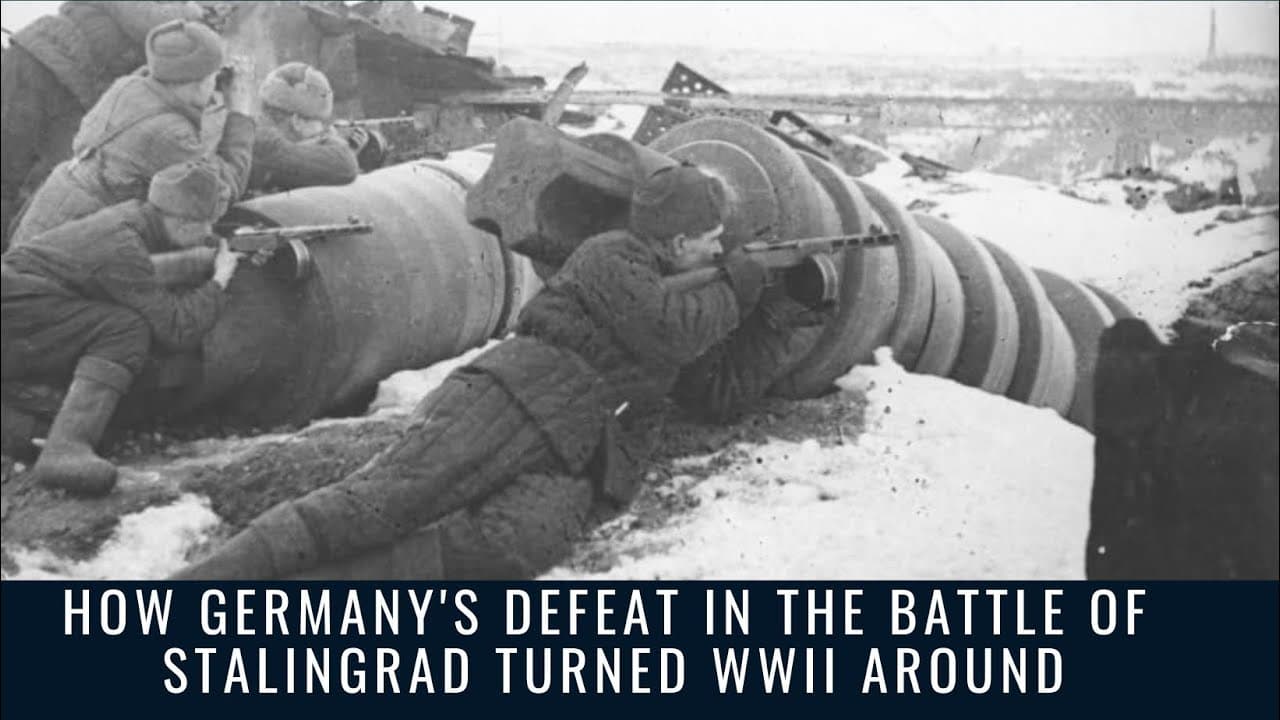
How Germany's Defeat in the Battle of Stalingrad Turned WWII Around
TL;DR
Stalingrad marked a pivotal defeat for Germany, shifting WWII dynamics.
Transcript
by early 1942 adolph hitler's dream of destroying the soviet union seemed closer to fulfillment jack-booted german soldiers had marched victoriously through the streets of the communist nation's major cities while their comrades laid siege to leningrad and threatened the capital of moscow then late that summer the nazi leader attack... Read More
Key Insights
- The Battle of Stalingrad was a turning point in WWII, marking Germany's first major defeat on the Eastern Front, significantly impacting the war's outcome.
- With nearly four million combatants, the Battle of Stalingrad was one of the largest and bloodiest battles in history, resulting in over one million Axis casualties.
- The Soviet Union's defense of Stalingrad became a source of national pride, showcasing their resilience in the face of overwhelming odds and brutal winter conditions.
- Hitler's decision to attack Stalingrad, against the advice of his commanders, diverted crucial resources and weakened Germany's southern offensive into the Caucasus.
- Operation Uranus, the Soviet counter-offensive, successfully encircled the German Sixth Army, leading to their eventual surrender and a significant strategic victory for the Allies.
- The defeat at Stalingrad was a psychological blow to Nazi Germany, with Hitler visibly shaken and the German public kept in the dark about the extent of the disaster.
- The United States' Lend-Lease program played a critical role in bolstering Soviet capabilities, with Soviet leaders acknowledging its importance in their victory.
- The Battle of Stalingrad set the stage for subsequent Soviet offensives, ultimately leading to the liberation of Eastern Europe and contributing to the Allied victory in WWII.
Install to Summarize YouTube Videos and Get Transcripts
Explore YouTube Video Summarizer or Get YouTube Transcript Extractor
Questions & Answers
Q: What was the significance of the Battle of Stalingrad in WWII?
The Battle of Stalingrad was significant as it marked the first major defeat for Nazi Germany on the Eastern Front. It was a pivotal turning point in WWII, shifting the momentum in favor of the Allies. The battle's outcome weakened Germany's military capabilities and morale, setting the stage for subsequent Soviet offensives and contributing to the eventual Allied victory.
Q: How did the Soviet Union manage to win the Battle of Stalingrad?
The Soviet Union's victory at Stalingrad was due to a combination of factors, including their strategic counter-offensive, Operation Uranus, which encircled the German Sixth Army. The Soviets capitalized on Germany's overextended supply lines and harsh winter conditions. Additionally, the resilience and determination of Soviet forces, coupled with crucial support from the U.S. Lend-Lease program, played a vital role in their success.
Q: What role did Hitler's decisions play in the outcome of the Battle of Stalingrad?
Hitler's decisions were pivotal in the outcome of the Battle of Stalingrad. Against his commanders' advice, he diverted resources to attack Stalingrad, weakening Germany's southern offensive. His refusal to allow the encircled Sixth Army to retreat or surrender led to their eventual defeat. These strategic missteps contributed significantly to the German loss at Stalingrad.
Q: How did the Battle of Stalingrad affect German morale and strategy?
The defeat at Stalingrad was a severe blow to German morale and strategy. It shattered the myth of German invincibility and exposed vulnerabilities in their military operations. The loss forced Germany onto the defensive on the Eastern Front, and the psychological impact was profound, with Hitler and the German public deeply affected by the scale of the defeat.
Q: What was Operation Uranus, and how did it impact the Battle of Stalingrad?
Operation Uranus was the Soviet counter-offensive launched on November 19, 1942, during the Battle of Stalingrad. It aimed to encircle and trap the German Sixth Army and their allies. The operation was successful, leading to the encirclement of 250,000 Axis soldiers, ultimately resulting in their surrender. This strategic victory was a turning point in the battle and the war.
Q: What were the human and material costs of the Battle of Stalingrad for Germany?
The Battle of Stalingrad was catastrophic for Germany, with over one million Axis casualties. The Germans lost 900 aircraft, 500 tanks, and 6,000 artillery pieces. The scale of the losses was impossible to recover from, given the Soviet Union's superior production capabilities. The human and material costs significantly weakened Germany's military strength and morale.
Q: How did the United States' Lend-Lease program aid the Soviet Union during the Battle of Stalingrad?
The United States' Lend-Lease program provided crucial support to the Soviet Union during the Battle of Stalingrad. It supplied the Soviets with essential resources, including food, vehicles, and equipment, bolstering their military capabilities. Soviet leaders, including Nikita Khrushchev, acknowledged that without this aid, the Soviet Union might not have been able to withstand Germany's onslaught and win the war.
Q: What were the broader implications of the Soviet victory at Stalingrad for WWII?
The Soviet victory at Stalingrad had broad implications for WWII. It marked the beginning of a series of Soviet offensives that pushed German forces back across Eastern Europe. The victory boosted Allied morale and demonstrated the effectiveness of Soviet military strategy. It also highlighted the importance of Allied cooperation, with the U.S. Lend-Lease program playing a key role in sustaining the Soviet war effort.
Summary & Key Takeaways
-
The Battle of Stalingrad was a critical turning point in World War II, marking Germany's first major defeat on the Eastern Front. The battle involved nearly four million combatants and resulted in over one million Axis casualties, significantly impacting the course of the war.
-
Hitler's decision to attack Stalingrad, against his commanders' advice, led to a strategic blunder that weakened Germany's southern offensive. The Soviet Union's successful defense and subsequent counter-offensive, Operation Uranus, resulted in the encirclement and surrender of the German Sixth Army.
-
The victory at Stalingrad bolstered Soviet morale and showcased their resilience. The battle's outcome was aided by the United States' Lend-Lease program, which provided crucial support to the Soviets. Stalingrad's defeat marked a psychological blow to Nazi Germany and set the stage for further Soviet advances.
Read in Other Languages (beta)
Share This Summary 📚
Summarize YouTube Videos and Get Video Transcripts with 1-Click
Try YouTube Summary with ChatGPT & Claude or YouTube Transcript Generator