10.5 Decay of a Pion
TL;DR
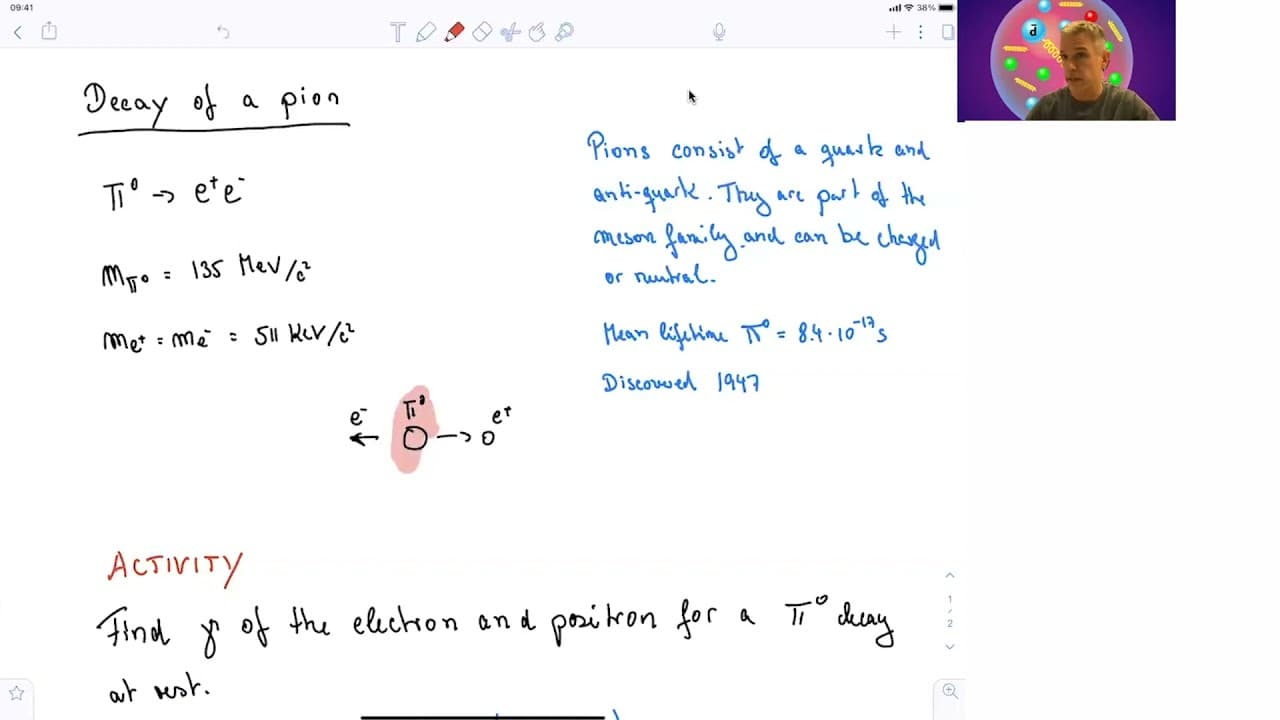
This video discusses the decay of a pion and focuses on the specific decay into an electron and a positron, using the energy-momentum relation in the rest frame of the pion.
Transcript
MARKUS KLUTE: Welcome back to 8.20, Special Relativity. In this section, we want to study the decay of a particle, in this case, the decay of a pion. The pion is a particle which consists of quarks and antiquarks, which are bound together by gluons. They're part of a family of particles which are called mesons. And they can be charged and neutral. ... Read More
Key Insights
- 😐 Pions are particles composed of quarks and antiquarks and can be charged or neutral.
- 😐 While neutral pions typically decay into a pair of photons, studying the decay into an electron and a positron provides an interesting example.
- 🧑🏭 The energy-momentum relation is a useful tool in determining the gamma factor and velocity of outgoing particles.
- 😣 By being in the rest frame of the pion, certain calculations can be simplified.
- 😐 The mass of a neutral pion is significantly larger than that of an electron.
- 💆 The gamma factor is found to be equal to the pion mass divided by 2 times the electron mass.
- 👶 The decay of a particle into two new particles offers insights into fundamental physics principles.
Install to Summarize YouTube Videos and Get Transcripts
Explore YouTube Video Summarizer or Get YouTube Transcript Extractor
Questions & Answers
Q: What is a pion and how is it composed?
Pions are meson particles consisting of quarks and antiquarks, bound together by gluons. They can be charged or neutral, with positively-charged, negatively-charged, and neutral pions.
Q: Why is the decay of a neutral pion into a pair of photons more common?
The majority of neutral pions decay into a pair of photons, which was discovered in the 1940s. However, studying the decay into an electron and a positron is more interesting for this example.
Q: How can the gamma factor of the electron or positron be determined?
By considering the energy and momentum of the pion and applying the energy relation, the gamma factor can be found to be equal to the pion mass divided by 2 times the electron mass.
Q: What is the significance of studying the decay of a particle into two new particles?
The decay of a particle into two new particles provides insight into the energy-momentum relation and allows for the determination of the velocity or gamma factor of the outgoing particles.
Summary & Key Takeaways
-
The video introduces the pion, a meson particle composed of quarks and antiquarks, which can be charged or neutral.
-
The decay of a neutral pion into a pair of photons is commonly observed, but the video explores the decay into an electron and a positron.
-
By utilizing the energy-momentum relation in the rest frame of the pion, the gamma factor and velocity of the outgoing particles can be determined.
Read in Other Languages (beta)
Share This Summary 📚
Summarize YouTube Videos and Get Video Transcripts with 1-Click
Try YouTube Summary with ChatGPT & Claude or YouTube Transcript Generator
Explore More Summaries from MIT OpenCourseWare 📚
Summarize YouTube Videos and Get Video Transcripts with 1-Click
Try YouTube Summary with ChatGPT & Claude or YouTube Transcript Generator