25. Introduction to Glassy Solids (Intro to Solid-State Chemistry)
TL;DR
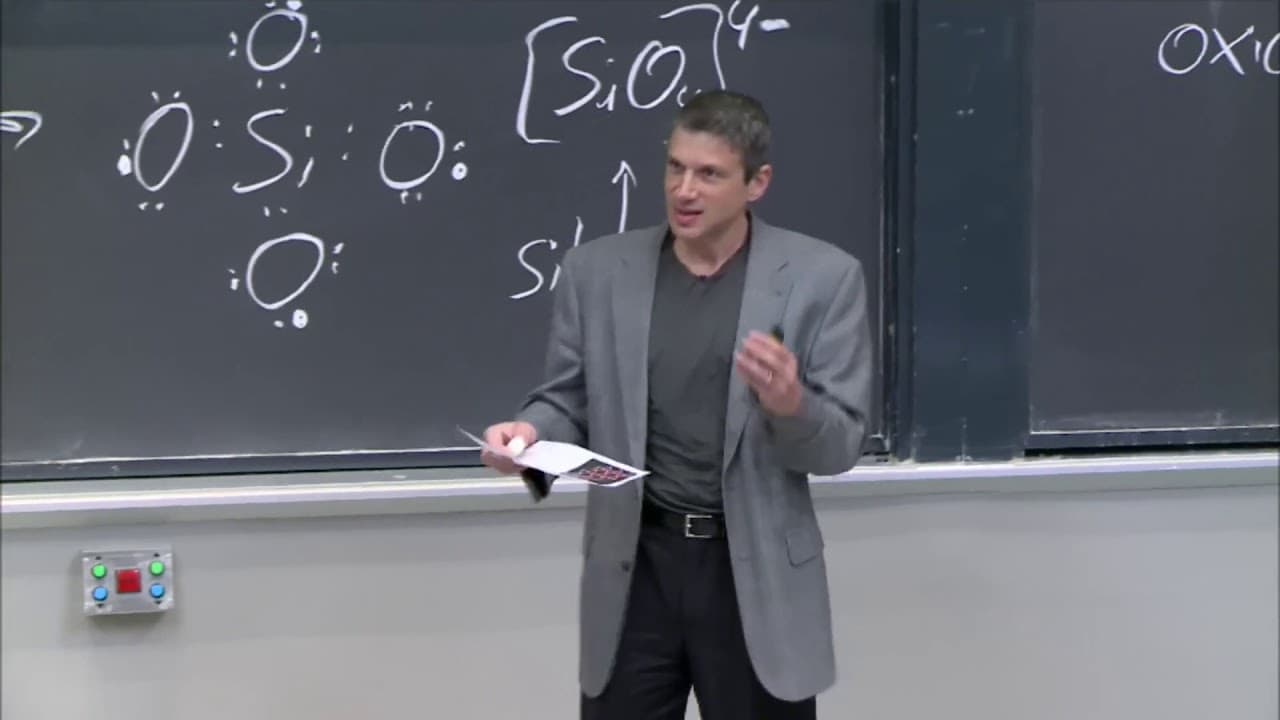
Glass is an amorphous solid formed through the cooling of a liquid, and its properties can be modified through the addition of elements that provide charged oxygen atoms.
Transcript
Today, we're going to just start by talking about what glass is and what its properties are. But before we do, this came in-- we've been talking about defects, OK. And vacancies, point defects, and then on Wednesday, we did line defects. Remember those? Right, and they create these planes that come in. They're slip planes that allow atoms to slide ... Read More
Key Insights
- 😎 Glass is an amorphous solid formed through the cooling of a liquid, with its properties depending on the cooling rate.
- 😎 The cooling rate affects the formation of glass, with slower rates leading to crystalline structures and faster rates favoring glass formation.
- 😎 The addition of elements, such as soda and lime, can modify the properties of glass by providing charged oxygen atoms.
- 😎 Charged oxygen atoms play a crucial role in cutting bonds within the glass structure and altering its properties.
Install to Summarize YouTube Videos and Get Transcripts
Explore YouTube Video Summarizer or Get YouTube Transcript Extractor
Questions & Answers
Q: What is the difference between glass and crystalline solids?
Glass is an amorphous solid with a disordered structure, while crystalline solids have a regular and long-range order.
Q: How does the cooling rate affect the formation of glass?
A faster cooling rate increases the likelihood of glass formation, as it prevents the silicate groups from finding lattice sites and forming a crystal structure.
Q: What elements are commonly added to glass to modify its properties?
Elements such as soda, lime, magnesia, and alumina are often added to glass to provide charged oxygen atoms, which can alter its properties.
Q: How does charged oxygen contribute to the modification of glass properties?
Charged oxygen atoms can cut the bonds within the glass structure, allowing for the modification of its properties, such as strength, transparency, and thermal expansion.
Summary & Key Takeaways
-
Glass is an amorphous solid that can be formed by cooling a liquid, and it can have various properties depending on the cooling rate.
-
The structure of glass is disordered and lacks long-range order, making it different from crystalline solids.
-
The formation and engineering of glass involve controlling the cooling rate and incorporating elements that provide charged oxygen atoms, which can modify its properties.
Read in Other Languages (beta)
Share This Summary 📚
Summarize YouTube Videos and Get Video Transcripts with 1-Click
Try YouTube Summary with ChatGPT & Claude or YouTube Transcript Generator
Explore More Summaries from MIT OpenCourseWare 📚



Summarize YouTube Videos and Get Video Transcripts with 1-Click
Try YouTube Summary with ChatGPT & Claude or YouTube Transcript Generator