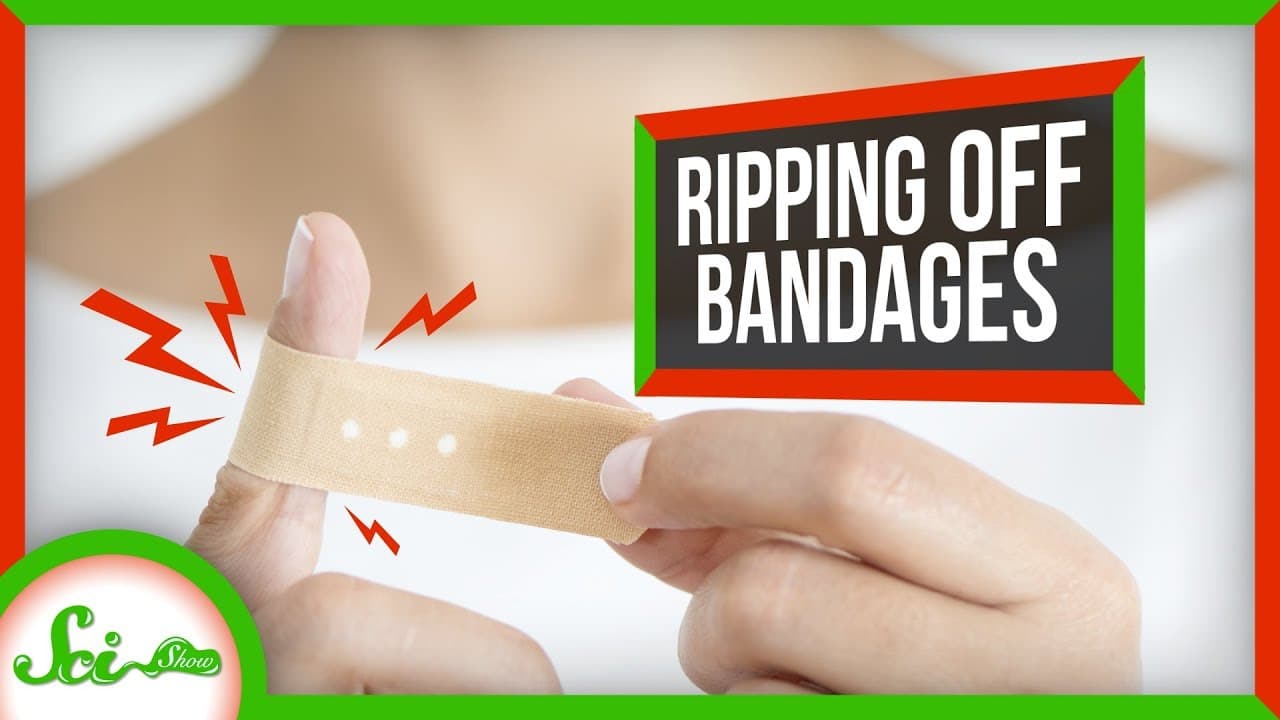
Does Ripping Off a Bandage Hurt Less?
TL;DR
One study suggests that quickly removing adhesive bandages is less painful than peeling them off slowly, but pain perception can be influenced by various factors.
Transcript
Thanks to Brilliant for supporting this whole week of SciShow! Go to Brilliantorg/SciShow to learn more. [ INTRO ] To peel slowly or just rip it off? Everyone has their opinions when it comes to taking off an adhesive bandage. Maybe you’re one of the people that falls in the just rip it! camp. Or maybe you like to carefully pull it back, so you don... Read More
Key Insights
- 🤕 Quickly removing bandages was associated with less pain than peeling them off slowly.
- 👩🎨 Women experienced less pain than men during bandage removal.
- 👱 Individuals with minimal body hair found slow removal to be more painful.
- 🧑🏭 Pain perception is subjective and influenced by factors like beliefs, culture, and gender.
- 🖤 Studying pain objectively is challenging due to its complex nature and the lack of effective measurement methods.
- 🧠 Brain imaging is being used to develop more quantitative measures of pain.
- 🤕 Objective measures of pain could potentially determine whether ripping off a bandage or peeling it slowly is more painful.
Install to Summarize YouTube Videos and Get Transcripts
Explore YouTube Video Summarizer or Get YouTube Transcript Extractor
Questions & Answers
Q: Is it less painful to quickly remove an adhesive bandage compared to peeling it off slowly?
According to a study, quick removal of bandages caused less pain, scoring an average of 0.92 compared to 1.58 for slow removal.
Q: Do factors like gender and body hair affect the pain experienced during bandage removal?
Yes, the study found that women experienced less pain than men, and individuals with less body hair found slow removal more painful.
Q: How does preconception about pain affect actual pain scores?
The study revealed that people's beliefs about which method would be more painful were reflected in their actual pain scores.
Q: Why is it difficult to study pain objectively?
Pain perception is influenced by various factors such as previous pain experiences, beliefs, culture, gender, and even body hair, making it challenging to study pain in an unbiased, scientific way.
Summary & Key Takeaways
-
A 2009 study found that quickly removing adhesive bandages caused less pain compared to peeling them off slowly.
-
Women experienced less pain than men, and individuals with minimal body hair found slow removal more painful.
-
Participants' preconceived notions about pain influenced their actual pain scores.
-
Studying pain objectively is challenging due to its subjective nature and the influence of various factors.
Read in Other Languages (beta)
Share This Summary 📚
Summarize YouTube Videos and Get Video Transcripts with 1-Click
Try YouTube Summary with ChatGPT & Claude or YouTube Transcript Generator
Explore More Summaries from SciShow 📚


Summarize YouTube Videos and Get Video Transcripts with 1-Click
Try YouTube Summary with ChatGPT & Claude or YouTube Transcript Generator