Surface Area of Solid of Revolution (about x-axis, formula explained)
TL;DR
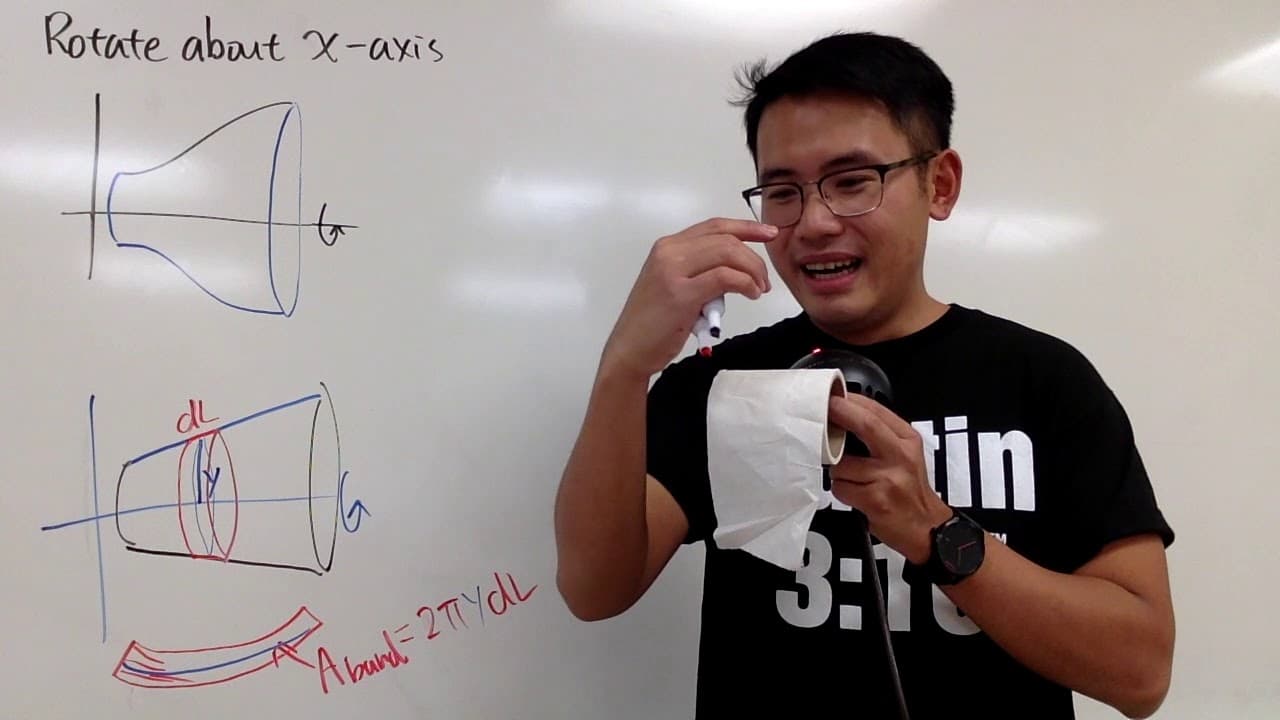
This video explains how to calculate the lateral area and surface area of rotated shapes, specifically cones, using integration and the concept of arc length.
Transcript
this has been curved up so it's like this and you have to rotate that you actually have to talk about the lateral area of a cone well just part of it all right in this video we can find them talk about the surface area well we're going to start with the following I just want to consider this portion of the curve and I will take that and rotate abou... Read More
Key Insights
- ☺️ Rotating a curve about the x-axis can help determine the lateral area of a cone.
- 🤕 The area of a band cut from a cone and unfolded can be used to find the lateral area.
- 🫠 The surface area of a rotated shape can be calculated using the arc length formula and integration, considering whether Y is a function of X or X is a function of Y.
Install to Summarize YouTube Videos and Get Transcripts
Explore YouTube Video Summarizer or Get YouTube Transcript Extractor
Questions & Answers
Q: How can the lateral area of a cone be calculated when it is rotated about the x-axis?
To calculate the lateral area of a cone when it is rotated about the x-axis, you need to consider a small portion of the curve, rotate it, and find the area of the resulting band. This can be done by multiplying the circumference (2πY) by the length (DL) of the band and integrating the result.
Q: What is the difference between calculating the lateral area of a straight cylinder and a curved cone?
The main difference lies in the shape of the curve. In the case of a straight cylinder, the lateral area can be found by rotating a horizontal line. However, for a curved cone, the curve needs to be considered, and the lateral area is just a part of it. Integration is still used to calculate the area by multiplying the circumference (2πY) by the length (DL) of the band.
Q: How does the concept of arc length play a role in finding the surface area of rotated shapes?
The concept of arc length is essential in finding the surface area of rotated shapes. The arc length formula is used to calculate the DL (change in arc length) in the equations for lateral area and surface area. In the integration process, the formula is modified based on whether Y is a function of X or X is a function of Y in order to obtain the correct DL term.
Q: What is the process for calculating the surface area of a rotated shape?
To calculate the surface area of a rotated shape, such as a cone, integration is used. Depending on whether Y is a function of X or X is a function of Y, the appropriate version of the arc length formula is applied. The formula involves squaring the derivative term (dy/dx or dx/dy) and multiplying it with 1 plus the square of the derivative, which is then integrated along with the circumference (2πY) of the shape.
Summary & Key Takeaways
-
The video discusses the concept of rotating a curve about the x-axis to find the lateral area of a cone.
-
It explains how to calculate the area of a band after cutting and unfolding it from the cone shape.
-
The surface area of the rotated shape is found by integrating the arc length formula with respect to either x or y, depending on the situation.
Read in Other Languages (beta)
Share This Summary 📚
Summarize YouTube Videos and Get Video Transcripts with 1-Click
Try YouTube Summary with ChatGPT & Claude or YouTube Transcript Generator
Explore More Summaries from blackpenredpen 📚
Summarize YouTube Videos and Get Video Transcripts with 1-Click
Try YouTube Summary with ChatGPT & Claude or YouTube Transcript Generator