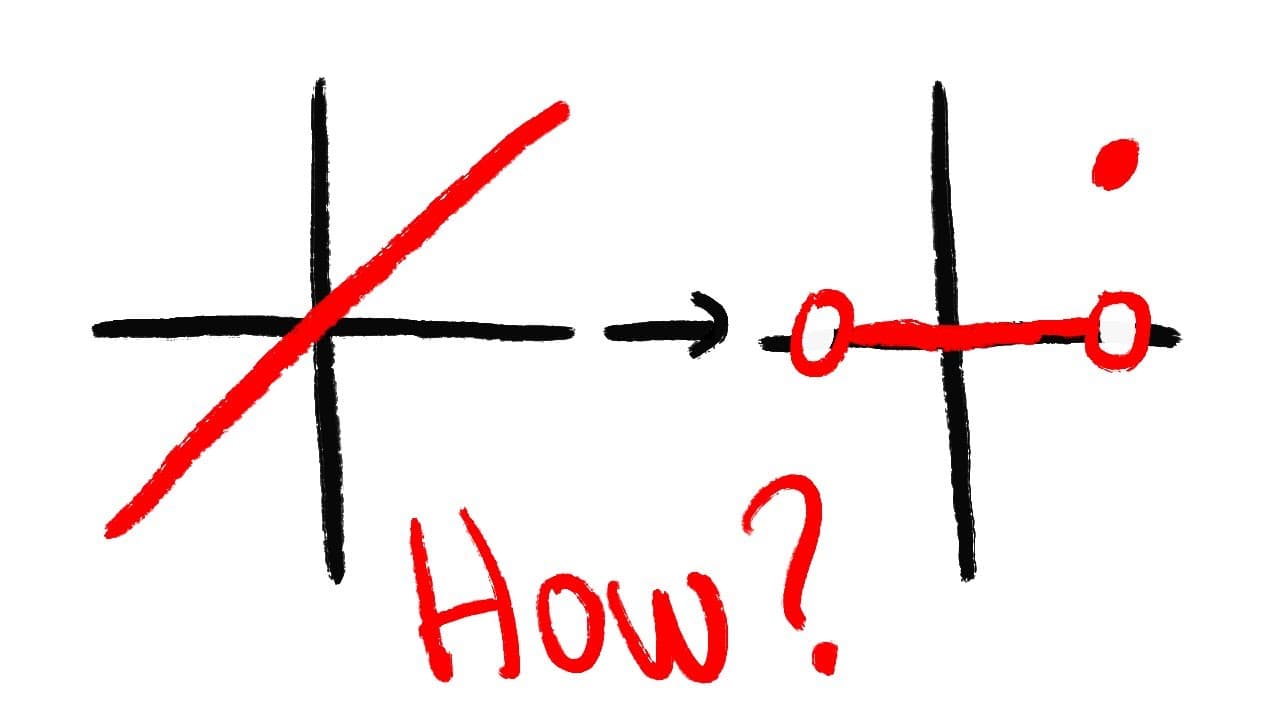
limit of a sequence of continuous functions, need not to be continuous
TL;DR
When multiplying infinitely many continuous functions, the result may not be continuous.
Transcript
before we start on the forget about putting that work he is a wonderful place for you gets to go if you are interested to learn about how to solve interesting and challenging math questions and I often call the earth to grab information or maybe lesson ideas for you guys because they have this community page where people around the world ... Read More
Key Insights
- ✖️ Multiplying infinitely many continuous functions may result in a function that is not continuous.
- ✊ The behavior of the output depends on the parity of the power of the function.
- ✊ The output is consistent when the powers are odd and alternates between 1 and -1 when the powers are even.
- ✊ When X is exactly 1, the output is always 1, regardless of the power of the function.
- 🥡 The limiting function, obtained by taking the limit as the number of functions approaches infinity, is discontinuous at -1 and 1.
- ☺️ The limiting function is defined as f(X) = 0 for X between -1 and 1, and f(X) = 1 for X = 1.
- 🧡 Outside of the specified range, the limiting function is considered to diverge.
Install to Summarize YouTube Videos and Get Transcripts
Explore YouTube Video Summarizer or Get YouTube Transcript Extractor
Questions & Answers
Q: What happens when you multiply infinitely many continuous functions?
When multiplying infinitely many continuous functions, the resulting function may not be continuous. This is illustrated by the function f(X) = X^n, where n is a positive whole number.
Q: How does the output of the functions behave when the powers are odd?
When the powers of the functions are odd, the output remains consistent. For example, when X = 1, the output is always 1. When X = -1, the output is -1 if the power is odd, and 1 if the power is even.
Q: What happens to the output of the functions when X is exactly 1?
When X is exactly 1, the output of the functions is always 1, regardless of the power of the function. This is because raising 1 to any power results in 1.
Q: Does the concept of infinity affect the continuity of these functions?
Yes, when taking the limit as the number of functions approaches infinity, the resulting limiting function is no longer continuous. This can be seen from the graph, where sharp discontinuities occur at the points -1 and 1.
Summary & Key Takeaways
-
The video discusses the concept of multiplying infinitely many continuous functions and how the results may not always be continuous.
-
The speaker defines a sequence of functions (f1, f2, f3, f4) and graphs them.
-
It is shown that when the powers of the functions are odd, the output is consistent (e.g., 1 to the 1st power, 1 to the 3rd power, etc.). However, when the powers are even, the output alternates between 1 and -1.
Read in Other Languages (beta)
Share This Summary 📚
Summarize YouTube Videos and Get Video Transcripts with 1-Click
Try YouTube Summary with ChatGPT & Claude or YouTube Transcript Generator
Explore More Summaries from blackpenredpen 📚

Summarize YouTube Videos and Get Video Transcripts with 1-Click
Try YouTube Summary with ChatGPT & Claude or YouTube Transcript Generator