flip flops | Characteristic equations | STLD | Lec-121
TL;DR
This video explains how to derive characteristic equations for various flip flops.
Transcript
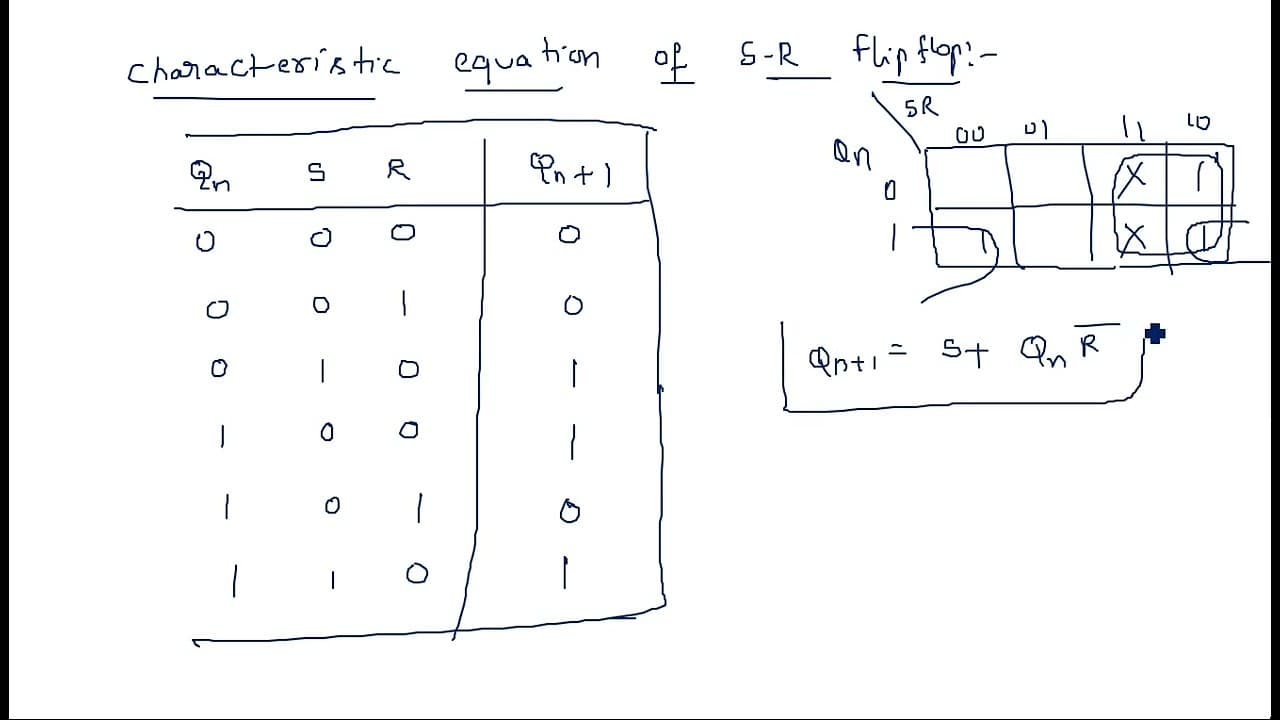
hi everyone in this video I'm going to explain how to obtain the characteristic equations of the flip flops so characteristic equation is nothing but based on the input and previous conditions previous output condition we are going to obtain the equation for the next state so characteristic equation characteristic equation determines the next state... Read More
Key Insights
- 🐬 The characteristic equations of flip flops determine the output based on current inputs and previous states, crucial for function in digital circuits.
- 🔠 The SR flip flop is sensitive to its input states, producing an indeterminate output when both inputs are high.
- 🐬 The JK flip flop introduces toggling behavior, allowing for more dynamic state changes in digital systems compared to the SR flip flop.
- 🐬 D flip flops provide predictable outputs, making them preferable for data storage without complications of indeterminate states.
- 🎨 T flip flops serve well in applications requiring toggling functionality, simplifying circuit design for state transitions.
- 😑 Utilizing Karnaugh maps can simplify the derivation of complex logic expressions, making circuit design more efficient.
- 🐬 Understanding the characteristic equations assists in switching between flip flop types based on application needs, facilitating versatile circuit usage.
Install to Summarize YouTube Videos and Get Transcripts
Explore YouTube Video Summarizer or Get YouTube Transcript Extractor
Questions & Answers
Q: What is a characteristic equation, and why is it important for flip flops?
A characteristic equation describes the next state of a flip flop based on its current state and inputs. It is crucial for understanding how flip flops will behave in digital circuits, helping engineers design reliable systems by predicting state changes in response to inputs.
Q: How many types of flip flops are discussed in the video?
The video discusses four types of flip flops: SR (Set-Reset), JK, D (Data), and T (Toggle). Each flip flop has unique functionality and characteristic equations derived from its input and output relationships.
Q: Can you explain the characteristic equation for the D flip flop?
The characteristic equation for the D flip flop is qn + 1 = D. This indicates that the next state is equal to the current input state, making it a straightforward option for ensuring predictable behavior in digital circuits without indeterminate states.
Q: How does the JK flip flop differ from the SR flip flop?
Unlike the SR flip flop, which can reach an indeterminate state (both inputs high), the JK flip flop toggles the output when both inputs are high, creating a more flexible state transition. Its characteristic equation reflects this toggle behavior.
Q: What role do Karnaugh maps play in deriving characteristic equations?
Karnaugh maps assist in simplifying Boolean expressions by visually grouping states, making it easier to derive characteristic equations for flip flops. They help identify patterns in input-output relationships, which streamlines the design process.
Q: Why is it impossible to have a stable state for both inputs at 1 in the SR flip flop?
In the SR flip flop, when both inputs S and R are high (1), it leads to an indeterminate state. This situation cannot be resolved, hence the design avoids this configuration to maintain reliable output behavior.
Q: How does the T flip flop's characteristic equation differ from the D flip flop's?
The T flip flop's characteristic equation is qn + 1 = T qn' + T' qn, meaning its next state depends on the current state and the toggle input. This makes it more versatile than the D flip flop, which simply mirrors its input.
Summary & Key Takeaways
-
The video discusses the characteristic equations of four main types of flip flops: SR, JK, D, and T, each defined by their input-output relationships.
-
It explains how the characteristic equations are derived using truth tables and Karnaugh maps (K maps) and highlights the essential inputs for each flip flop type.
-
Finally, the video emphasizes the usefulness of these equations in transitioning between different flip flop types for circuit design and analysis.
Read in Other Languages (beta)
Share This Summary 📚
Summarize YouTube Videos and Get Video Transcripts with 1-Click
Try YouTube Summary with ChatGPT & Claude or YouTube Transcript Generator