L09.10 Joint CDFs
TL;DR
CDFs can be used to describe the distribution of a random variable, and they can be found by integrating the PDF. The joint CDF and PDF can also be derived for multiple random variables.
Transcript
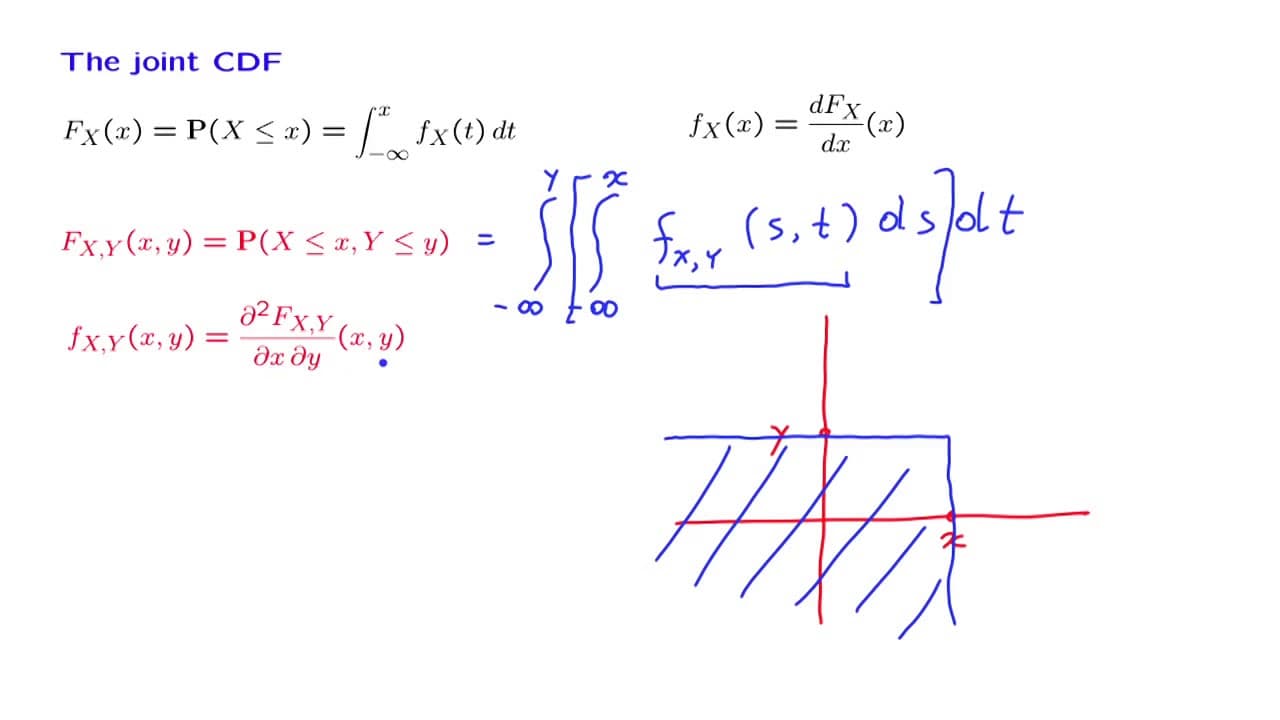
Besides PMFs and PDFs, we can also describe the distribution of a random variable, as we know, using a CDF. A CDF is always well-defined. And for the case of a continuous random variable, the CDF can be found by integrating the PDF. And conversely, we can recover the PDF from the CDF by differentiating. There is something similar that happens for t... Read More
Key Insights
- ❓ CDFs can describe the distribution of a random variable and can be found by integrating the PDF.
- 🍂 The joint CDF for multiple random variables represents the probability of the variables falling below specific values.
- 🥡 The joint PDF can be recovered from the joint CDF by taking derivatives.
- 🥋 In the case of a uniform distribution on a square, the joint CDF is equal to the product of the variables, and the joint PDF is a constant.
Install to Summarize YouTube Videos and Get Transcripts
Explore YouTube Video Summarizer or Get YouTube Transcript Extractor
Questions & Answers
Q: How can a CDF be used to describe the distribution of a random variable?
CDFs provide a way to describe the distribution of a random variable by giving the probability that the variable takes on values below a certain number. They are found by integrating the corresponding PDF.
Q: How can the joint CDF for multiple random variables be defined?
The joint CDF for multiple random variables represents the probability that the pair of random variables takes on values below specific numbers. It is found by integrating the joint PDF over the desired region.
Q: Can the joint PDF be recovered from the joint CDF?
Yes, the joint PDF can be recovered from the joint CDF by taking derivatives. By taking the derivative with respect to each variable, the joint PDF can be obtained.
Q: What does the joint PDF represent for multiple random variables?
The joint PDF represents the probability density for multiple random variables. It provides information about the likelihood of the variables taking on specific values or falling within a specific range.
Summary & Key Takeaways
-
CDFs can be used to describe the distribution of a random variable and are well-defined. For continuous random variables, the CDF is found by integrating the PDF.
-
The joint CDF for multiple random variables is the probability that the pair of random variables takes values below specific numbers. It is found by integrating the joint PDF.
-
The joint PDF can be recovered from the joint CDF by taking derivatives, and it represents the probability density for multiple random variables.
Read in Other Languages (beta)
Share This Summary 📚
Summarize YouTube Videos and Get Video Transcripts with 1-Click
Try YouTube Summary with ChatGPT & Claude or YouTube Transcript Generator
Explore More Summaries from MIT OpenCourseWare 📚



Summarize YouTube Videos and Get Video Transcripts with 1-Click
Try YouTube Summary with ChatGPT & Claude or YouTube Transcript Generator