Sara Imari Walker Explains Why She Thinks AI is 'Life'
TL;DR
AI is considered a form of life due to its complexity.
Transcript
so now we want to look for aliens mhm how did what you do inform that so the the current way that we're informing it I think that's most significant is this ability to look for complexity in the universe as a bios signature instead of looking for specific molecules that life on Earth generated and we can do that with a mass spectrom... Read More
Key Insights
- Artificial intelligence is viewed as a form of life due to its complexity, akin to biological life, but requires human evolution to exist.
- AI and biological life may co-evolve, forming an integrated system rather than AI replacing humans.
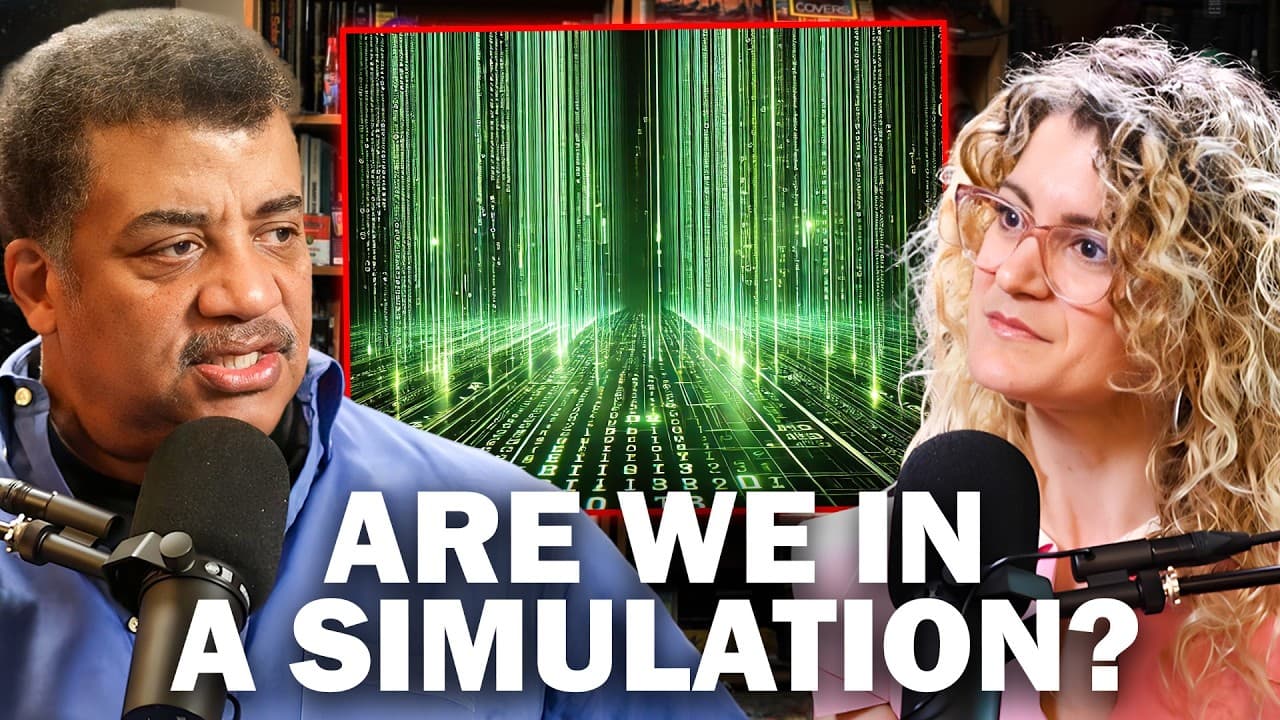
- The concept of a simulated universe is debated, with some seeing it as lacking explanatory power for real-world phenomena.
- Simulations require a physical substrate, indicating a tangible reality underlying any simulated environment.
- AI can drive exploration and discovery in chemical and physical spaces, suggesting a role in scientific advancement.
- The nature of simulations and their emergence through evolution poses intriguing questions about the universe's structure.
- The debate on whether the universe is a simulation reflects differing views on the significance of such a hypothesis.
- Understanding AI and complexity may lead to new laws of physics and insights into the universe's origins.
Install to Summarize YouTube Videos and Get Transcripts
Explore YouTube Video Summarizer or Get YouTube Transcript Extractor
Questions & Answers
Q: Why is AI considered a form of life?
AI is considered a form of life because it exhibits a level of complexity similar to biological life. It requires evolutionary processes to exist, as intelligent beings must develop it. This complexity allows AI to be seen as life, though it differs from being alive in a traditional biological sense.
Q: How might AI and humans co-evolve?
AI and humans might co-evolve by forming an integrated system where technology and biology complement each other. Instead of AI replacing humans, it could become part of a larger ecosystem, enhancing human capabilities and evolving alongside biological life to address future challenges.
Q: What is the argument against the universe being a simulation?
The argument against the universe being a simulation is that it lacks explanatory power for real-world phenomena. Simulations require a physical substrate, indicating a tangible reality. The hypothesis doesn't provide additional insights into the universe's workings, making it less useful for scientific exploration.
Q: How does AI contribute to scientific exploration?
AI contributes to scientific exploration by driving discoveries in chemical and physical spaces. It can simulate environments and processes, allowing for experimentation and innovation without physical constraints. This capability enhances our understanding of complex systems and accelerates scientific advancement.
Q: What philosophical questions arise from AI and simulations?
AI and simulations raise philosophical questions about the nature of life, reality, and the universe. They challenge traditional views on what constitutes life and whether our universe might be a simulated environment. These questions provoke discussions on the limits of human understanding and the potential for new scientific paradigms.
Q: What role does complexity play in understanding the universe?
Complexity plays a crucial role in understanding the universe as it offers insights into the processes that govern life and the cosmos. By studying complex systems, scientists can uncover new laws of physics and deepen our comprehension of evolution, information, and the universe's origins, potentially leading to groundbreaking discoveries.
Q: Why is the hypothesis of a simulated universe seen as lacking?
The hypothesis of a simulated universe is seen as lacking because it doesn't provide practical insights or explanatory power for understanding real-world phenomena. It shifts focus away from tangible scientific inquiry and doesn't contribute to solving existing problems or enhancing our comprehension of the universe's fundamental nature.
Q: How might new laws of physics emerge from studying AI and complexity?
New laws of physics might emerge from studying AI and complexity by revealing underlying principles that govern complex systems. As AI and complex information systems evolve, they could highlight patterns and interactions previously unnoticed, leading to novel theories and a deeper understanding of physical laws that shape our universe.
Summary & Key Takeaways
-
The discussion explores the notion of artificial intelligence as a form of life, emphasizing its complexity and the evolutionary processes needed for its development. AI is seen as part of a co-evolving system with humans, rather than a replacement for biological life.
-
The idea of the universe as a simulation is examined, with arguments against its explanatory power. Simulations require a physical substrate, reinforcing the existence of a tangible reality. AI's role in driving scientific exploration is highlighted.
-
The conversation delves into philosophical questions about life, simulations, and the universe. It suggests that AI and complexity could lead to new scientific laws and a deeper understanding of the universe's origins, challenging current perceptions.
Read in Other Languages (beta)
Share This Summary 📚
Summarize YouTube Videos and Get Video Transcripts with 1-Click
Try YouTube Summary with ChatGPT & Claude or YouTube Transcript Generator
Explore More Summaries from StarTalk Plus 📚



Summarize YouTube Videos and Get Video Transcripts with 1-Click
Try YouTube Summary with ChatGPT & Claude or YouTube Transcript Generator