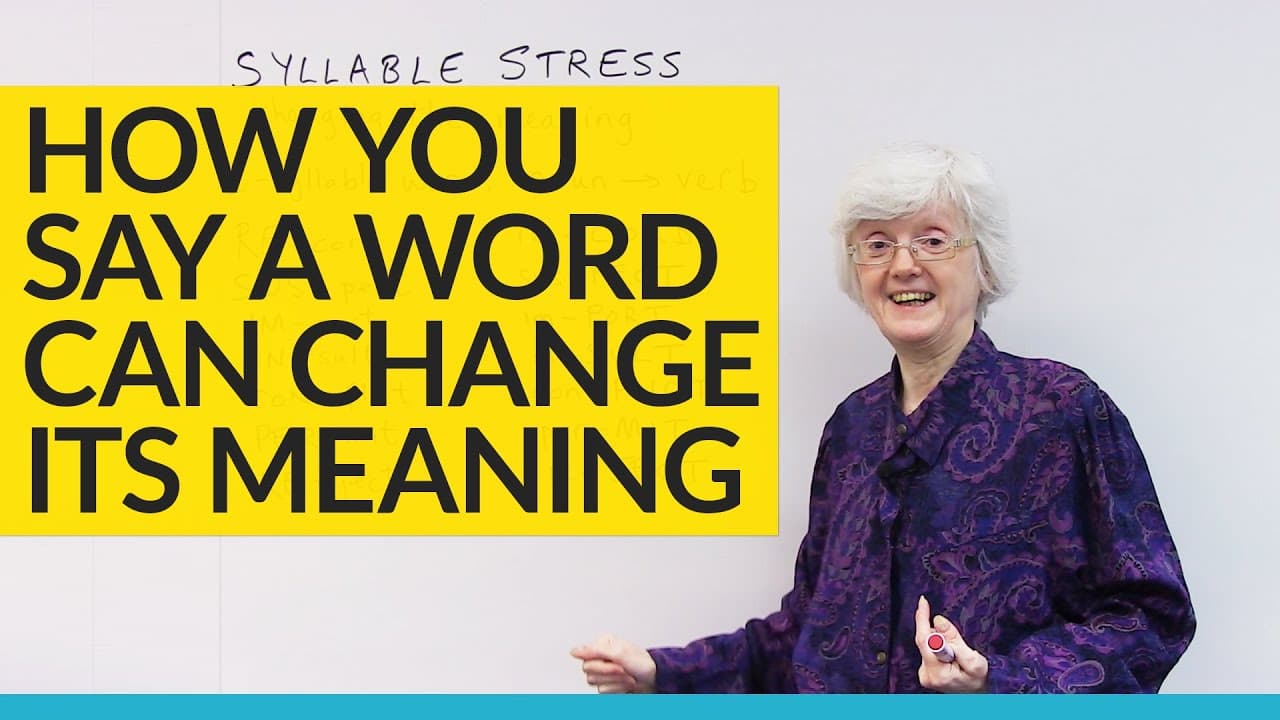
Change word meanings with SYLLABLE STRESS
TL;DR
This video explains how changing the stress on different syllables in English words can change the word's meaning, using examples of noun-to-verb transformations and words with completely different meanings.
Transcript
Hello. This is Gill at www.engvid.com, and today, we're going to be having a look at a very interesting aspect of the English language: What happens with some words if you stress a different syllable. Okay? This is quite important, because sometimes the change of stress just changes a noun to a verb, or a verb to a noun, but there are some other wo... Read More
Key Insights
- 💱 Changing the stress in two-syllable words can change them from nouns to verbs.
- 🔑 Some words have completely different meanings when the stress is shifted.
- 😯 Stressing different syllables can also result in different meanings without changing the part of speech.
Install to Summarize YouTube Videos and Get Transcripts
Explore YouTube Video Summarizer or Get YouTube Transcript Extractor
Questions & Answers
Q: How does changing the stress in a word affect its meaning?
Changing the stress in a word can change its part of speech or result in completely different meanings. It's important to stress the correct syllable to convey the intended meaning.
Q: Can you provide more examples of noun-to-verb transformations?
Yes, some examples include "IM-port" (noun) and "im-PORT" (verb), as well as "REF-use" (noun) and "re-FUSE" (verb). In both cases, changing the stress changes the word's part of speech.
Q: Are there any words where changing the stress doesn't change the part of speech?
Yes, an example is "EN-trance" (noun), which refers to an entryway, and "en-TRANCE" (verb), which means to captivate or mesmerize someone. The part of speech remains the same, but the meanings differ.
Q: How can I learn more about these word stress patterns?
The video mentions a resource document on the engvid.com website that provides further explanations and a quiz to test your understanding of word stress patterns.
Summary & Key Takeaways
-
Changing the stress in two-syllable words can change them from nouns to verbs, such as "RE-cord" (noun) and "re-CORD" (verb).
-
Some words have completely different meanings depending on the stress, like "SUS-pect" (noun) and "sus-PECT" (verb).
-
The video also covers words where changing the stress doesn't change the part of speech, but still results in different meanings, like "CON-tent" (noun) and "con-TENT" (adjective).
Read in Other Languages (beta)
Share This Summary 📚
Summarize YouTube Videos and Get Video Transcripts with 1-Click
Try YouTube Summary with ChatGPT & Claude or YouTube Transcript Generator
Explore More Summaries from Learn English with Gill · engVid 📚





Summarize YouTube Videos and Get Video Transcripts with 1-Click
Try YouTube Summary with ChatGPT & Claude or YouTube Transcript Generator