What Is Relative Density in Soil Classification?
TL;DR
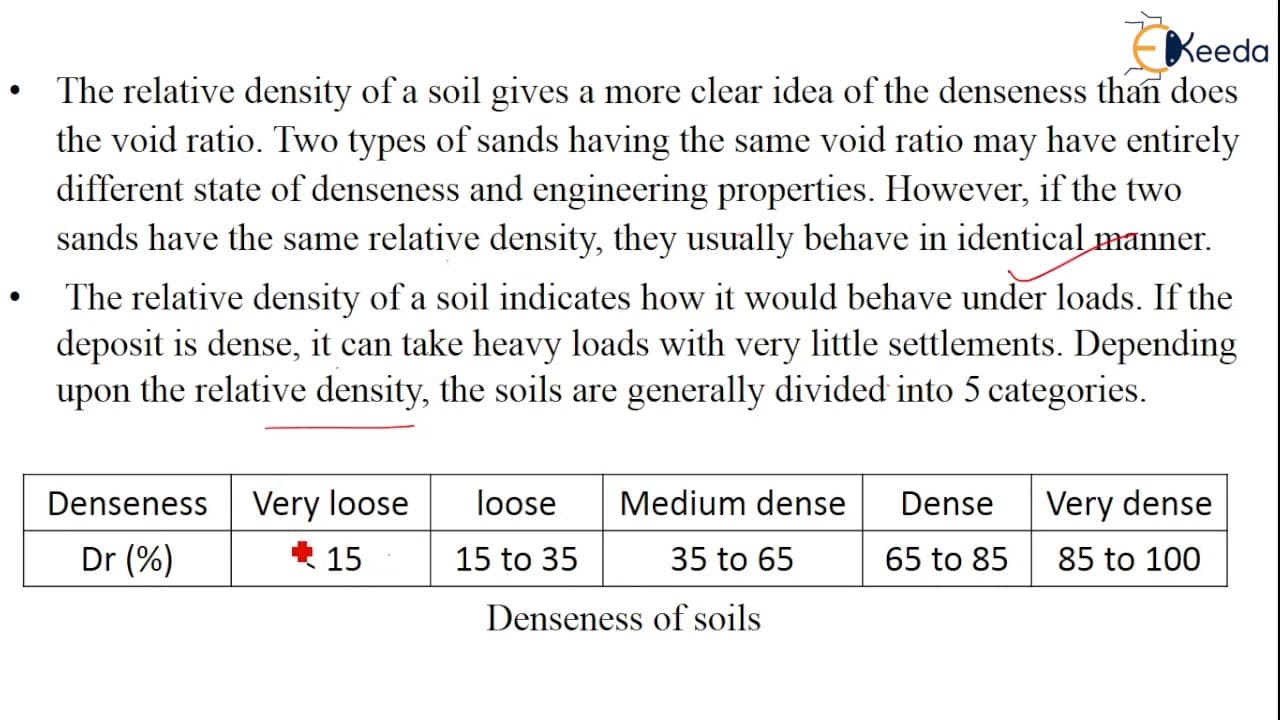
Relative density is a key property of cohesionless soil that indicates its denseness and behavior under loads. It classifies soil into five categories: very loose (0-15), loose (15-35), medium dense (35-65), dense (65-85), and very dense (85-100), affecting how well it can support structures. Understanding relative density helps predict soil performance and settlement under weight.
Transcript
hello students today we are going to learn about the next topic in the chapter 3 that is classification of soils what is next topic it is related to the relative density what do mean by relative density this property is very important index aggregate property of a cohesionless soil so this property is known as relative density so the engineering pr... Read More
Key Insights
- 🎨 The relative density of soil is a crucial property that affects its engineering behavior and design considerations.
- 🥳 Two sands with the same void ratio can have different denseness and engineering properties if their relative density differs.
- 🧡 Soil is categorized into five classes based on relative density, ranging from very loose to very dense.
- 😑 The mathematical expression for relative density involves the maximum and minimum void ratios.
- ❓ Determination of relative density involves measuring the maximum and minimum dry densities using various methods.
- ❣️ A dense deposit of soil can withstand heavy loads with minimal settlements, making it ideal for engineering structures.
- ❓ Loose deposits of soil may experience significant settlements under loads, affecting the stability and performance of structures.
Install to Summarize YouTube Videos and Get Transcripts
Explore YouTube Video Summarizer or Get YouTube Transcript Extractor
Questions & Answers
Q: What is relative density and why is it important in soil classification?
Relative density is an index property that measures the denseness of soil and determines its engineering behavior under loads. It categorizes soils into different classes based on their relative density values, which aids in understanding their behavior and design considerations.
Q: How is relative density mathematically expressed?
Relative density (dr) is mathematically expressed as dr = (emax - e) / (emax - emin) * 100, where emax is the maximum void ratio in the loosest condition, e is the void ratio in the natural state, and emin is the minimum void ratio in the densest condition.
Q: How does relative density affect the behavior of soil under loads?
The relative density of soil indicates how it would behave under certain loads. A dense deposit can withstand heavy loads with minimal settlements, making it advantageous for engineering structures. On the other hand, loose deposits may experience significant settlements under loads.
Q: How is the relative density of soil determined?
The relative density of soil can be determined using equations and methods for measuring the maximum and minimum dry densities. The minimum dry density is determined by pouring dry soil in a mold, while the maximum dry density is determined either by a dry method (using a vibrator deck) or a wet method (adding water and removing free water).
Summary & Key Takeaways
-
Relative density is a crucial index aggregate property of cohesionless soil and determines its engineering properties.
-
Two sands with the same void ratio can have different states of denseness and engineering properties if their relative density differs.
-
The relative density of soil categorizes it into very loose, loose, medium dense, dense, and very dense based on a scale of 0 to 100.
Read in Other Languages (beta)
Share This Summary 📚
Summarize YouTube Videos and Get Video Transcripts with 1-Click
Try YouTube Summary with ChatGPT & Claude or YouTube Transcript Generator
Explore More Summaries from Ekeeda 📚


Summarize YouTube Videos and Get Video Transcripts with 1-Click
Try YouTube Summary with ChatGPT & Claude or YouTube Transcript Generator