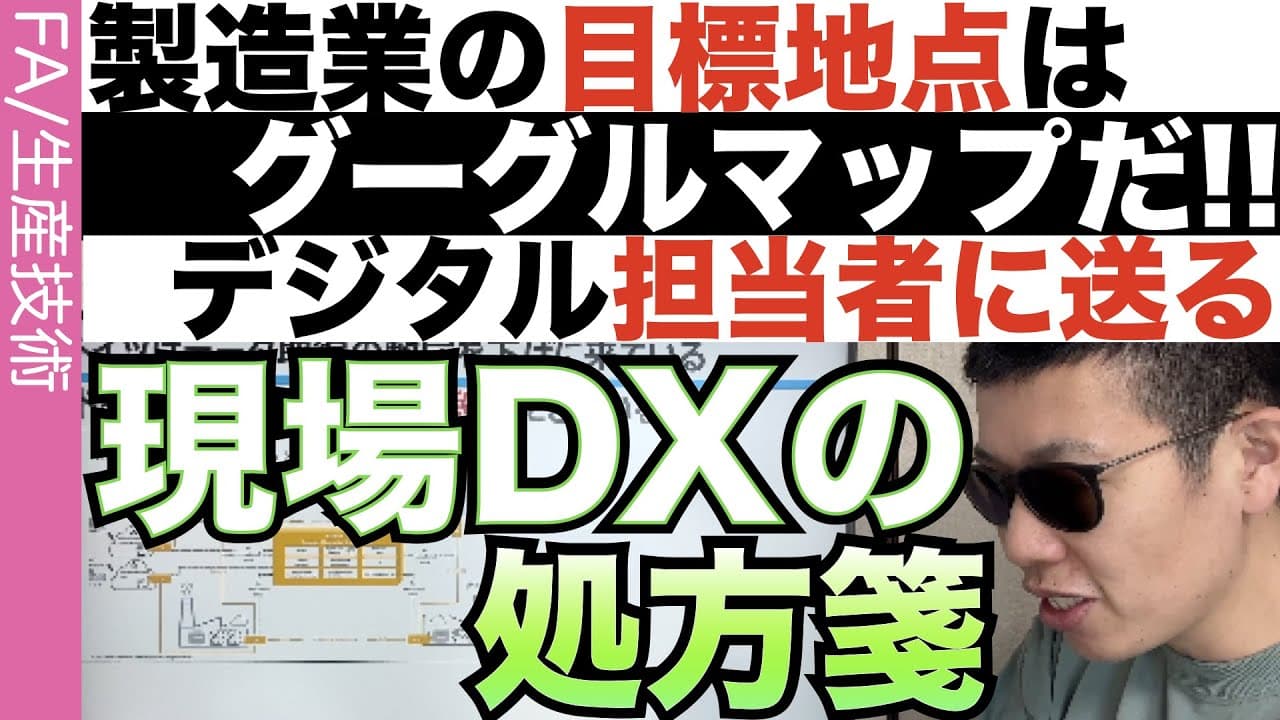
製造現場のデータを統合する最も簡単な方法の一つ。
TL;DR
Digital twins revolutionize manufacturing by transforming data into actionable insights.
Transcript
Hello. I'm Manufacturing man from Manufacturing man Channel . Today's theme is "Make data valuable information." Now is the era of DX and IOT. The wave of digitization is coming to the manufacturing industry as well. They need a lot of data. They have to turn it into valuable information. And they have to make decisions based on that. What should i... Read More
Key Insights
- Digital twins are transforming manufacturing by allowing companies to visualize and simulate production lines before they are built, similar to how Google Maps visualizes routes.
- The use of digital twins in manufacturing is reducing line build time and man-hours, enabling more efficient design and predictive maintenance.
- Standardization of data collection systems, as seen in Volkswagen and BASF, simplifies the creation of digital twins and enhances data acquisition.
- LI&FUNG exemplifies the orchestrator model by integrating data from thousands of factories to optimize supply chains and provide real-time visibility.
- DR.SUM software allows manufacturing personnel to handle vast amounts of data without specialized SQL knowledge, facilitating easier data extraction and integration.
- The digital twin concept extends beyond manufacturing, as seen in the textile industry, where real-time data visualization optimizes production and supply chains.
- IOT integration in manufacturing plants reduces the need for manual gauge checks, enhancing efficiency and reducing man-hours.
- Japanese manufacturing faces challenges in standardization, but solutions like DR.SUM offer a way to integrate disparate data systems and create digital twins.
Install to Summarize YouTube Videos and Get Transcripts
Explore YouTube Video Summarizer or Get YouTube Transcript Extractor
Questions & Answers
Q: What is the role of digital twins in manufacturing?
Digital twins play a crucial role in manufacturing by allowing companies to visualize and simulate production lines before they are physically built. This technology helps in reducing line build time and man-hours, enhancing design efficiency, and enabling predictive maintenance. By creating a virtual representation, manufacturers can optimize processes and make informed decisions based on real-time data.
Q: How does DR.SUM software benefit manufacturing personnel?
DR.SUM software benefits manufacturing personnel by allowing them to handle vast amounts of data without needing specialized SQL knowledge. This software facilitates easy data extraction and integration, enabling personnel to transform raw data into actionable insights. It supports decision-making processes by providing real-time data visualization and analysis, ultimately improving operational efficiency on the manufacturing floor.
Q: What challenges do Japanese manufacturers face regarding data standardization?
Japanese manufacturers face challenges in data standardization due to varying systems and styles across different factories and companies. This lack of standardization makes it difficult to combine and extract information seamlessly. However, solutions like DR.SUM offer a way to integrate disparate data systems, allowing manufacturers to create digital twins and optimize their operations despite these challenges.
Q: How does LI&FUNG utilize data in the textile industry?
LI&FUNG utilizes data in the textile industry by integrating information from over 20,000 factories worldwide to optimize supply chains. They provide real-time visibility into factory capacity, manufacturing unit prices, and quality, connecting end users with factories. This data-driven approach allows them to control the supply chain efficiently, providing a platform for real-time information visualization and enhancing business operations.
Q: What impact does IOT integration have on manufacturing plants?
IOT integration in manufacturing plants significantly enhances efficiency by reducing the need for manual gauge checks. It allows for remote monitoring and visualization of instrument behavior, minimizing man-hours and enabling quick responses to anomalies. This technology ensures continuous plant operations, optimizing processes and reducing the frequency of manual interventions required for maintenance and monitoring.
Q: Why is data extraction challenging for production engineers?
Data extraction is challenging for production engineers because it often falls outside their traditional scope of work. They may lack the technical skills required to handle SQL language and integrate data from various systems. Additionally, the non-standardized nature of data systems across different factories complicates the process, making it difficult to achieve seamless data integration and extraction without specialized tools like DR.SUM.
Q: What is the significance of standardizing factory systems as seen in Volkswagen and BASF?
Standardizing factory systems, as seen in Volkswagen and BASF, is significant because it simplifies data acquisition and integration, facilitating the creation of digital twins. Standardization eliminates the inefficiencies associated with different construction methods for each factory, allowing for consistent data collection and analysis. This approach enhances operational efficiency and decision-making processes by providing a unified platform for managing manufacturing data.
Q: How does the orchestrator model apply to companies like LI&FUNG and Apple?
The orchestrator model applies to companies like LI&FUNG and Apple by allowing them to control the value chain through data integration and visualization. These companies manage R&D, marketing, and other strategic functions internally while outsourcing manufacturing and logistics. By leveraging real-time data, they optimize supply chains and enhance business operations, providing a platform for efficient value chain management and decision-making.
Summary & Key Takeaways
-
Digital twins offer a significant advancement in manufacturing by allowing companies to digitally simulate and optimize production lines, reducing time and resources needed for physical builds.
-
DR.SUM software empowers manufacturing personnel to manage extensive data sets without requiring specialized technical skills, facilitating better decision-making and operational efficiency.
-
Companies like LI&FUNG use data integration to optimize supply chains, demonstrating the broader applicability of digital twins and data visualization in various industries beyond manufacturing.
Read in Other Languages (beta)
Share This Summary 📚
Summarize YouTube Videos and Get Video Transcripts with 1-Click
Try YouTube Summary with ChatGPT & Claude or YouTube Transcript Generator
Explore More Summaries from ものづくり太郎チャンネル 📚

Summarize YouTube Videos and Get Video Transcripts with 1-Click
Try YouTube Summary with ChatGPT & Claude or YouTube Transcript Generator