How to Use Vietnamese Classifiers Effectively
TL;DR
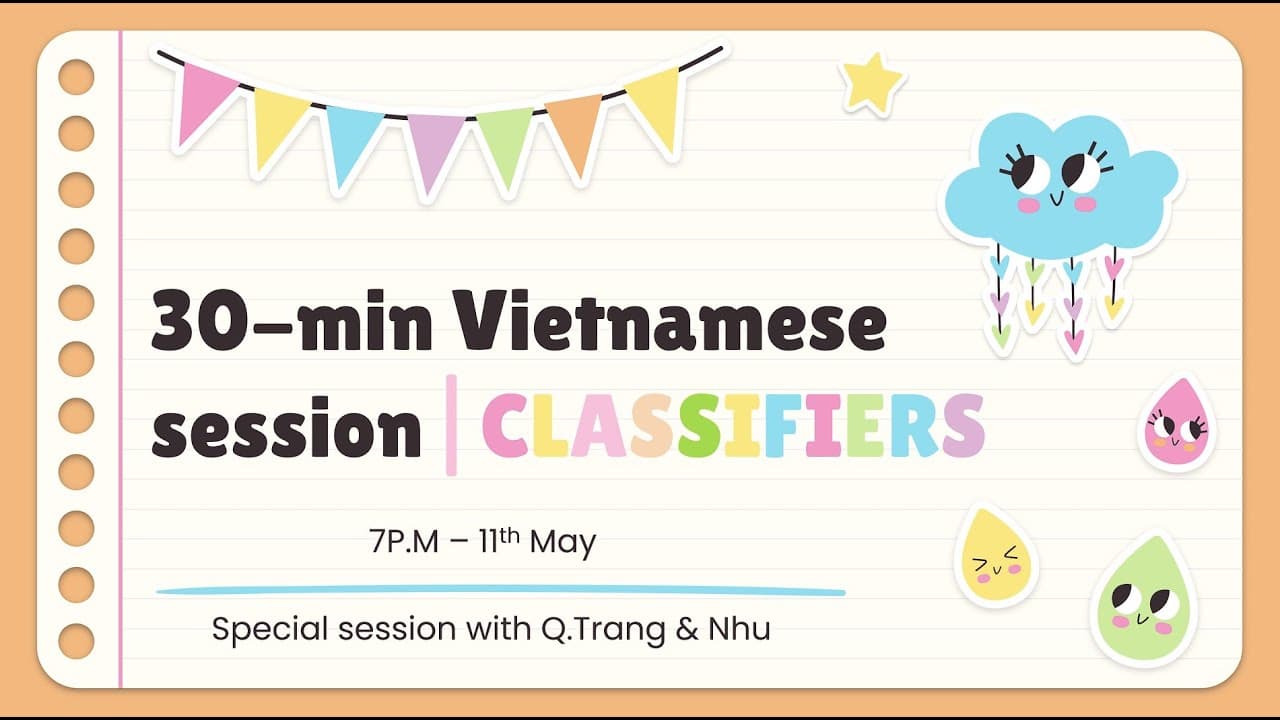
Vietnamese classifiers are essential for distinguishing nouns based on specific attributes such as quantity, specificity, and the nature of the object. Learning classifiers involves understanding their usage in context, especially when dealing with specific quantities or objects. Practice with examples, and remember that some classifiers are unique to particular nouns.
Transcript
okay later that hello m hello hello hello oh foreign now is anyone here watching the football game between vietnam and the philippines my can you say something to us we have we have 12 peoples watching now hello soy have you had dinner um wow hungry how home my zoom delam z home hi guys do you know what classifiers are used for let us know by comme... Read More
Key Insights
- Vietnamese classifiers are used when mentioning specific quantities of nouns.
- Classifiers help in identifying specific nouns, distinguishing them from general references.
- Certain classifiers are used based on the nature of the object, such as living beings or inanimate objects.
- Some nouns can serve as classifiers themselves, especially when they refer to the container of an object.
- Common classifiers include 'con' for living beings, 'cái' for inanimate objects, and 'quả' for fruits.
- In spoken Vietnamese, classifiers may be omitted for brevity, but correct usage is essential for formal communication.
- Learning classifiers involves memorizing them with the nouns they accompany to ensure accurate usage.
- Understanding the context, such as specificity and quantity, is crucial for selecting the appropriate classifier.
Install to Summarize YouTube Videos and Get Transcripts
Explore YouTube Video Summarizer or Get YouTube Transcript Extractor
Questions & Answers
Q: How to use classifiers for specific quantities in Vietnamese?
Classifiers are used when there is a specific quantity mentioned in Vietnamese. For example, when saying 'two cats', you would use 'hai con mèo', where 'con' is the classifier for animals. It's important to include the classifier to specify the exact quantity of the noun.
Q: What are the most common classifiers in Vietnamese?
The most common classifiers in Vietnamese include 'con' for living beings, 'cái' for inanimate objects, and 'quả' for fruits. These classifiers are essential for correctly identifying and quantifying nouns in various contexts.
Q: When should classifiers be omitted in Vietnamese?
Classifiers are typically omitted in Vietnamese when referring to nouns in a general sense, without mentioning specific quantities or when the noun itself acts as a classifier. In everyday spoken language, classifiers may also be omitted for brevity.
Q: How do classifiers function with specific nouns?
Classifiers are used with specific nouns to indicate particular items. For example, when referring to 'the cat over there', you use 'con mèo kia', where 'con' specifies the noun 'mèo' as a particular cat, rather than cats in general.
Q: Can nouns serve as classifiers in Vietnamese?
Yes, in Vietnamese, some nouns can serve as classifiers, particularly when they refer to containers. For instance, 'chai' can mean a bottle and also act as a classifier when referring to a bottle of something, like 'một chai nước' (a bottle of water).
Q: Why are classifiers important in learning Vietnamese?
Classifiers are important in learning Vietnamese because they provide clarity and precision in communication. They help distinguish between general and specific references, and they are crucial for correctly quantifying nouns, which is essential for accurate language use.
Q: How can I practice using classifiers effectively?
To practice using classifiers effectively, memorize them alongside the nouns they accompany. Engage in exercises that require you to fill in the blanks with the correct classifiers, and pay attention to contextual cues like quantity and specificity when selecting classifiers.
Q: What challenges might learners face with Vietnamese classifiers?
Learners might face challenges with Vietnamese classifiers due to their large number and context-dependent usage. Some classifiers are unique to specific nouns, and understanding when to use or omit them requires practice and familiarity with Vietnamese language conventions.
Summary & Key Takeaways
-
Vietnamese classifiers are crucial for specifying nouns, particularly when dealing with specific quantities or objects. Understanding their usage requires recognizing when a noun is specific or general, and whether it is associated with a particular quantity.
-
Common classifiers like 'con', 'cái', and 'quả' are used based on the nature of the noun, such as living beings, inanimate objects, or fruits. Some nouns can act as classifiers themselves, especially when they refer to containers.
-
Practice and memorization are key to mastering classifiers, as they often accompany specific nouns. Contextual cues, such as specific quantities or the nature of the object, guide the appropriate use of classifiers.
Read in Other Languages (beta)
Share This Summary 📚
Summarize YouTube Videos and Get Video Transcripts with 1-Click
Try YouTube Summary with ChatGPT & Claude or YouTube Transcript Generator
Explore More Summaries from Tieng Viet Oi - Vietnamese Lessons 📚

Summarize YouTube Videos and Get Video Transcripts with 1-Click
Try YouTube Summary with ChatGPT & Claude or YouTube Transcript Generator