ScienceCasts: A Supermoon Trilogy
TL;DR
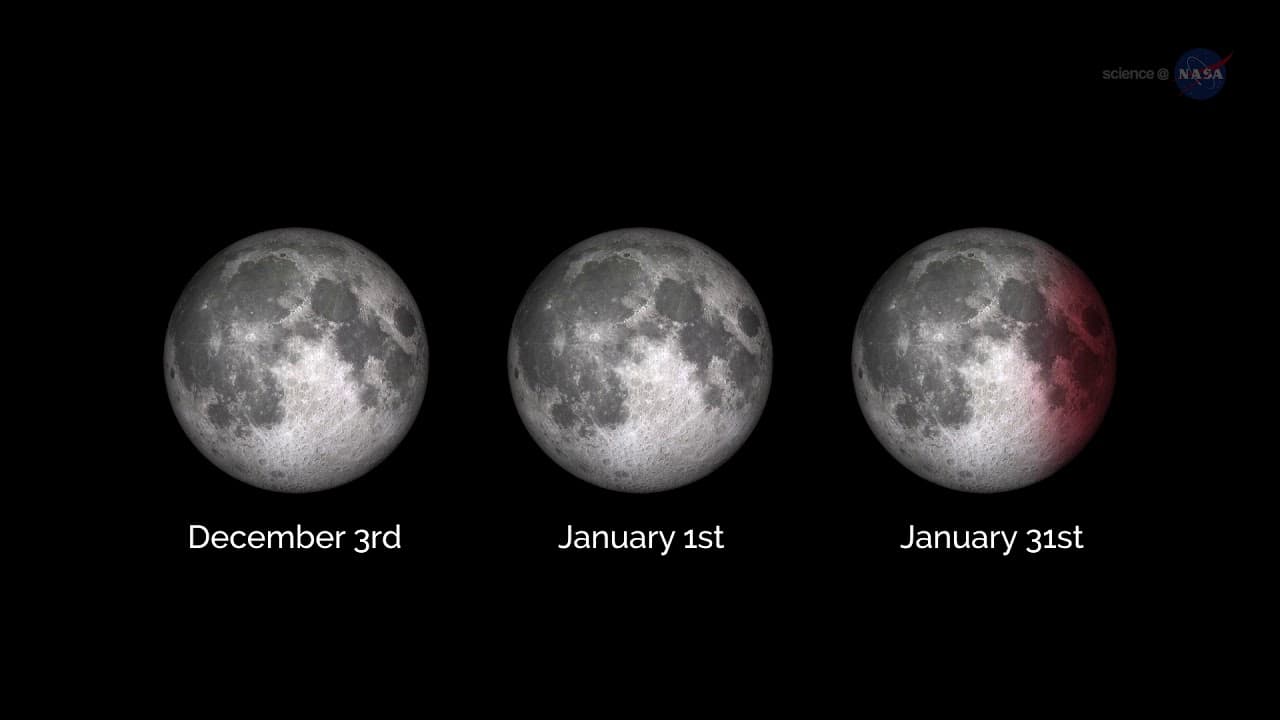
Three supermoons will occur on December 3, 2017, January 1, 2018, and January 31, 2018, featuring larger and brighter full moons. The final supermoon will also have a total lunar eclipse.
Transcript
[ MUSIC ] A Supermoon Trilogy – Presented by Science@NASA Mark your calendars: a series of three supermoons will appear on the celestial stage on December 3, 2017, January 1, 2018, and January 31, 2018. A supermoon is a Moon that is full when it is also at or near its closest point in its orbit around Earth. Since the Moon’s orbit is elliptical, on... Read More
Key Insights
- 😚 Supermoons occur when the Moon is at its closest point to Earth, resulting in a larger and brighter appearance.
- 🫥 The third supermoon on January 31, 2018, will also feature a total lunar eclipse visible from western North America to Eastern Asia.
- 💙 The January 31 supermoon will be a "super blue blood" Moon, combining the second full Moon of the month with a reddish hue due to sunlight passing through Earth's atmosphere.
- 💅 Supermoons provide an opportunity for people to observe and appreciate the Moon's beauty and encourage skywatching.
- 😀 The Moon's orbit is elliptical, with one side (apogee) about 30,000 miles farther from Earth than the other (perigee).
- 😘 Observing a full Moon when it is low on the horizon can create an illusion of a larger size.
- 🙂 Lunar eclipses occur when the Moon lines up perfectly with the Earth and Sun, with the Earth's shadow blocking the Sun's light from reaching the Moon.
Install to Summarize YouTube Videos and Get Transcripts
Explore YouTube Video Summarizer or Get YouTube Transcript Extractor
Questions & Answers
Q: What is a supermoon?
A supermoon is a full Moon that occurs when the Moon is at or near its closest point to Earth in its elliptical orbit, appearing larger and brighter.
Q: When will the supermoons occur?
The supermoons will occur on December 3, 2017, January 1, 2018, and January 31, 2018.
Q: What makes the January 31, 2018 supermoon special?
The third supermoon will coincide with a total lunar eclipse, where the Moon will take on an eerie, fainter-than-normal glow due to the Earth's shadow blocking the Sun's light.
Q: How often do Blue Moons occur?
Blue Moons, which refer to the second full Moon in a month, occur every two and a half years on average.
Summary & Key Takeaways
-
A series of three supermoons will occur on December 3, 2017, January 1, 2018, and January 31, 2018, where the Moon appears larger and brighter during its closest point in orbit around Earth.
-
The third supermoon on January 31, 2018, will coincide with a total lunar eclipse visible from western North America to Eastern Asia.
-
The January 31 supermoon will also be a "super blue blood" Moon, as it is the second full moon of the month and will have a reddish hue due to the Earth's atmosphere.
Read in Other Languages (beta)
Share This Summary 📚
Summarize YouTube Videos and Get Video Transcripts with 1-Click
Try YouTube Summary with ChatGPT & Claude or YouTube Transcript Generator
Explore More Summaries from NASA 📚

Summarize YouTube Videos and Get Video Transcripts with 1-Click
Try YouTube Summary with ChatGPT & Claude or YouTube Transcript Generator