L3.3 Degeneracy resolved to second order
TL;DR
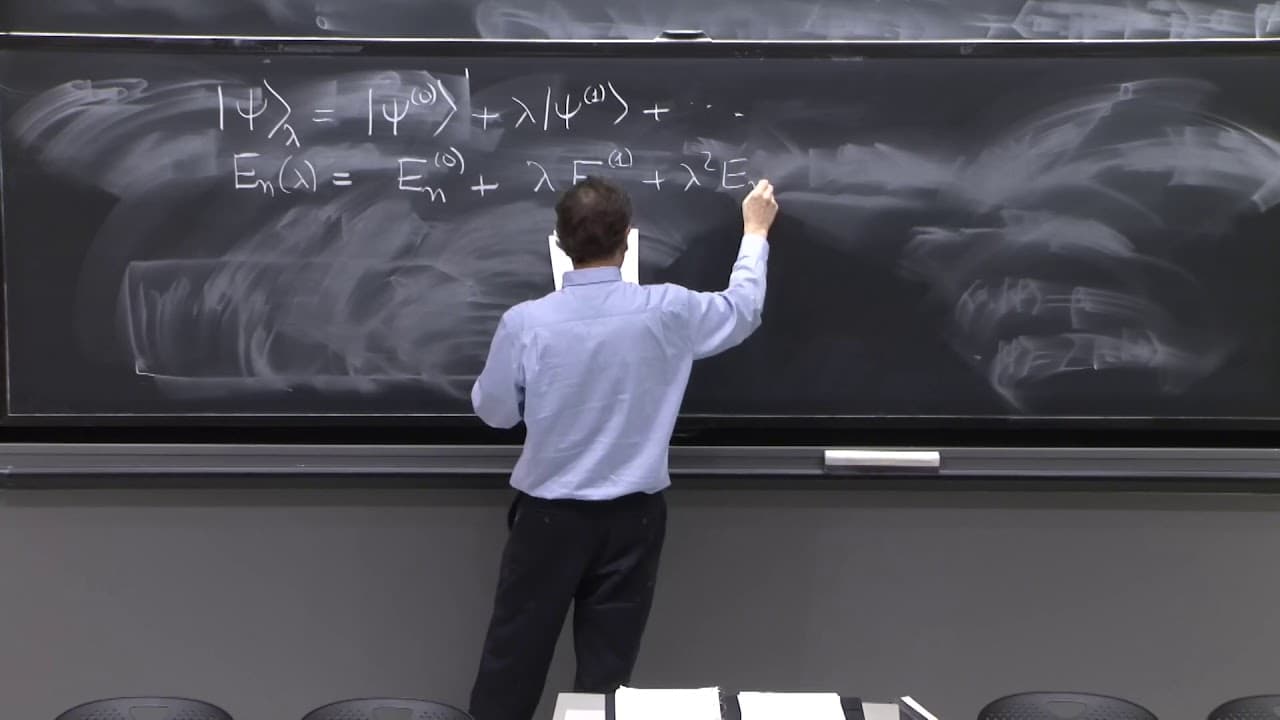
First-order perturbation theory does not lift degeneracy, and to find the good basis and correct states, second-order perturbation theory must be applied.
Transcript
PROFESSOR: We have a problem. The general perturbation theory, again, end states. But this time, the degeneracy is not broken. So degeneracy not lifted at first order. Surprisingly, this subject is, as you can see, you have to do things with care. It's not in any of the textbooks that I know. In fact, I don't know of any place where it is discussed... Read More
Key Insights
- 🦾 Degeneracy in quantum mechanics refers to when multiple states have the same energy, making it challenging to determine the correct states and basis.
- 🪈 First-order perturbation theory is unable to lift degeneracy, necessitating the use of second-order perturbation theory.
- 👻 Second-order perturbation theory allows for the correction and determination of the correct states and basis by splitting the degenerate states.
- 👋 The "good basis" in perturbation theory corresponds to the continuous changing eigenstates and is essential for accurately calculating energy corrections and finding the correct states.
- 🪈 The problem of degeneracy and the requirement for second-order perturbation theory are not extensively discussed in textbooks and may require improvisation from physicists.
- 🪈 Success in perturbation theory relies on finding the correct states and basis, which may require diagonalizing systems to second order.
- 👻 The diagonalization of systems to second order allows for the identification of the "good basis" and enables accurate perturbation theory calculations.
Install to Summarize YouTube Videos and Get Transcripts
Explore YouTube Video Summarizer or Get YouTube Transcript Extractor
Questions & Answers
Q: What is degeneracy in quantum mechanics?
Degeneracy refers to the situation where multiple states have the same energy, making it difficult to determine the correct states and basis.
Q: How does first-order perturbation theory handle degeneracy?
First-order perturbation theory does not lift degeneracy, resulting in the need for second-order perturbation theory to find the correct states and basis.
Q: What happens if the degenerate states do not split in second-order perturbation theory?
If the degenerate states do not split in second-order perturbation theory, the calculations become more complicated, and finding the correct states and basis becomes more challenging.
Q: Why is it important to find the "good basis" in perturbation theory?
The "good basis" corresponds to the continuous changing eigenstates and is crucial for accurately calculating energy corrections and determining the correct states in perturbation theory.
Summary & Key Takeaways
-
The video discusses the problem of degeneracy in perturbation theory in quantum mechanics.
-
Degeneracy refers to when multiple states have the same energy, and perturbation theory is used to calculate energy corrections for degenerate states.
-
First-order perturbation theory fails to lift degeneracy, and second-order perturbation theory is necessary to find the correct states and basis.
Read in Other Languages (beta)
Share This Summary 📚
Summarize YouTube Videos and Get Video Transcripts with 1-Click
Try YouTube Summary with ChatGPT & Claude or YouTube Transcript Generator
Explore More Summaries from MIT OpenCourseWare 📚



Summarize YouTube Videos and Get Video Transcripts with 1-Click
Try YouTube Summary with ChatGPT & Claude or YouTube Transcript Generator