Calculus 1: Lecture 3.5 Limits at Infinity
TL;DR
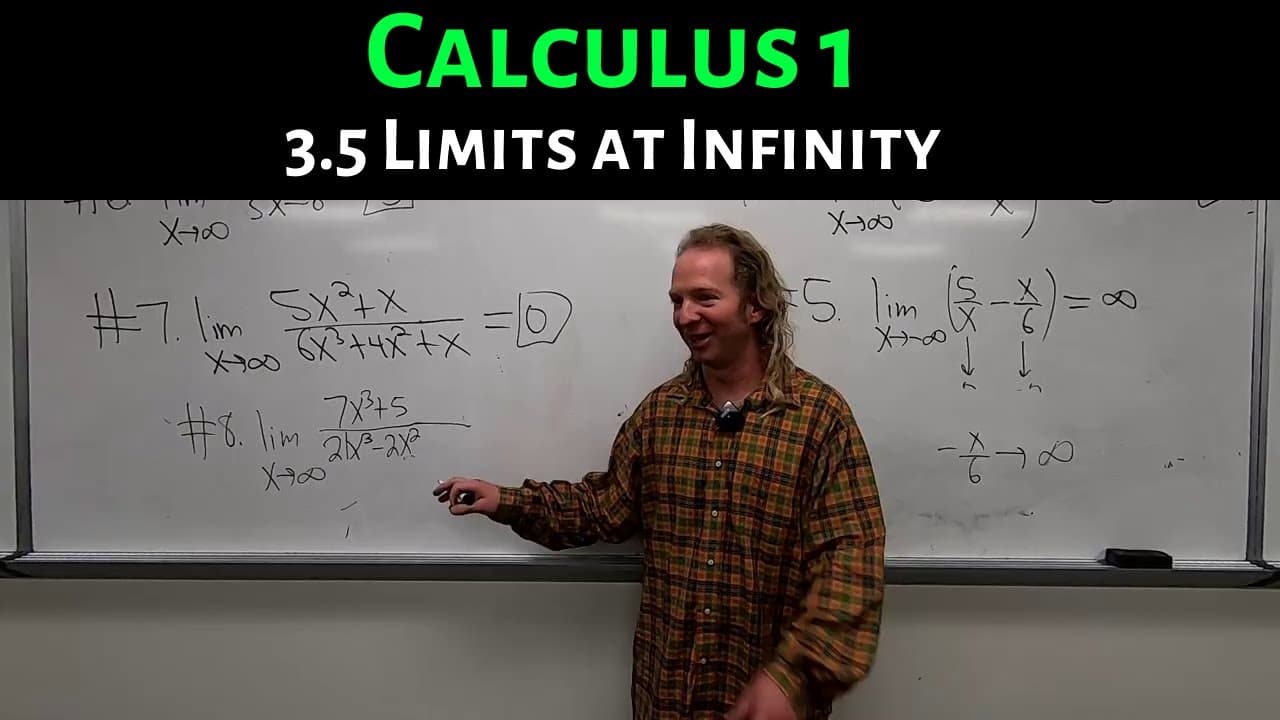
This content discusses limits, horizontal asymptotes, and the use of various techniques to determine the value of the limit as X approaches infinity or negative infinity.
Transcript
f of X and let's say it's equal to a number L so what does this mean this means so I'll just tell you what it means and I'll write it down it means that as X approaches infinity f of X approaches L so you might be wondering what does it mean for act to approach infinity it didn't mean that gets big so as X gets really really big yeah that's this is... Read More
Key Insights
- ☺️ Limits can be used to determine the value of a function as X approaches a specific value.
- ☺️ Horizontal asymptotes occur when a function approaches a specific value as X grows without bound.
- ♾️ Functions can have one or two horizontal asymptotes, depending on their behavior as X approaches infinity or negative infinity.
- 🥳 The ratio of leading coefficients can be used to determine the value of a limit in some cases.
Install to Summarize YouTube Videos and Get Transcripts
Explore YouTube Video Summarizer or Get YouTube Transcript Extractor
Questions & Answers
Q: What does it mean when the limit of a function as X approaches infinity equals a constant?
When the limit of a function as X approaches infinity equals a constant, it indicates that the function gets infinitely close to that constant value as X grows without bound. This is a characteristic of a horizontal asymptote.
Q: Can a function have two horizontal asymptotes?
Yes, some functions can have two horizontal asymptotes. One example is the arctan (arc tangent) graph, where the limit as X approaches infinity is equal to PI/2 and the limit as X approaches negative infinity is equal to -PI/2.
Q: How can the ratio of leading coefficients be used to determine the value of a limit?
When the degrees of the numerator and denominator of a rational function are the same, the ratio of their leading coefficients can be used to determine the value of the limit. For example, if the numerator has a leading coefficient of 2 and the denominator has a leading coefficient of 5, the limit is 2/5.
Summary & Key Takeaways
-
Limits can help determine the value of a function as X approaches a specific value, such as infinity or negative infinity.
-
Horizontal asymptotes occur when the function approaches a specific value as X grows without bound.
-
The content explores the concept of horizontal asymptotes in detail, using examples like the arc tangent graph.
Read in Other Languages (beta)
Share This Summary 📚
Summarize YouTube Videos and Get Video Transcripts with 1-Click
Try YouTube Summary with ChatGPT & Claude or YouTube Transcript Generator
Explore More Summaries from The Math Sorcerer 📚




Summarize YouTube Videos and Get Video Transcripts with 1-Click
Try YouTube Summary with ChatGPT & Claude or YouTube Transcript Generator