Products
Features
YouTube Video Summarizer
Summarize YouTube videos
Web & PDF Highlighter
Highlight web pages & PDFs
Chat with PDF
Ask any PDF questions with AI
Ask AI Clone
Chat with your highlights & memories
Audio Transcriber
Transcribe audio files to text
Glasp Reader
Read and highlight articles
Kindle Highlight Export
Export your Kindle highlights
Idea Hatch
Hatch ideas from your highlights
Integrations
Obsidian Plugin
Notion Integration
Pocket Integration
Instapaper Integration
Medium Integration
Readwise Integration
Snipd Integration
Hypothesis Integration
Apps & Extensions
Chrome Extension
Safari Extension
Edge Add-ons
Firefox Add-ons
iOS App
Android App
Discover
Discover
Ideas
Discover new ideas and insights
Articles
Curated articles and insights
Books
Book recommendations by great minds
Posts
Essays and notes from readers
Quotes
Inspiring quotes collection
Videos
Curated videos and summaries
Explore Glasp
Glasp Newsletter
Weekly insights and updates
Glasp Talk
Interview series with great minds
Glasp Blog
Latest news and articles
Glasp Use Cases
Learn how others use Glasp
Build & Support
Glasp API
Access Glasp's API for developers
MCP Connector
Connect Glasp to Claude & ChatGPT
Community
Glasp Reddit Community
Students
Student discount and benefits
FAQs
Frequently Asked Questions
AboutPricing
DashboardLog inSign up

Type I regions in three dimensions | Divergence theorem | Multivariable Calculus | Khan Academy
June 27, 2012
by
Khan Academy
YouTube video player
Type I regions in three dimensions | Divergence theorem | Multivariable Calculus | Khan Academy

TL;DR

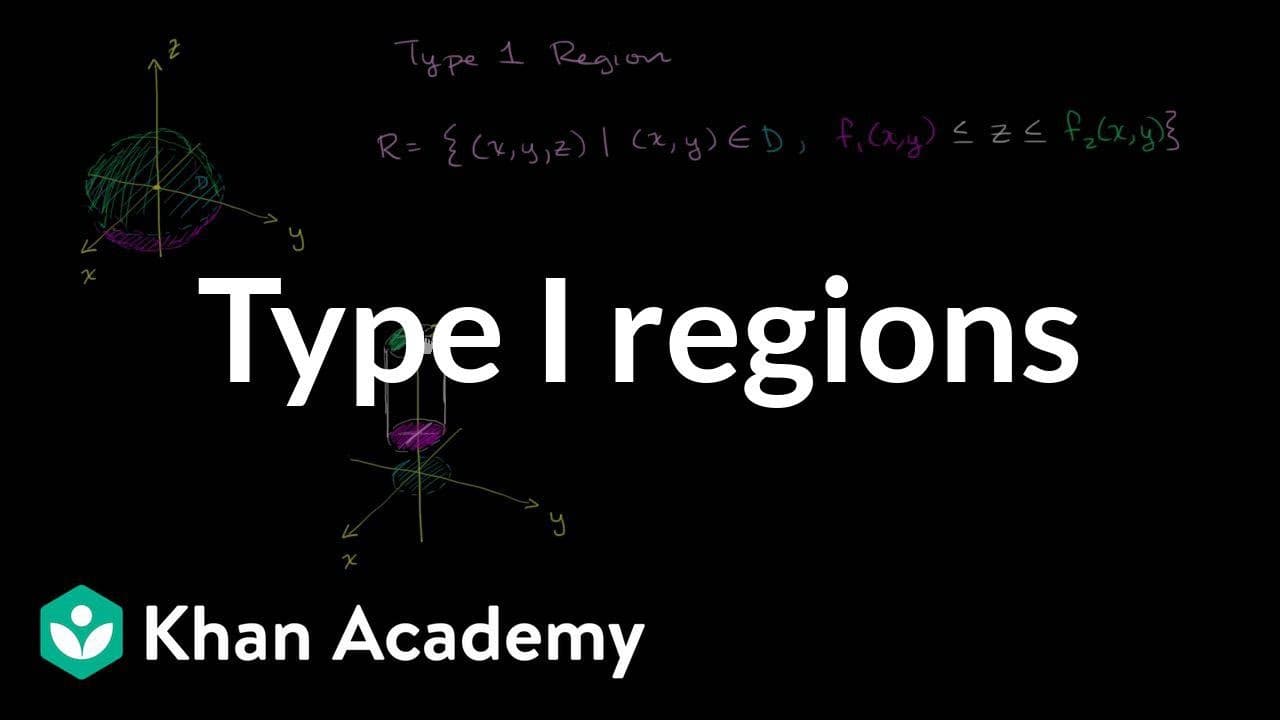
Type 1 regions in multivariable calculus are sets of points in 3D space where x and y belong to a specific domain, and z can vary between two functions of x and y.

Transcript

In this and the next few videos, I hope to explore different types of regions in three dimensions. And these will be useful for thinking about how to evaluate different double and triple integrals and also some interesting proofs in multivariable calculus. So the first type of region, and it's appropriately named, we will call a type 1 region. At f... Read More

Key Insights

  • 🤪 Type 1 regions are sets of points in 3D space with specific constraints on the x, y, and z coordinates.
  • 🅰️ Examples of type 1 regions include spheres and cylinders.
  • 🍳 Type 1 regions can have complex shapes and may need to be broken into multiple regions for accurate representation.
  • 👍 Understanding type 1 regions is essential for evaluating integrals and proving concepts in multivariable calculus.

Install to Summarize YouTube Videos and Get Transcripts

Explore YouTube Video Summarizer or Get YouTube Transcript Extractor

Questions & Answers

Q: What is a type 1 region in multivariable calculus?

A type 1 region is a set of points in 3D space where the x and y coordinates belong to a specific domain, and the z coordinate varies between two functions of x and y.

Q: Can type 1 regions have complex shapes?

Yes, type 1 regions can have complex shapes. If the shape cannot be defined with just one lower bound and one upper bound function for z, it can be broken into multiple type 1 regions.

Q: What are some examples of type 1 regions?

Examples of type 1 regions include spheres, cylinders, and any other shape where x and y belong to a domain and z varies within specific bounds determined by functions of x and y.

Q: Why are type 1 regions important in multivariable calculus?

Understanding type 1 regions is crucial for evaluating double and triple integrals and for proving certain concepts in multivariable calculus. They provide a framework for analyzing and visualizing functions in three dimensions.

Summary & Key Takeaways

  • Type 1 regions are defined as sets of points in 3D space where x and y are part of a domain and z varies between two functions of x and y.

  • Examples of type 1 regions include spheres and cylinders.

  • Type 1 regions can also be broken into separate regions if their shapes are more complex, such as a dumbbell shape.


Read in Other Languages (beta)

English

Share This Summary 📚

Summarize YouTube Videos and Get Video Transcripts with 1-Click

Download browser extensions on:

Try YouTube Summary with ChatGPT & Claude or YouTube Transcript Generator

Explore More Summaries from Khan Academy 📚

How to classify numbers | Numbers and operations | 8th grade | Khan Academy thumbnail
How to classify numbers | Numbers and operations | 8th grade | Khan Academy
Khan Academy
Long straddle | Finance & Capital Markets | Khan Academy thumbnail
Long straddle | Finance & Capital Markets | Khan Academy
Khan Academy
Calculating average value of function over interval | AP Calculus AB | Khan Academy thumbnail
Calculating average value of function over interval | AP Calculus AB | Khan Academy
Khan Academy
Sums and products of irrational numbers thumbnail
Sums and products of irrational numbers
Khan Academy
Direct comparison test | Series | AP Calculus BC | Khan Academy thumbnail
Direct comparison test | Series | AP Calculus BC | Khan Academy
Khan Academy
Discriminant for types of solutions for a quadratic | Algebra II | Khan Academy thumbnail
Discriminant for types of solutions for a quadratic | Algebra II | Khan Academy
Khan Academy

Summarize YouTube Videos and Get Video Transcripts with 1-Click

Download browser extensions on:

Try YouTube Summary with ChatGPT & Claude or YouTube Transcript Generator

Apps & Extensions

  • Chrome Extension
  • Safari Extension
  • Edge Add-ons
  • Firefox Add-ons
  • iOS App
  • Android App

Key Features

  • YouTube Video Summarizer
  • Web & PDF Summarizer
  • Web & PDF Highlighter
  • Chat with PDF
  • Ask AI Clone
  • Audio Transcriber
  • Glasp Reader
  • Kindle Highlight Export
  • Idea Hatch

Integrations

  • Obsidian Plugin
  • Notion Integration
  • Pocket Integration
  • Instapaper Integration
  • Medium Integration
  • Readwise Integration
  • Snipd Integration
  • Hypothesis Integration

More Features

  • APIs
  • MCP Connector
  • Blog & Post
  • Embed Links
  • Image Highlight
  • Personality Test
  • Quote Shots

Company

  • About us
  • Blog
  • Community
  • FAQs
  • Job Board
  • Newsletter
  • Pricing
Terms

•

Privacy

•

Guidelines

© 2026 Glasp Inc. All rights reserved.