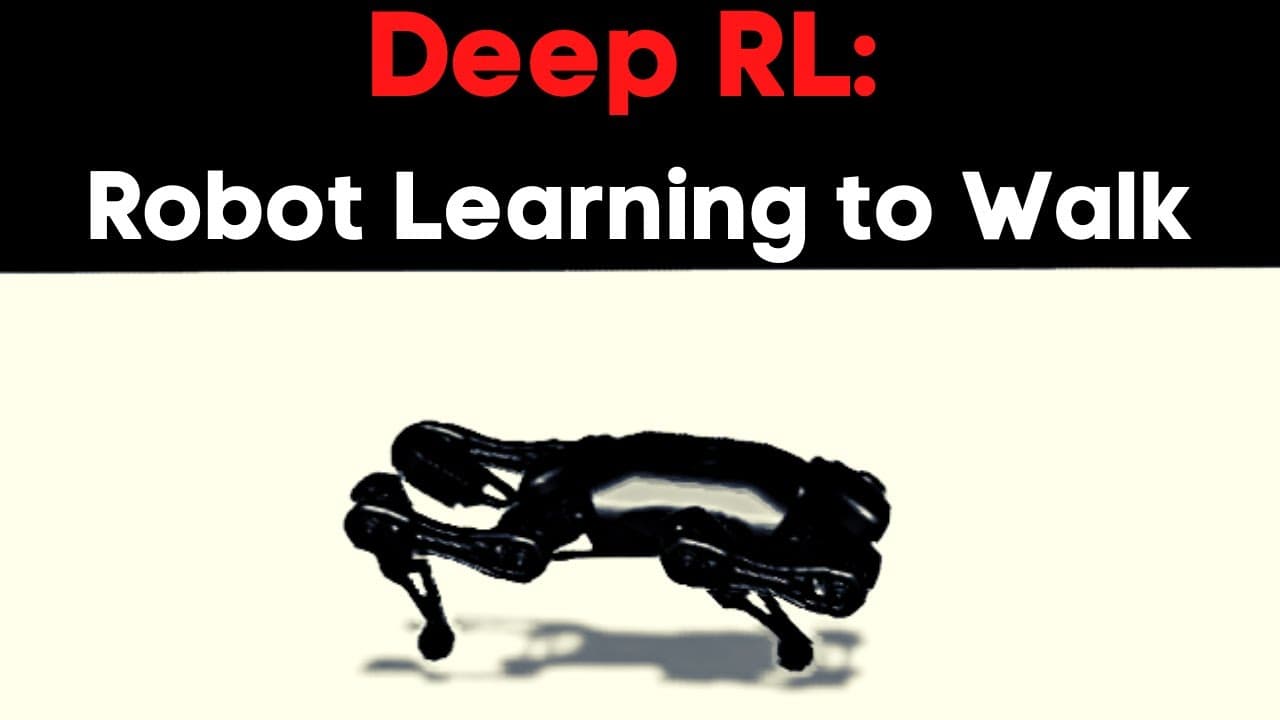
Robot Dog Learns to Walk - Bittle Reinforcement Learning p.3
TL;DR
The content discusses the progress and challenges faced while implementing reinforcement learning with the Biddle robot dog and Nvidia's Isaac Sim.
Transcript
what is going on everybody and welcome to part three of the reinforcement learning with the biddle robot dog and nvidia's isaac sim a lot has happened since the last video each step a little baby step sometimes backwards but overall i'm getting much closer to my end goal and i'm learning a ton on the way the very first thing i did since part two wa... Read More
Key Insights
- 🤖 The addition of a camera provides important visual information for navigation in the Biddle robot dog.
- 🚂 Training an autoencoder helps in reducing the dimensionality of the camera imagery for processing.
- 🐢 The camera sensor in the simulation slows down the training process, requiring exploration of alternative methods like an IMU sensor.
- 👍 Discrete Delta PPO proves to be the best-performing algorithm for the reinforcement learning task.
- 🤖 Movement punishments and frame stacking techniques are explored to improve the walking gait of the Biddle robot dog.
- 🗯️ Finding the right balance between rewards and restrictions is crucial in optimizing the learning process.
- 👨🔬 More research and experimentation are needed to refine the walking gait and improve overall performance.
Install to Summarize YouTube Videos and Get Transcripts
Explore YouTube Video Summarizer or Get YouTube Transcript Extractor
Questions & Answers
Q: How does adding a camera to the Biddle robot dog aid in navigation?
By adding a camera, the Biddle robot dog can gather visual information about the environment, such as the horizon and objects to navigate around.
Q: How is the camera attached and accessed in the Isaac Sim?
The camera is attached in the Isaac Sim, and the data can be accessed by running the relevant code. The process of accessing the camera data is explained in the content.
Q: What is the purpose of training an autoencoder on the camera imagery?
The autoencoder is trained to encode the camera imagery into a smaller set of features, which can be used for further processing and analysis.
Q: What challenges are faced in terms of speed while accessing camera data?
The camera sensor in the simulation slows down the training process significantly, making it impractical for real-life training. The slow speed is due to the code used to grab the camera sensor values.
Summary & Key Takeaways
-
The content discusses the addition of a camera to the Biddle robot dog to provide visual information for navigation.
-
The process of accessing the camera data and training an autoencoder on the imagery is explained.
-
The slow speed of the camera sensor and the introduction of an IMU sensor as an alternative are discussed.
Read in Other Languages (beta)
Share This Summary 📚
Summarize YouTube Videos and Get Video Transcripts with 1-Click
Try YouTube Summary with ChatGPT & Claude or YouTube Transcript Generator
Explore More Summaries from sentdex 📚

Summarize YouTube Videos and Get Video Transcripts with 1-Click
Try YouTube Summary with ChatGPT & Claude or YouTube Transcript Generator