Bootstrap time base generator | Transistor | Example problem | PDC | Lec-88
TL;DR
A video explains designing a transistor bootstrap time-based generator circuit and its operation nuances.
Transcript
hi everyone in this video I am going to explain about an example problem on transistor based bootstrap time based generator in the previous video I have given you the explanation and derivation for the transistor base at boot step time base generator where we can get a linearity when compared to the Miller Time by generator by using some circuitry ... Read More
Key Insights
- ❓ The operation of transistors Q1 and Q2 in different states is crucial for achieving desired output characteristics in the bootstrap circuit.
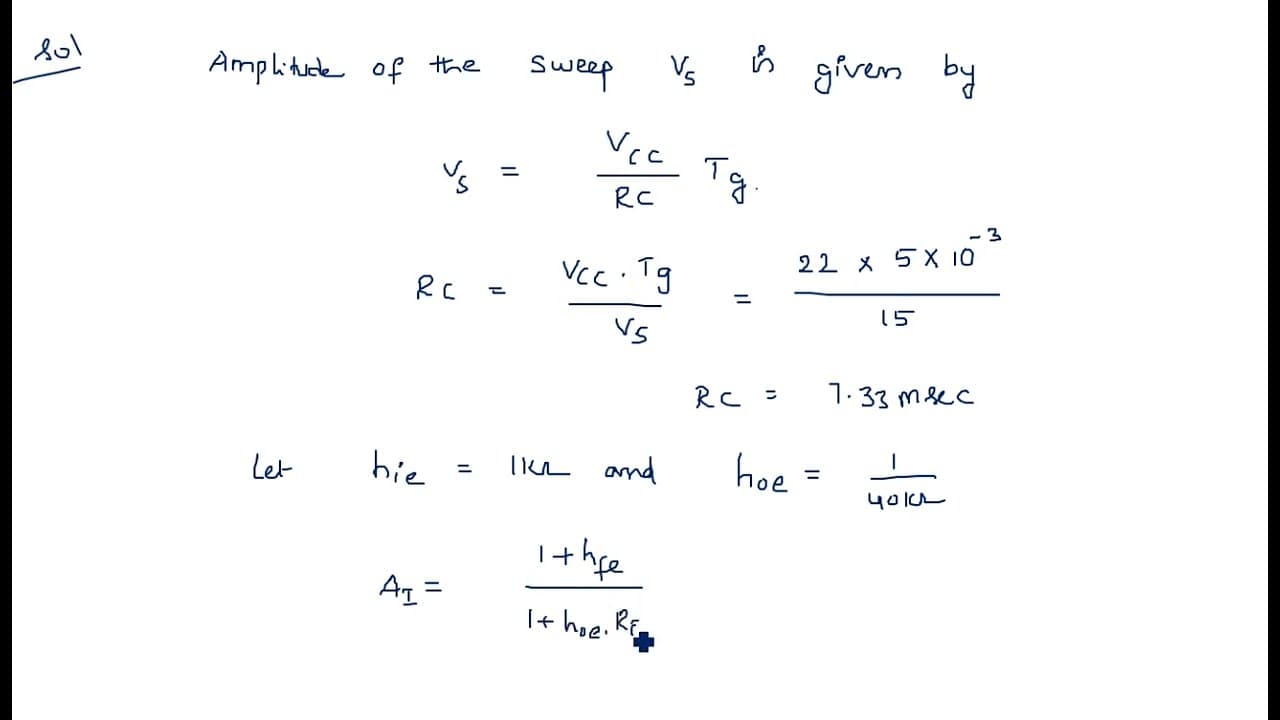
- ⚾ Mathematical equations are fundamental in designing the circuit, helping derive necessary values for resistors and capacitors based on input specifications.
- 💐 A constant current flow through the transistors is essential for enabling a linear discharge and charge cycle of the output capacitor.
- ⌚ The relationship between components is critical; for instance, C1 should be ten times the value of C to ensure stability and desired performance.
- 💦 Understanding the voltage drops across various components such as diodes and transistors impacts current calculations and overall circuit design.
- 🎨 Circuit configurations dictate how various equations are applied; attention to detail in circuit design is necessary for successful operation.
- ⌛ The specific component values derived from calculations aim to produce a time-based generator that meets precise voltage and timing criteria conducive to practical applications.
Install to Summarize YouTube Videos and Get Transcripts
Explore YouTube Video Summarizer or Get YouTube Transcript Extractor
Questions & Answers
Q: What is the significance of using a transistor bootstrap in a time-based generator?
A transistor bootstrap allows the time-based generator to achieve a linear output by enhancing the circuit stability under varying load conditions. By ensuring that both transistors operate efficiently in saturation and cutoff states, the generator maintains consistent performance, which is crucial for applications demanding precision in timing.
Q: How are the values for resistors and capacitors determined in the circuit design?
The values for resistors and capacitors are derived from the circuit requirements, including maximum voltage, desired linearity, and timing specifications. Using the equations derived from the circuit characteristics, such as Ohm's law and the charge/discharge rates of capacitors, designers calculate necessary values to ensure that the output meets the specified parameters.
Q: What role do the transistors play in the functioning of the bootstrap circuit?
In the bootstrap circuit, transistors Q1 and Q2 operate in different states (saturation and conduction) based on the input gating pulse. Q1 controls the charging and discharging of the capacitor while maintaining linearity, whereas Q2 acts as an emitter follower, facilitating a stable output voltage with minimal gain variation.
Q: What measures are taken for ensuring output linearity in the generator?
To ensure output linearity, the circuit employs a constant current flow through the transistors, which governs the charge and discharge cycles of the capacitor. Additionally, precise calculations for resistor and capacitor values based on theoretical equations contribute to maintaining the linear ramp output within the specified tolerance.
Q: Can you explain the significance of the current gain mentioned in the design?
The current gain, represented as beta (hFE), indicates how effectively a transistor can amplify its input current. In this design, a minimum current gain of 25 is needed to ensure the transistors function properly within the circuit, allowing sufficient output current to achieve the desired load driving capability while maintaining overall efficiency.
Q: How does the input pulse's amplitude and width impact the circuit's performance?
The input pulse's amplitude and width are critical as they determine how quickly the transistors react to changes in input signals. A negative gating pulse with defined amplitude and duration influences the charging and discharging cycles of the capacitor, ultimately affecting the linearity and stability of the generated output ramp signal.
Q: What are the expected values for the components after the calculations?
The design calculations yield specific values for various components: resistor R is determined to be approximately 481.62 ohms, capacitor C is around 15.2 microfarads, capacitor C1 is set to 152 microfarads, and RB (the input resistance for the first transistor) is calculated to be about 8.068 kilo ohms, effectively meeting the design requirements.
Summary & Key Takeaways
-
The video provides a step-by-step explanation of designing a transistor-based bootstrap time generator, emphasizing the circuit operation and parameters required for linearity in output.
-
It covers the mathematical derivation of key components, including relationships between resistors, capacitors, and the respective voltages in the circuit design to achieve desired output characteristics.
-
The presenter calculates crucial circuit values, such as input resistance and capacitor values, ensuring the design meets specifications such as voltage, current, and timing requirements.
Read in Other Languages (beta)
Share This Summary 📚
Summarize YouTube Videos and Get Video Transcripts with 1-Click
Try YouTube Summary with ChatGPT & Claude or YouTube Transcript Generator