Why Are Honeybees Making Mummies?
TL;DR
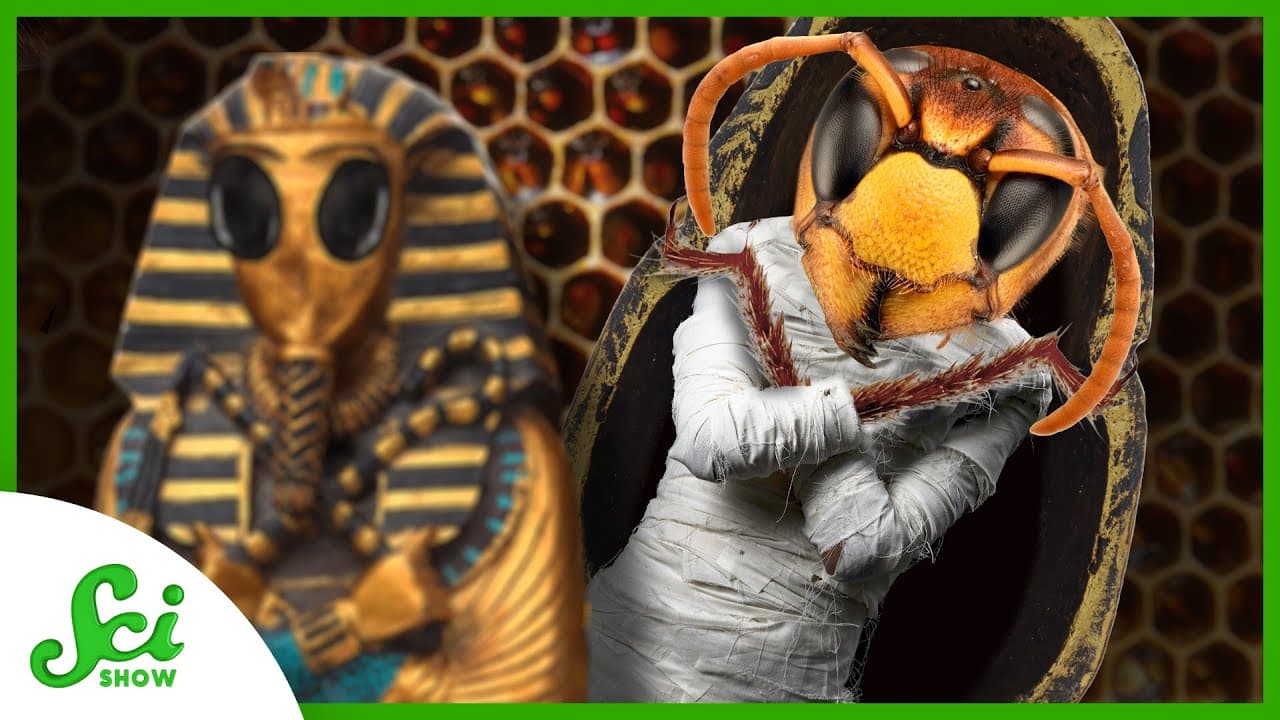
Honeybees use a sticky substance called propolis, or bee glue, for sealing cracks in their hives and defending against pests. They also encase large intruders, like mice, in propolis to mummify them. This behavior may have inspired ancient Egyptians in their mummification practices.
Transcript
Thank you to Cometeer for sponsoring today’s episode! Cometeer is 100% brewed coffee, flash frozen and delivered to your door. Check the link in the description and you’ll get 30% off your first order plus free shipping! [♪ INTRO] Honeybees make more than just honey. They also make something called propolis, or bee glue. This is a sticky substance ... Read More
Key Insights
- 😒 Honeybees use propolis as a sealant, defense mechanism against pests, and for mummifying large intruders.
- 🐝 Propolis contains chemicals from plants that help bees defend against diseases and pests like bacteria and mites.
- 🐝 The encasing of intruders in propolis by honeybees may have influenced ancient Egyptian mummification practices.
- 🤑 Propolis has a rich history of uses, including in traditional medicine.
Install to Summarize YouTube Videos and Get Transcripts
Explore YouTube Video Summarizer or Get YouTube Transcript Extractor
Questions & Answers
Q: What is propolis and how do honeybees use it?
Propolis is a sticky substance made by honeybees using resin from trees and plants mixed with their saliva. Honeybees use it to seal cracks in their hives and protect against pests.
Q: How do honeybees defend against large intruders like mice?
Honeybees can actively defend against large intruders when they are active in warmer weather. However, in colder weather when bees cluster around the queen, they encase the bodies of large intruders in propolis to protect the colony.
Q: Did ancient Egyptians use propolis in their mummification process?
Yes, research suggests that ancient Egyptians coated the bodies of their dead in propolis as part of the mummification process. While observing bee behaviors may not have established the entire mummification process, it likely inspired the Egyptians to experiment with it.
Q: Besides mummification, what other uses does propolis have?
Propolis has been used throughout history for various purposes, including in traditional medicine for its antifungal and disease-fighting properties. Further research may uncover more uses for this sticky substance.
Summary & Key Takeaways
-
Honeybees create propolis, or bee glue, from resin collected from trees and plants and their own saliva. They use it as a sealant and defense mechanism against pests.
-
During winter, when bees are less active, larger intruders like mice may enter the hive. Since bees cannot move them, they encase their bodies in propolis to protect the colony.
-
The ancient Egyptians may have observed this behavior and used propolis to help mummify their dead.
Read in Other Languages (beta)
Share This Summary 📚
Summarize YouTube Videos and Get Video Transcripts with 1-Click
Try YouTube Summary with ChatGPT & Claude or YouTube Transcript Generator
Explore More Summaries from SciShow 📚


Summarize YouTube Videos and Get Video Transcripts with 1-Click
Try YouTube Summary with ChatGPT & Claude or YouTube Transcript Generator