Bode plot | Poles at origin | Example | CS | Control Systems | Lec-76
TL;DR
This content explains how to draw and analyze Bode plots with multiple poles at the origin.
Transcript
hello everyone last session in the last session we will discuss about how to draw the boda plot with the example so before entering into deeply into the border plan first we will discuss some important points in that in the border plot n pulls at origin so in the given open loop transfer function we have n poles at origin so that means so he give o... Read More
Key Insights
- 🎮 Bode plots are a vital tool in control systems for assessing frequency response.
- 💈 Poles at the origin significantly influence both magnitude and phase of a system.
- ❓ The magnitude in decibels is critically important and calculated as -20n log(ω).
- 💱 Differentiating the magnitude provides insights into the slope, indicating gain changes with frequency.
- 😑 Phase calculations are straightforward, with a simple expression for systems with multiple poles.
- 🔠 Frequency is crucial, affecting how systems behave under different conditions and inputs.
- 😫 Magnitude plots generally slope downwards, while phase plots display fixed values for set number of poles.
Install to Summarize YouTube Videos and Get Transcripts
Explore YouTube Video Summarizer or Get YouTube Transcript Extractor
Questions & Answers
Q: What is a Bode plot and why is it important?
A Bode plot is a graphical representation of a system's frequency response, depicting both magnitude and phase across a range of frequencies. It is crucial in control systems to analyze stability, gain, and phase margins, aiding in designing controllers.
Q: How do you find the magnitude in decibels for a system with 'n' poles at the origin?
For a system with 'n' poles at the origin, the magnitude can be expressed as -20n log(ω). This provides a logarithmic scale for analyzing gain across frequencies, making it easier to assess system performance in a Bode plot.
Q: What does differentiating the magnitude with respect to log(ω) provide?
Differentiating the magnitude in decibels with respect to log(ω) yields the slope of the magnitude plot. This slope, calculated as -20n, is essential for understanding how the system's gain changes with frequency, indicating stability and response characteristics.
Q: How do you calculate the phase of a system with multiple poles?
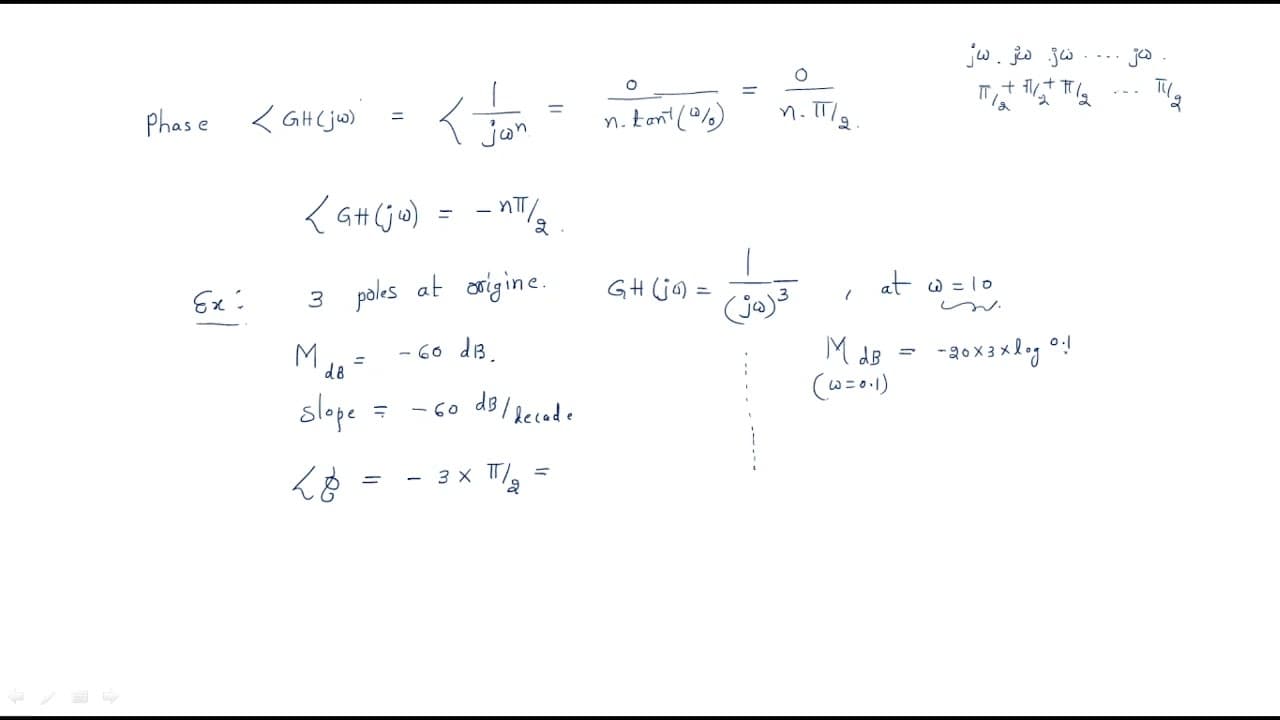
The phase for a system with 'n' poles at the origin can be calculated as -n*(π/2). This accounts for the phase shifts introduced by each pole at the origin, characterizing the system's behavior in relation to input frequency.
Q: Can you explain the significance of frequency in Bode plots?
Frequency plays a critical role in Bode plots as it dictates how the system responds over a range of inputs. It helps in predicting system behavior, analyzing stability, and understanding how the gain and phase shift change as frequency varies.
Q: What is the graphical representation of a magnitude plot in a Bode plot?
The magnitude plot is represented on a logarithmic scale, usually showing a downward slope starting from the y-axis. Each decrement in frequency corresponds to a specific dB reduction, reflecting the attenuation imposed by the poles at the origin.
Q: How does the phase plot look compared to the magnitude plot in Bode plots?
In Bode plots, the phase plot is typically constant for a given number of poles at the origin, showing a horizontal line at -n*(π/2). This contrasts with the magnitude plot, which varies significantly across frequencies.
Q: Why is it essential to understand both magnitude and phase together in control systems?
Understanding both magnitude and phase is essential because they collectively provide insights into the stability and response of control systems. Analyzing them together helps identify potential issues such as instability and performance limitations.
Summary & Key Takeaways
-
The session discusses the process of creating a Bode plot for systems with 'n' poles at the origin, focusing on analysis in the frequency domain.
-
Key steps include finding the magnitude in decibels, differentiating to determine the slope, and analyzing the phase for the given transfer function.
-
A practical example is provided to illustrate how to calculate both magnitude and phase, enabling better understanding of Bode plots for control systems.
Read in Other Languages (beta)
Share This Summary 📚
Summarize YouTube Videos and Get Video Transcripts with 1-Click
Try YouTube Summary with ChatGPT & Claude or YouTube Transcript Generator