Can 1^x=2?
TL;DR
Can we find a solution to the equation 1^x = 2? Let's explore the complex numbers to see if we can find an answer.
Transcript
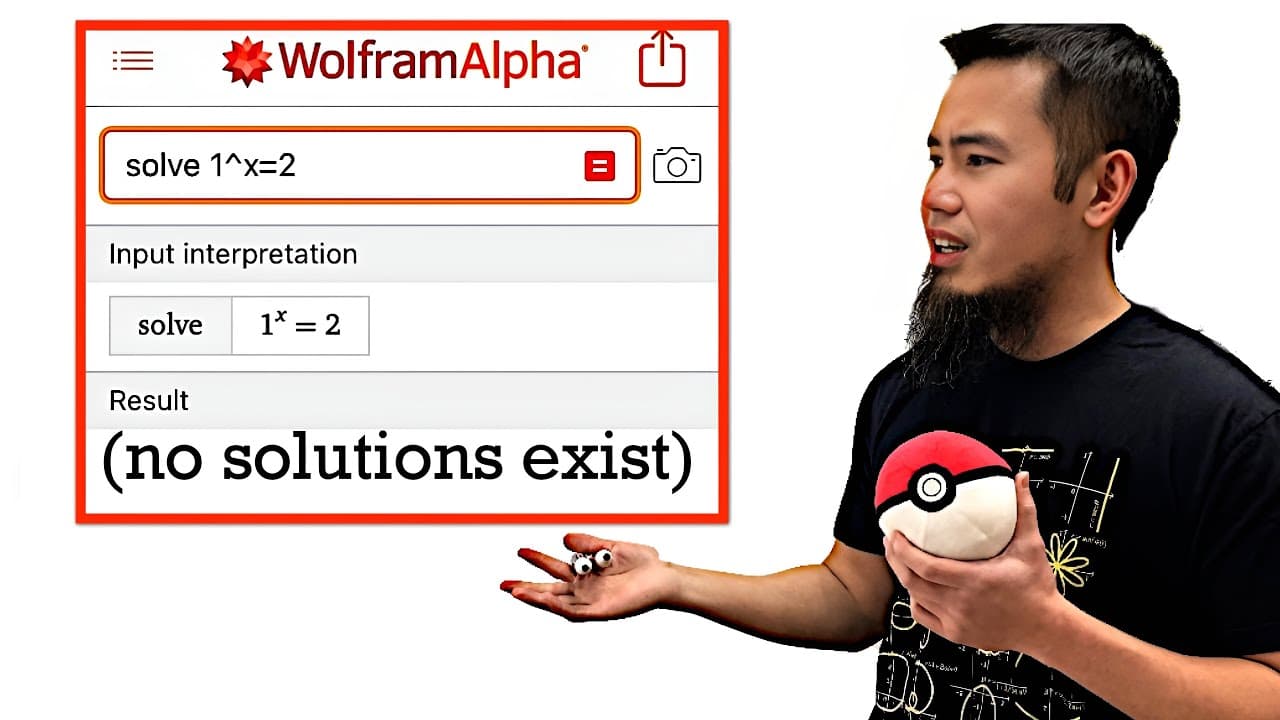
okay let's do some math for fun here i have a very interesting question for you guys is it possible to have 1 to some power and the result is equal to 2 (i.e. can we solve the exponential equation 1^x=2?) what do you guys think well let me tell you if you enter this on WolframAlpha you will see right here it shows no solutions it doesn't e... Read More
Key Insights
- #️⃣ Traditional methods, like WolframAlpha, fail to provide solutions for the equation 1^x = 2, even in complex numbers.
- 👻 Using complex numbers and converting 1 into its polar form allows us to obtain solutions involving ln2/(2pi) + in, where n is an integer.
- #️⃣ Not all solutions obtained using complex numbers will yield the desired answer of 2, as complex analysis involves infinitely many possible answers.
Install to Summarize YouTube Videos and Get Transcripts
Explore YouTube Video Summarizer or Get YouTube Transcript Extractor
Questions & Answers
Q: Can the equation 1^x = 2 be solved using traditional methods?
No, traditional methods, such as WolframAlpha, do not provide any solutions to the equation 1^x = 2, even in complex numbers. This is because the real number computation treats 1^x as always equal to 1.
Q: How can complex numbers be used to solve the equation 1^x = 2?
By converting 1 into its complex form, we can represent it as re^(itheta), where r is the distance from the origin (which is 1) and theta is the angle. By substituting this form into the equation, we get ln2/(2pi) + in, where n is an integer representing infinitely many solutions.
Q: Do all the solutions obtained using complex numbers yield the expected result?
No, not all solutions obtained using complex numbers yield the expected result. When computing 1^(-iln2/(2pi)) with the polar form of 1, there are infinitely many answers due to the nature of complex analysis. Only some of these answers will result in 2.
Q: How does changing the equation to 1 = 2^(1/x) impact the solutions?
When changing the equation to 1 = 2^(1/x), and then solving for x, the equation provides a valid solution. This is because raising 2 to the power of 1/x allows for the use of real numbers, unlike the issue encountered with 1^x.
Summary & Key Takeaways
-
The content discusses the possibility of solving the equation 1^x = 2 and explores the limitations of using traditional methods, such as WolframAlpha.
-
The video introduces the concept of using complex numbers to find a solution to the equation and explains the process step-by-step.
-
It highlights that while there are infinitely many solutions involving complex numbers, traditional real number computation may not give the expected result.
Read in Other Languages (beta)
Share This Summary 📚
Summarize YouTube Videos and Get Video Transcripts with 1-Click
Try YouTube Summary with ChatGPT & Claude or YouTube Transcript Generator
Explore More Summaries from blackpenredpen 📚
Summarize YouTube Videos and Get Video Transcripts with 1-Click
Try YouTube Summary with ChatGPT & Claude or YouTube Transcript Generator