How to Solve Logarithmic Equations Step-by-Step
TL;DR
To solve logarithmic equations, isolate the logarithm on one side of the equation and convert both sides into exponents. For negative or fractional exponents, simplify them to positive exponents or use square roots as necessary. Always check your solutions to ensure they are valid within the original context.
Transcript
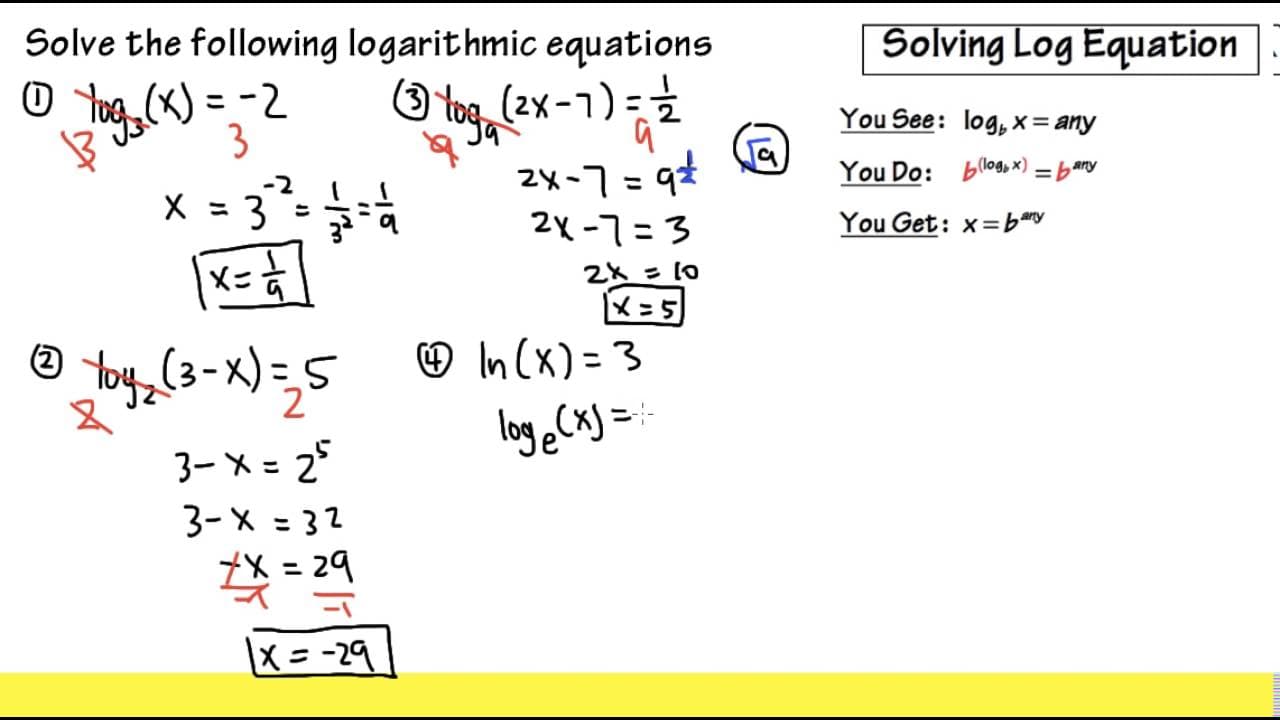
William this video is for you we are going to see how to solve these log equations and let me show you the steps right here first I'll will show you three steps what you see what you do and what you get to solve a log equation ideally speaking we want to isolate the log on one side of the equations and PR body on the left hand side if we see that w... Read More
Key Insights
- 😑 Solving log equations involves isolating the logarithm on one side and the remaining expression on the other side.
- 🧑💻 Exponentiation rules, such as canceling logarithms with their respective bases, are used to solve log equations.
- ❎ Negative exponents can be simplified by converting them to positive exponents, while fractional exponents can be simplified using square roots.
Install to Summarize YouTube Videos and Get Transcripts
Explore YouTube Video Summarizer or Get YouTube Transcript Extractor
Questions & Answers
Q: How do you solve log equations?
Log equations can be solved by isolating the logarithm and applying exponentiation rules. First, identify the base of the logarithm and the term inside it. Then, pretend both sides of the equation are exponents with the same base and solve for the variable.
Q: Can log equations have negative numbers or fractions on the right-hand side?
Yes, log equations can have any number, including negative numbers and fractions, on the right-hand side. As long as the logarithm is isolated on one side of the equation, any number can be used.
Q: What does it mean to have a negative exponent in a log equation?
A negative exponent signifies the reciprocal of the base raised to the positive exponent. For example, if the base is 3 and the exponent is -2, it means 1 divided by 3 squared, which simplifies to 1/9.
Q: Why is it important to check the answer in log equations?
It is crucial to check the answer in log equations because occasionally, solutions may yield invalid results. For instance, log equations with negative or zero values inside the logarithm are undefined. Checking the answer helps verify its correctness.
Summary & Key Takeaways
-
Log equations can be solved by isolating the logarithm on one side and the remaining expression on the other side.
-
To do this, pretend both sides of the equation are exponents and apply exponentiation rules.
-
Negative and fraction exponents can be simplified by converting them to positive exponents or using square roots.
Read in Other Languages (beta)
Share This Summary 📚
Summarize YouTube Videos and Get Video Transcripts with 1-Click
Try YouTube Summary with ChatGPT & Claude or YouTube Transcript Generator
Explore More Summaries from blackpenredpen 📚
Summarize YouTube Videos and Get Video Transcripts with 1-Click
Try YouTube Summary with ChatGPT & Claude or YouTube Transcript Generator