What Actually Is Game Theory?
TL;DR
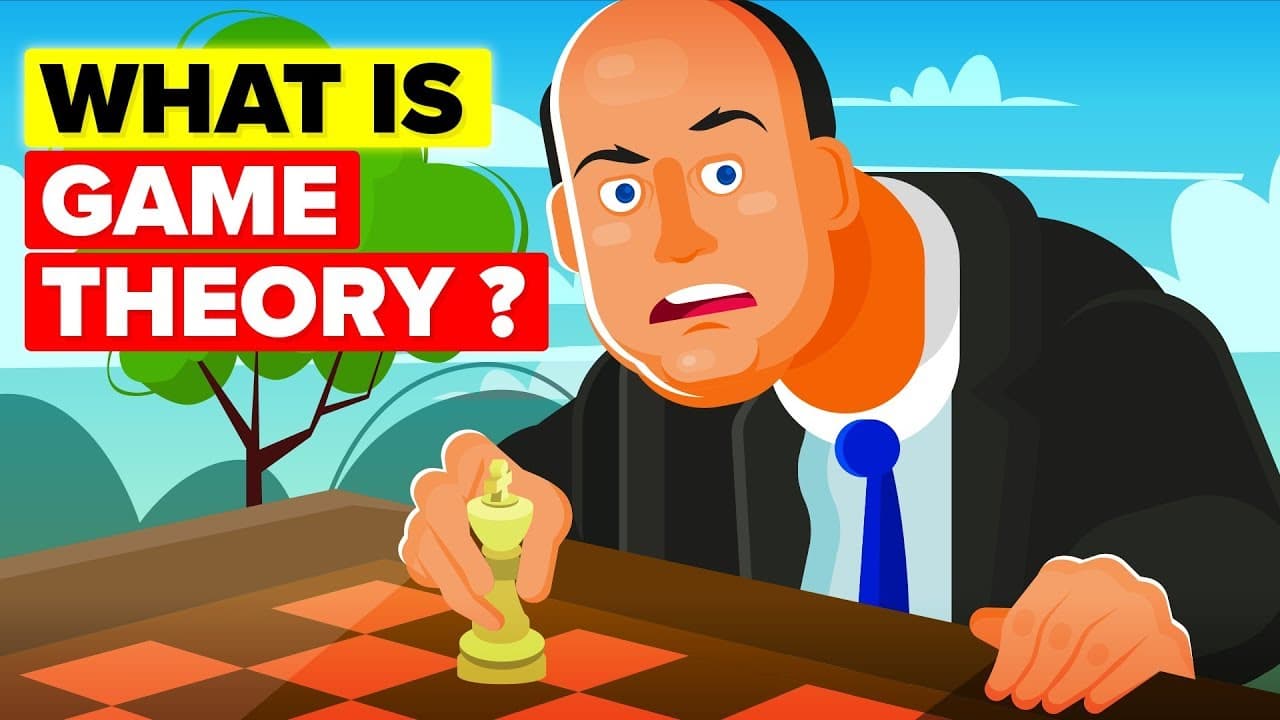
Game theory, developed by John von Neumann, is a mathematical modeling of strategic interactions between rational adversaries, as seen in the Prisoner's Dilemma.
Transcript
Game theory as we know it today came about in part because of one man’s interest in poker. This man was not just your average man on the street. He was a mathematician, physicist, and computer scientist named John von Neumann. His goal was loftier than becoming a better poker player. According to a Forbes article, he “was only interested in poker b... Read More
Key Insights
- ❗️ John von Neumann, a mathematician, physicist, and computer scientist, developed game theory with the goal of creating a general theory that could be applied to various aspects of life, such as diplomacy, war, and business strategy.
- 💡 Game theory involves players, strategies, and payoffs. Players have "common knowledge" of the rules, strategies, and possible outcomes of a game.
- 💼 Von Neumann's version of game theory focused on finding optimal strategies for zero-sum games, where one player's gain is another player's loss. Critics argue that life is often more complex and involves more complicated game scenarios.
- 🎭 The Prisoner's Dilemma is a classic example in game theory, illustrating the concept of dominant strategies and Nash equilibrium. It shows that rational strategies may not always lead to the best outcomes for both players.
- 🧩 Nash equilibrium is a solution in which no player can improve their outcome by changing strategies. It includes dominant strategy equilibria but can also solve games without dominant strategies.
- 👏 Nash's work in game theory was initially dismissed by von Neumann but was recognized by others. Nash, Selten, and Harsanyi received the Nobel Memorial Prize in Economic Sciences for their contributions to game theory.
- 💥 Nash's contributions expanded game theory to a wider range of applications and scenarios, allowing for further developments in the field.
- ❓ Share your experience with game theory in the comments! Game theory can be applied to various scenarios, such as economics, politics, and social interactions. Explore our other videos for more fascinating content!
Install to Summarize YouTube Videos and Get Transcripts
Explore YouTube Video Summarizer or Get YouTube Transcript Extractor
Questions & Answers
Q: How did John von Neumann contribute to the development of game theory?
John von Neumann, a mathematician, physicist, and computer scientist, developed game theory as a mathematical model that could be applied to various aspects of life. His collaboration with economist Oskar Morgenstern resulted in the book "A Theory of Games and Economic Behavior," which laid the foundation for game theory as we know it today.
Q: What are the three basic components of a game in game theory?
The three basic components of a game in game theory are players, strategies, and payoffs. Players are the individuals or entities involved in the game, strategies refer to the actions they take, and payoffs represent the outcomes resulting from the strategies applied.
Q: What is the Prisoner's Dilemma and why is it a classic example in game theory?
The Prisoner's Dilemma is a game in which two players, Jack and Tom, must decide whether to confess or not confess to a crime they committed together. The game showcases the interdependence of players' actions, as both their choices affect the payoffs they receive. It is a classic example in game theory because it demonstrates the complexities and challenges in determining optimal strategies when rationality is involved.
Q: What is the Nash equilibrium and how does it relate to dominant strategies?
The Nash equilibrium is a solution concept in game theory where none of the players would benefit from unilaterally deviating from their chosen strategy. It represents a stable state in which each player is making the best decision given the strategies of others. Dominant strategies, on the other hand, are strategies that provide the best outcome regardless of what the other players choose. While any dominant strategy equilibrium is also a Nash equilibrium, the Nash equilibrium can be used to solve games that do not have a dominant strategy.
Q: What was John Nash's contribution to game theory, and how was it received by John von Neumann?
John Nash, a mathematician, made significant contributions to game theory, including the development of the Nash equilibrium, which helped solve games that do not have a dominant strategy. However, John von Neumann, initially dismissive of Nash's work, considered it mathematically simple and trivial. Despite von Neumann's opinion, Nash's contributions were widely recognized, and he shared the 1994 Nobel Memorial Prize in Economic Sciences for his work in game theory.
Summary & Key Takeaways
-
Game theory was developed by John von Neumann, a mathematician, physicist, and computer scientist, who aimed to create a mathematical model that could be applied to various aspects of life, including diplomacy, war, love, and business strategy.
-
The three basic components of a game in game theory are players, strategies, and payoffs. Strategies are the actions players take, while payoffs are the outcomes resulting from the strategies applied.
-
Von Neumann's game theory initially focused on zero-sum games but has evolved to analyze a wider range of games, such as the Prisoner's Dilemma.
Read in Other Languages (beta)
Share This Summary 📚
Summarize YouTube Videos and Get Video Transcripts with 1-Click
Try YouTube Summary with ChatGPT & Claude or YouTube Transcript Generator
Explore More Summaries from The Infographics Show 📚





Summarize YouTube Videos and Get Video Transcripts with 1-Click
Try YouTube Summary with ChatGPT & Claude or YouTube Transcript Generator