1. Introduction, Finite Automata, Regular Expressions
TL;DR
Regular languages are a class of languages that can be recognized by finite automata, and they are closed under union operation.
Transcript
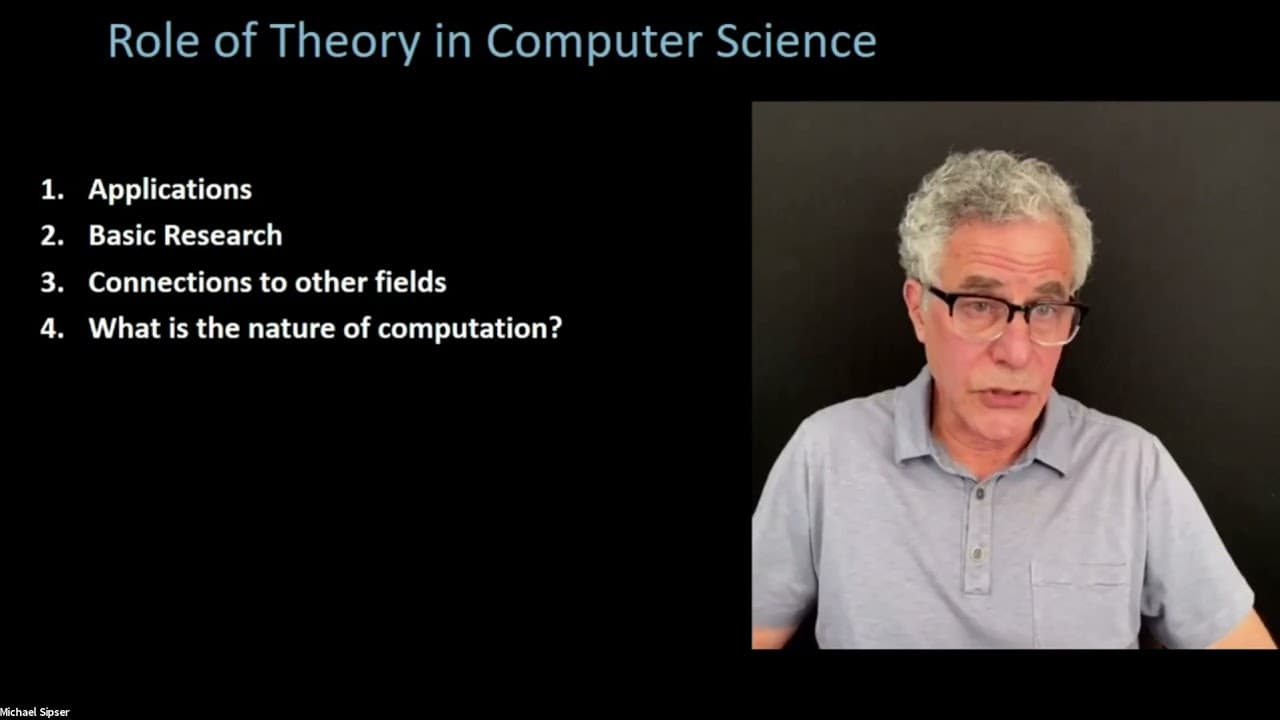
[SQUEAKING] [RUSTLING] [CLICKING] MICHAEL SIPSER: So, welcome, everybody, to the Fall 2020 online Introduction to the Theory of Computing 18.404/6.840. My name is Mike Sipser. I'm going to be your instructor for the semester in this class. So let me just tell you what the course is about. Basically, it's going to be in two halves. We're going to be... Read More
Key Insights
- ❓ Regular languages can be recognized by finite automata, which are abstract models of computation.
- 😚 Regular languages are closed under the union operation, meaning that combining two regular languages results in another regular language.
- 😑 Regular expressions are a powerful tool for describing regular languages in a concise and precise manner.
- ❓ Understanding the concept of closure properties is essential for analyzing and manipulating regular languages.
Install to Summarize YouTube Videos and Get Transcripts
Explore YouTube Video Summarizer or Get YouTube Transcript Extractor
Questions & Answers
Q: What is a regular language?
A regular language is a language that can be recognized by a finite automaton, a mathematical model of computation.
Q: What operations can be applied to regular languages?
Regular languages can be combined using the union, concatenation, and star operations.
Q: Are regular languages closed under the union operation?
Yes, the union of two regular languages is also a regular language.
Q: How are regular expressions used to describe regular languages?
Regular expressions are composed of basic elements such as alphabet symbols and regular operations, and they provide a concise way to describe regular languages.
Summary & Key Takeaways
-
Regular languages can be recognized by finite automata, which are abstract models of computation.
-
Regular languages are closed under the union operation, meaning that if two regular languages are combined, the resulting language is also regular.
-
Regular expressions are used to describe regular languages and are composed of basic elements and regular operations such as union, concatenation, and star.
Read in Other Languages (beta)
Share This Summary 📚
Summarize YouTube Videos and Get Video Transcripts with 1-Click
Try YouTube Summary with ChatGPT & Claude or YouTube Transcript Generator
Explore More Summaries from MIT OpenCourseWare 📚



Summarize YouTube Videos and Get Video Transcripts with 1-Click
Try YouTube Summary with ChatGPT & Claude or YouTube Transcript Generator