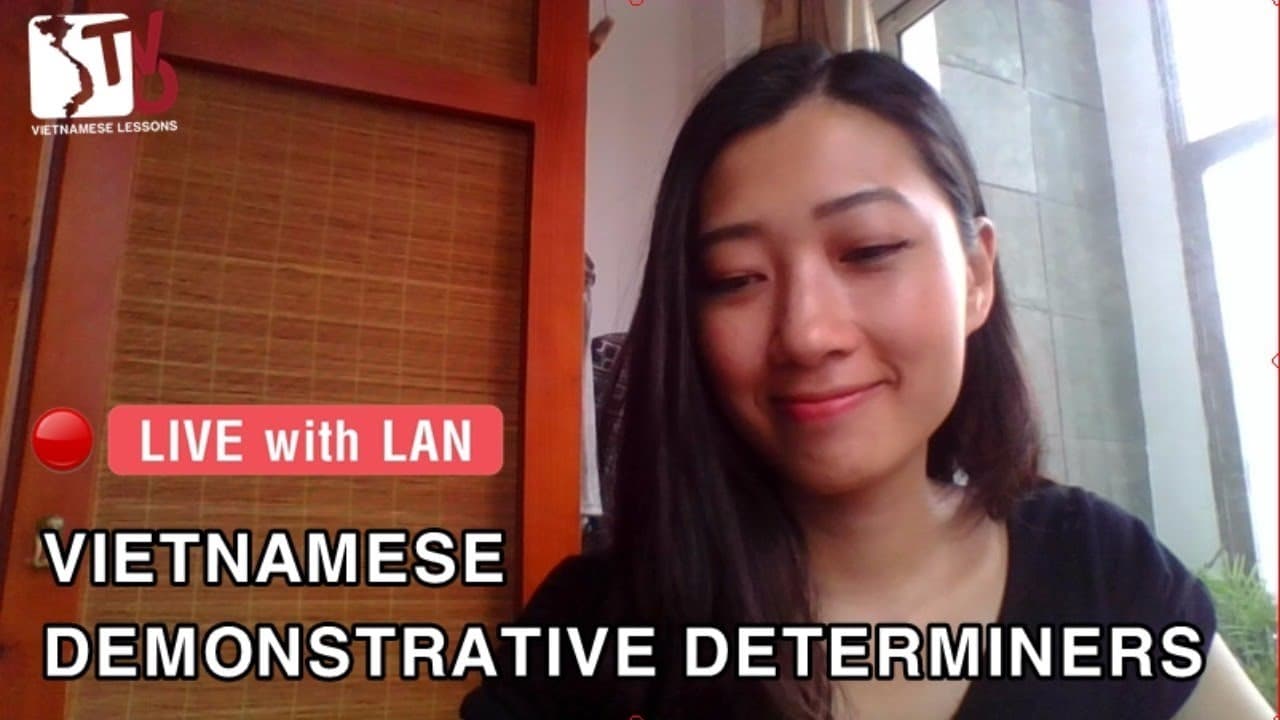
Live with Lan: Demonstrative Determiners
TL;DR
Exploring Vietnamese demonstrative determiners and their usage in sentences.
Transcript
come on lay happy livers day I don't know if you know but what if you live in Vietnam then you definitely do but if you don't the first of May is Labor Day in Vietnam and we all have a day off today and accordance John Steven hi Steve very happy to hear that by the way it should be something Sam not some sound yeah I'll show you how to spell that i... Read More
Key Insights
- The Vietnamese language treats 'this' and 'these' as the same word, and similarly, 'that' and 'those' are also treated the same.
- In Vietnamese, demonstrative pronouns can be used in two ways: as a pronoun or to support a noun.
- The use of 'day' and 'kia' in Vietnamese depends on the proximity of the object to the speaker and listener.
- Vietnamese often uses 'day' at the beginning of a sentence as a demonstrative pronoun.
- The order of words in Vietnamese sentences often places the demonstrative determiner after the noun.
- Non-physical objects like memories or days use 'nay' or 'no' instead of 'kia' in Vietnamese.
- Vietnamese pronunciation sometimes differs from spelling for ease of speech, like 'no' often pronounced as 'nay'.
- Blue Dragon is an NGO in Vietnam that supports children and victims of human trafficking, and the livestream aimed to support their cause.
Install to Summarize YouTube Videos and Get Transcripts
Explore YouTube Video Summarizer or Get YouTube Transcript Extractor
Questions & Answers
Q: What are the Vietnamese words for 'this' and 'that'?
In Vietnamese, 'this' and 'these' are translated as 'nay', while 'that' and 'those' are translated as 'no'. These words do not change for singular or plural forms, unlike in English.
Q: How does Vietnamese handle pluralization with demonstrative determiners?
Vietnamese often does not explicitly mark pluralization. When a number or quantity is given, it's clear that the noun is plural, so additional markers are not necessary. Without a number, the context usually clarifies whether the noun is plural.
Q: What is the role of 'kia' in Vietnamese sentences?
'Kia' is used to indicate something that is far from both the speaker and the listener, similar to saying 'over there' in English. It is used for objects that are distant in physical space.
Q: Why do Vietnamese people sometimes pronounce words differently from their spelling?
In Vietnamese, pronunciation can differ from spelling for ease of speech. For example, 'no' is often pronounced as 'nay' because it is easier and quicker to say, similar to how some English words are contracted in casual speech.
Q: How are demonstrative determiners ordered in Vietnamese sentences?
In Vietnamese, demonstrative determiners are placed after the noun. The typical order is quantity (if any), classifier, noun, and then the determiner, such as 'con mèo này' for 'this cat'.
Q: What is Blue Dragon, and how is it related to the livestream?
Blue Dragon is a non-governmental organization in Vietnam dedicated to helping children and victims of human trafficking. The livestream was used as a platform to raise awareness and funds for Blue Dragon's initiatives.
Q: Can 'nay' and 'no' be used for non-physical objects?
Yes, 'nay' and 'no' can be used for non-physical objects like events, memories, or days. In such contexts, 'kia' is not typically used, as it denotes physical distance.
Q: What is the significance of practicing pronunciation in learning Vietnamese?
Pronunciation is crucial in Vietnamese due to its tonal nature. Accurate pronunciation ensures clear communication and understanding, as small variations in tone can change the meaning of words.
Summary & Key Takeaways
-
The livestream focused on explaining the use of demonstrative determiners in Vietnamese, such as 'nay', 'no', and 'kia'.
-
Participants engaged in exercises to practice using these determiners in sentences and understanding their correct usage.
-
The session also highlighted the charitable work of Blue Dragon, encouraging donations to support Vietnamese children and trafficking victims.
Read in Other Languages (beta)
Share This Summary 📚
Summarize YouTube Videos and Get Video Transcripts with 1-Click
Try YouTube Summary with ChatGPT & Claude or YouTube Transcript Generator
Explore More Summaries from Tieng Viet Oi - Vietnamese Lessons 📚

Summarize YouTube Videos and Get Video Transcripts with 1-Click
Try YouTube Summary with ChatGPT & Claude or YouTube Transcript Generator