Array antennas | Phased | Applications, Advantages & Limitations | Radar Systems | Lec-70
TL;DR
Phased array antennas provide efficient beam steering and diverse applications, despite their high cost.
Transcript
hi everyone in this video I am going to explain about the applications advantages limitations of phased array antennas so you know page Dairy antennas are nothing but a group of antennas what is the purpose of phasory antennas to steal the beam in a particular direction without orienting the plate of antenna okay normally when you are going for the... Read More
Key Insights
- 😁 Phased array antennas provide a new approach to beam steering without mechanical parts, leading to faster response times.
- 👻 They are integral in modern radar systems, allowing for efficient tracking and detection of multiple targets simultaneously.
- 📡 The antennas' applications extend to telecommunications, significantly enhancing the capacity and quality of signals in broadcasting.
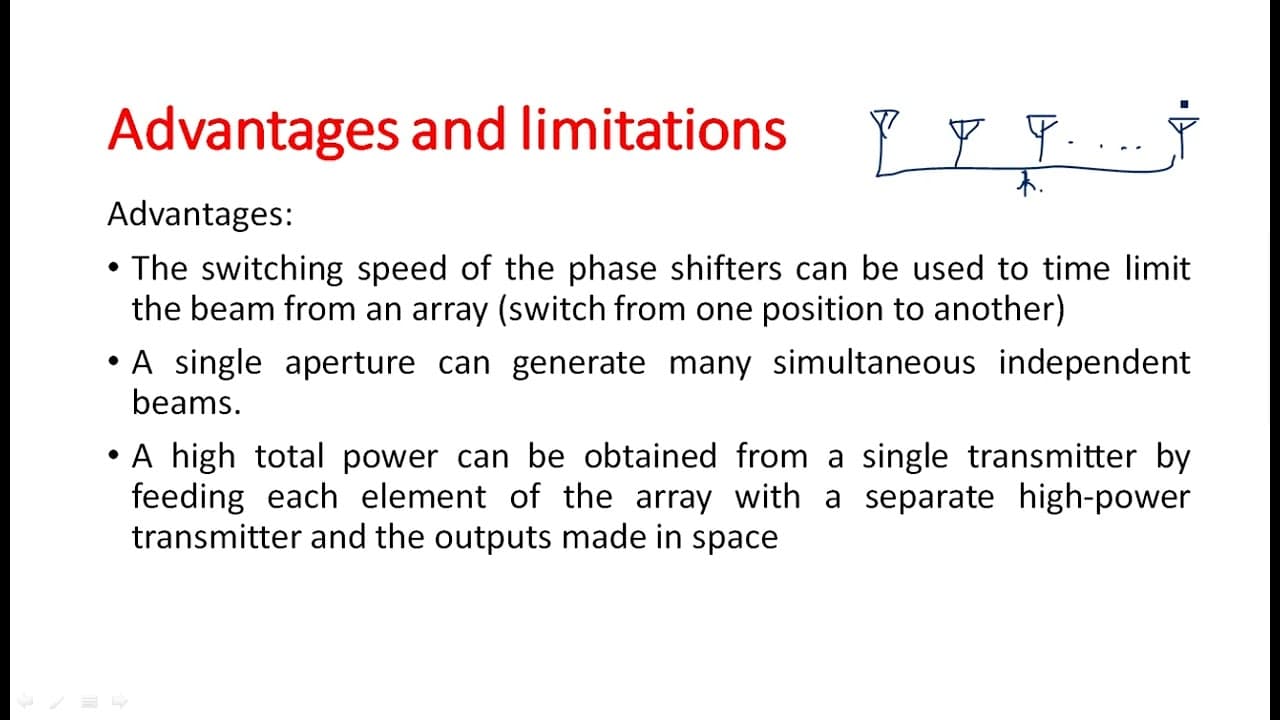
- ✋ High total power can be achieved from a single transmitter feeding multiple antennas, improving energy efficiency.
- 🥺 The elimination of significant side lobes in radiation patterns minimizes wasted signal energy, leading to clearer communication.
- 📡 Gradual failure of array elements offers greater reliability and operational continuity compared to conventional antennas.
- 🎁 Despite their benefits, the intricate design and maintenance requirements can present challenges, particularly in cost and complexity.
Install to Summarize YouTube Videos and Get Transcripts
Explore YouTube Video Summarizer or Get YouTube Transcript Extractor
Questions & Answers
Q: What is the primary function of phased array antennas?
The primary function of phased array antennas is to electronically control the direction of their radiation beam without physically moving the antennas. They achieve this by introducing phase differences across the array elements, allowing for rapid adjustments in beam direction and enhanced tracking capabilities in applications such as radar and communications.
Q: How do phased array antennas improve radar systems?
Phased array antennas enhance radar systems by eliminating the need for mechanical rotation of antenna plates. By controlling the phase of the signals sent from multiple antenna elements, they can steer the radar beam electronically, resulting in faster and more efficient target tracking and signal detection, especially in dynamic environments.
Q: What are some applications of phased array antennas in broadcasting?
In broadcasting, phased array antennas are used in both AM and FM radio to improve signal strength and coverage. By enabling simultaneous transmission and reducing interference, they allow broadcasters to reach larger audiences and enhance audio quality, particularly in urban environments with high signal demand.
Q: What are the advantages of using phased array antennas?
The advantages of phased array antennas include their ability to steer beams electronically, allowing for rapid and precise adjustments in direction. They can generate multiple independent beams, maintain low side lobes in radiation patterns, and exhibit gradual failure of individual elements, ensuring better system reliability.
Q: What limitations do phased array antennas face?
Key limitations of phased array antennas include their high cost due to the necessity of multiple components like phase shifters and power splitters. Additionally, the complexity of maintaining low side lobe levels increases with the number of elements, requiring careful maintenance and potentially complicating the operation of the radar systems.
Q: How does the distributed nature of phased array antennas benefit their operation?
The distributed nature of phased array antennas allows for individual elements to fail without causing the entire system to malfunction. This gradual failure ensures persistent functionality, enhancing overall system resilience and reliability, which is especially advantageous in critical applications such as military and space communications.
Summary & Key Takeaways
-
Phased array antennas consist of multiple antenna elements that can steer their beam direction electronically without physical movement, effectively improving tracking capabilities in various radar systems.
-
Their applications span communication technologies, including optical communication, AM/FM broadcasting, and military uses in tracking and missile guidance systems.
-
While offering significant advantages such as rapid beam steering and high power transmission, phased array antennas come with limitations like high costs and complex maintenance requirements.
Read in Other Languages (beta)
Share This Summary 📚
Summarize YouTube Videos and Get Video Transcripts with 1-Click
Try YouTube Summary with ChatGPT & Claude or YouTube Transcript Generator